
India’s Foodgrain Management: Addressing Surplus, Subsidy, and Diversification
Context
The recent Kuruvai season procurement crisis in Tamil Nadu has highlighted systemic inefficiencies in India’s foodgrain procurement framework. It underscores the urgent need to reform procurement mechanisms, incentivize crop diversification, and rationalize food security policies to ensure long-term sustainability.
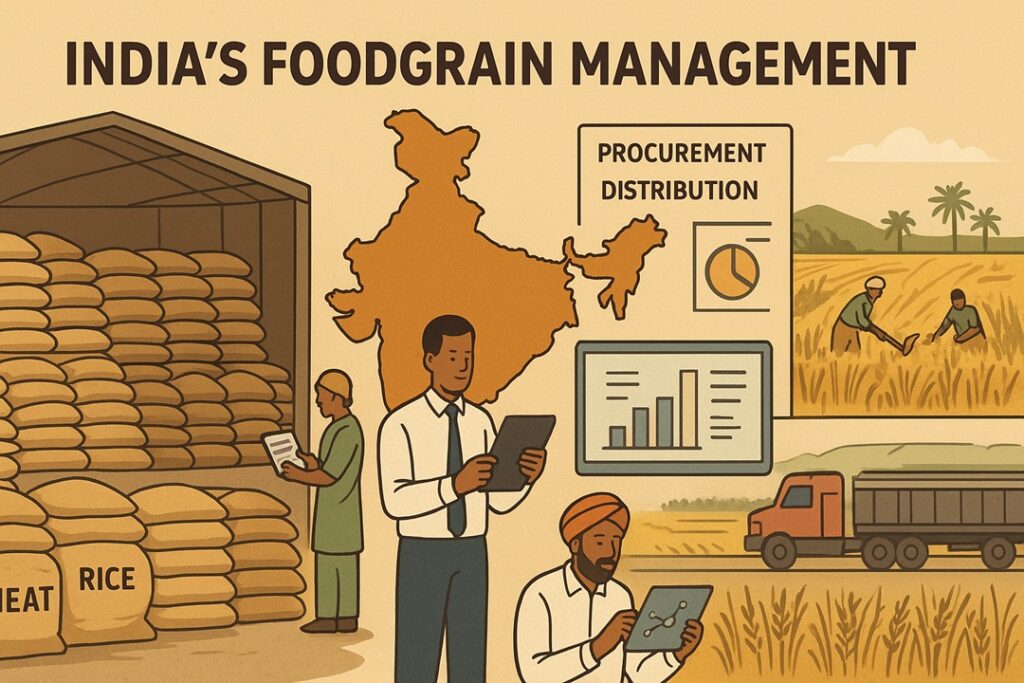
India’s Foodgrain Procurement System
Purpose and Oversight
• Managed centrally by the Food Corporation of India (FCI) along with state agencies.
• Overseen by the Ministry of Consumer Affairs, Food and Public Distribution.
• Ensures food security, stabilizes prices, and provides a safety net for farmers through Minimum Support Prices (MSP).
Procurement and Distribution
• Grains are purchased at MSP and stored in the Central Pool.
• Supports distribution under the National Food Security Act (NFSA) and other welfare schemes.
• Operates through Centralized and Decentralized Procurement (DCP) mechanisms.
• FCI handles storage, transportation, and bulk allocation, while states distribute through the Public Distribution System (PDS).
• Procurement follows “Fair Average Quality” (FAQ) specifications.
Challenges in India’s Foodgrain System
Overproduction of Rice
• India consistently produces rice beyond domestic needs; as of October 2025, stocks stood at 356.1 lakh tonnes—over three times the buffer norm of 102.5 lakh tonnes.
Procurement-Utilization Mismatch
• Annual rice procurement (525–547 lakh tonnes) exceeds PDS offtake (392–427 lakh tonnes), leading to stockpiling and wastage.
• Wheat procurement is more balanced, with PDS offtake sometimes exceeding procurement.
High Food Subsidy Burden
• Government spends around Rs. 2 lakh crore annually on food subsidies due to excessive procurement and storage.
Import Dependence Despite Domestic Potential
• Pulses: India produces 252.4 lakh tonnes (2024–25) but imports Rs. 30,000 crore worth (2023–24).
• Edible oils: Imports cover 55% of demand (Rs. 1.2 lakh crore in 2023–24) despite 25 million hectares under domestic cultivation.
MSP-Driven Paddy Monoculture
• Farmers prefer paddy due to assured MSP returns, discouraging crop diversification.
PDS Leakages and Institutional Inefficiencies
• ICRIER estimates 28% leakage in rice and wheat distribution.
• Centralized procurement lacks agility and transparency; Tamil Nadu Civil Supplies Corporation faced procurement delays and corruption allegations.
Legacy Issues
• Liberalized edible oil imports in the 1990s stunted domestic oilseed production.
Way Forward: Enhancing India’s Foodgrain System
Reassess Procurement Policy
• Evaluate sustainability of rice-centric procurement and consider decentralizing procurement with more stakeholder involvement.
Promote Crop Diversification
• Conduct area-specific market studies and provide financial incentives to reduce farmer risk in switching crops.
Rethink Export Restrictions
• Allow farmers to export surplus rice to maintain stable market access and confidence.
Strengthen Farmer Institutions
• Empower Farmer Producer Organisations (FPOs) to manage procurement, marketing, and supply chains.
• Facilitate direct linkages between producers and processors.
Build Institutional Capacity
• Invest in training FPOs, cooperatives, and self-help groups.
• Promote soil health awareness, market intelligence, and diversification strategies.
Leverage AI and Technology
• Use AI-enabled systems to enhance coordination among stakeholders in procurement and distribution.
Conclusion
Reforming India’s foodgrain procurement system is a long-term task. However, collaborative efforts involving agriculture experts, farmers, policymakers, and food security specialists can initiate meaningful changes. Addressing procurement inefficiencies, promoting diversification, and modernizing distribution systems are essential to ensure sustainable food security and fiscal prudence.
Source : The Hindu