
India’s Forest Gains: Policy, Technology, and Community in Action
Context:
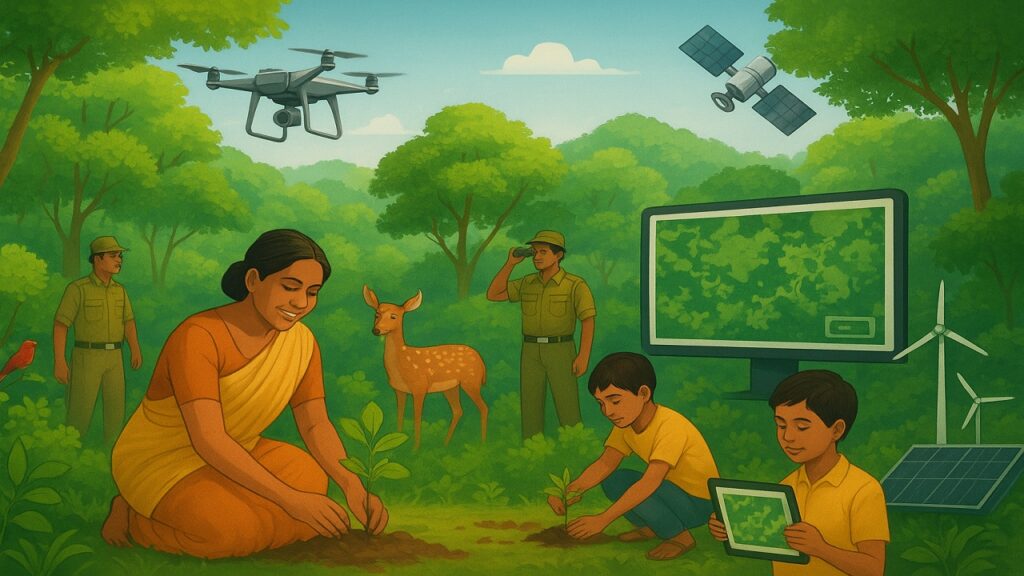
India has made a significant leap in global forest rankings, ascending to 9th position worldwide in total forest area. Moreover, it continues to hold the 3rd position in annual forest gain, according to the Global Forest Resources Assessment (GFRA) 2025, released by the Food and Agriculture Organization (FAO) in Bali. This achievement highlights India’s consistent efforts in forest restoration, sustainable management, and ecological conservation.
About the Global Forest Resources Assessment (GFRA) 2025
What is GFRA?
The Global Forest Resources Assessment (GFRA) is a comprehensive evaluation of forest resources globally. It tracks forest extent, management practices, and utilization across 236 countries, offering periodic updates every five years on global forest trends, health, and challenges.
Publisher: Conducted and published by the Food and Agriculture Organization (FAO) of the United Nations.
History:
- The FRA initiative began in 1946 and has evolved into a data-driven, collaborative platform integrating remote sensing, national reports, and statistical modeling.
- The 2025 edition marks 80 years of continuous global forest monitoring, reflecting long-term ecological insights and trends.
Key Highlights of GFRA 2025
Global Forest Extent:
- Forests now cover 4.14 billion hectares, with tropical forests accounting for 45%, highlighting both their biodiversity richness and vulnerability to deforestation.
Top Forest-Holding Countries:
- Russia, Brazil, Canada, USA, and China together hold over 50% of global forest cover, showing a concentration of forest resources in a few nations.
Deforestation Trends:
- Annual global deforestation has slowed to 10.9 million hectares (2015–2025), attributed to enhanced monitoring, policy reforms, and afforestation initiatives, especially in Asia and South America.
Forest Gain:
- The world has seen a net gain of 6.78 million hectares annually, largely driven by restoration efforts in Asia and Europe, indicating positive ecological recovery.
Planted Forests:
- 8% of global forests are planted, with Asia contributing 23%, reflecting deliberate afforestation and carbon sequestration programs.
Protected Areas:
- Approximately 813 million hectares (20%) of forests are legally protected, marking an addition of 250 million hectares since 1990, safeguarding ecosystems and species.
Carbon Stock:
- Forests store 714 Gt of carbon, with 46% in soil and 44% in biomass, emphasizing their critical role as climate change buffers.
Ownership Patterns:
- Around 71% of forests are publicly owned, while 24% are under private or community management, highlighting the growing importance of inclusive forest governance.
India in GFRA 2025
Global Ranking:
- India ranks 9th in total forest area and 3rd in annual forest gain, reflecting policy-driven successes in expanding green cover.
Forest Cover Expansion Initiatives:
- Programs such as the Green India Mission, CAMPA, and National Afforestation Programme (NAP) have been pivotal in increasing forest areas through restoration and compensatory afforestation.
Community Participation:
- Initiatives like Van Dhan Yojana and Joint Forest Management empower local communities in forest conservation while creating sustainable livelihood opportunities.
Sustainable Management Practices:
- India integrates biodiversity corridors, mangrove conservation, and carbon sink creation, aligning with the Paris Agreement and Nationally Determined Contributions (NDCs).
Technological Advancements:
- Tools like Bhuvan and AI-based forest mapping enhance precision in data collection, monitoring, and governance.
Challenges Highlighted by GFRA 2025
- Deforestation Hotspots: Land-use conversion for agriculture and mining threatens tropical ecosystems.
- Forest Degradation: Wildfires, pests, and climate stress accelerate decline despite net forest area gains.
- Funding Constraints: Long-term restoration programs face financial and institutional limitations.
- Data Disparity: Uneven reporting among nations hinders accurate global assessments.
- Biodiversity Loss: Habitat fragmentation continues to endanger species, even in countries with increasing forest cover.
Recommendations for Future Action
- Community Forestry: Strengthen local governance and integrate livelihood opportunities.
- Carbon Accounting: Utilize AI and satellite tools for accurate forest carbon measurement and emission tracking.
- South–South Cooperation: Promote knowledge exchange among tropical nations for joint forest restoration initiatives.
- Eco-tourism: Encourage nature-based tourism to generate income and support conservation efforts.
- Policy and Finance: Implement robust legal frameworks and cross-country funding mechanisms under FAO guidance.
Conclusion
India’s rise in global forest rankings underscores its ecological resilience, policy commitment, and sustainable forest management. However, the GFRA 2025 reminds the global community that achieving sustainable forest goals requires collective action, precise data, equitable finance, and continuous restoration efforts. It serves as both a warning and a roadmap for nations to work towards a greener, climate-resilient planet.
Source : FAO