
India’s March Towards a Naxal-Free Bharat
Context
India is close to achieving a Naxal-free Bharat, with LWE-affected districts reduced from 126 in 2014 to 11 in 2025, and only 3 most-affected districts remaining.
Trends in Naxalism 2014–2025
Territorial contraction
Maoist presence has shrunk from 126 districts to 11 districts. The most-affected districts declined from 36 to 3, indicating near dismantling of the Red Corridor.
Decline in violence
Violence has reduced sharply with incidents down by 53 percent, civilian deaths down by 70 percent, and security force deaths down by 73 percent compared to 2004–14.
Cadre attrition
Focused operations and surrender policies weakened manpower. In 2025 alone, 317 cadres were neutralised, over 800 arrested, and around 2,000 surrendered.
Collapse of parallel governance
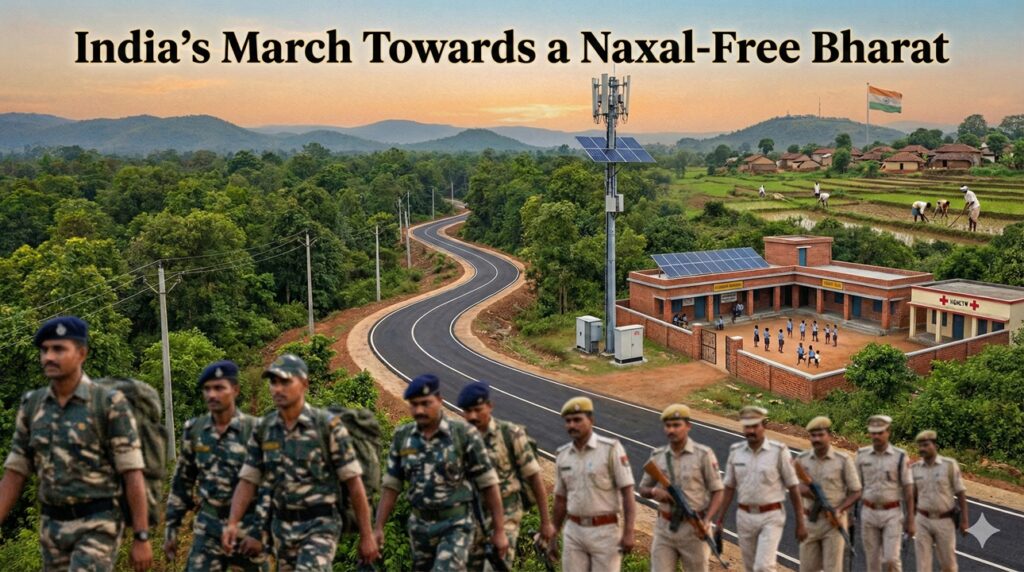
Expansion of roads, telecom and permanent security camps dismantled Maoist shadow administration and jungle sanctuaries.
Historical evolution of Naxalism
Origin phase 1967
The Naxalbari uprising in West Bengal arose from landlessness and agrarian exploitation. Charu Mazumdar shaped Maoist revolutionary ideology.
Expansion phase 1980s–2000s
The movement spread to Fifth Schedule tribal areas due to weak governance and land alienation. The 2004 formation of CPI Maoist unified factions and intensified LWE.
Peak and initial decline 2005–2014
Maoists established liberated zones and parallel systems, but coordinated state action began shrinking their influence.
Decisive rollback post 2014
An integrated security and development strategy with permanent camps, roads and telecom reduced Maoist mobility, particularly in Bastar and Dandakaranya.
Government initiatives against Naxalism
Constitutional and governance measures
The Fifth Schedule ensures special governance for Scheduled Areas.
The PESA Act 1996 empowers Gram Sabhas over local resources and consent.
The Forest Rights Act 2006 recognises individual and community forest rights.
Development and welfare measures
Infrastructure expansion reduced isolation and improved service delivery.
Financial inclusion and DBT weakened extortion-based economies.
Skill development and education reduced the recruitment base.
Security and enforcement measures
Permanent security presence ensured area domination and protected development works.
Financial crackdowns disrupted extortion and arms networks.
Surrender-cum-rehabilitation policies converted cadres into stakeholders of peace.
Challenges ahead
Governance gaps
Limited access to courts, healthcare and schools sustains distrust. Low tribal representation in administration reinforces outsider perceptions.
Weak implementation of rights laws
Dilution of FRA and PESA, especially bypassing Gram Sabha consent in mining areas, risks renewed alienation.
Socio-economic vulnerability
Poverty, land disputes and displacement around mineral corridors keep communities vulnerable to mobilisation.
Ideological and urban support
Despite territorial losses, propaganda and digital narratives can persist.
Conclusion
India has decisively weakened the territorial and military base of Naxalism through integrated security, development and rehabilitation. The next phase must prioritise governance reform, justice delivery and tribal empowerment to ensure lasting peace in Fifth Schedule areas.
Source : The Hindu