
India’s New Environmental and Solar Standard Facilities
Context
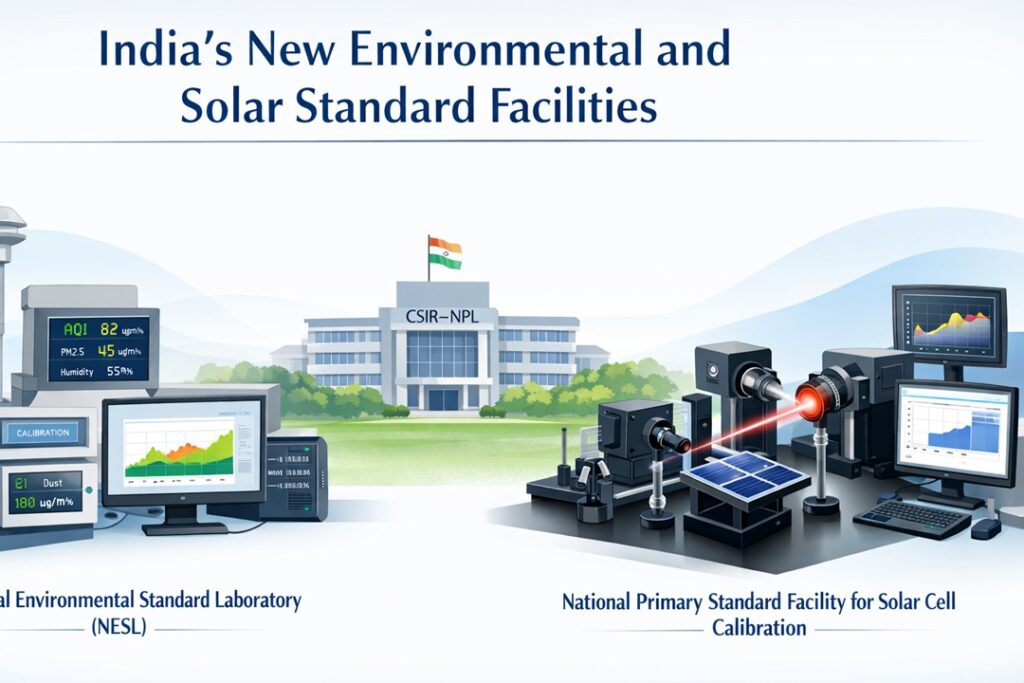
India has inaugurated the world’s second National Environmental Standard Laboratory and the world’s fifth National Primary Standard Facility for Solar Cell Calibration at CSIR–National Physical Laboratory, New Delhi.
National Environmental Standard Laboratory NESL
Nature: Apex national facility for testing, calibration and certification of air pollution monitoring instruments under Indian conditions.
Institutional Framework: Established at CSIR–NPL, New Delhi under Council of Scientific and Industrial Research CSIR.
Objective: Development of India-specific environmental standards and strengthening implementation of National Clean Air Programme NCAP.
Key Features: Calibration under Indian climatic conditions such as temperature, humidity and dust load; ensures accurate, traceable and standardised air quality data.
Economic and Regulatory Relevance: Supports domestic manufacturers, startups, MSMEs and pollution control regulators.
Global Significance: India becomes the second country after the UK to have such a national-level environmental standards facility.
National Primary Standard Facility for Solar Cell Calibration
Nature: Advanced metrology facility for high-precision calibration of solar cells ensuring global comparability of photovoltaic measurements.
Location: CSIR–National Physical Laboratory, New Delhi.
Technology Used: Laser-based Differential Spectral Responsivity L-DSR system.
Accuracy Benchmark: Achieves world-leading calibration uncertainty of 0.35 percent k equals 2.
International Collaboration: Developed in partnership with Physikalisch-Technische Bundesanstalt PTB, Germany.
Global Standing: India joins an elite global group, with this being only the fifth such facility worldwide.
Conclusion
These facilities enhance India’s environmental governance, clean energy measurement capability and scientific self-reliance, supporting evidence-based policymaking and global standard compliance.
Source : PIB