
India’s Research Ecosystem : Bridging the Gender Gap in STEM
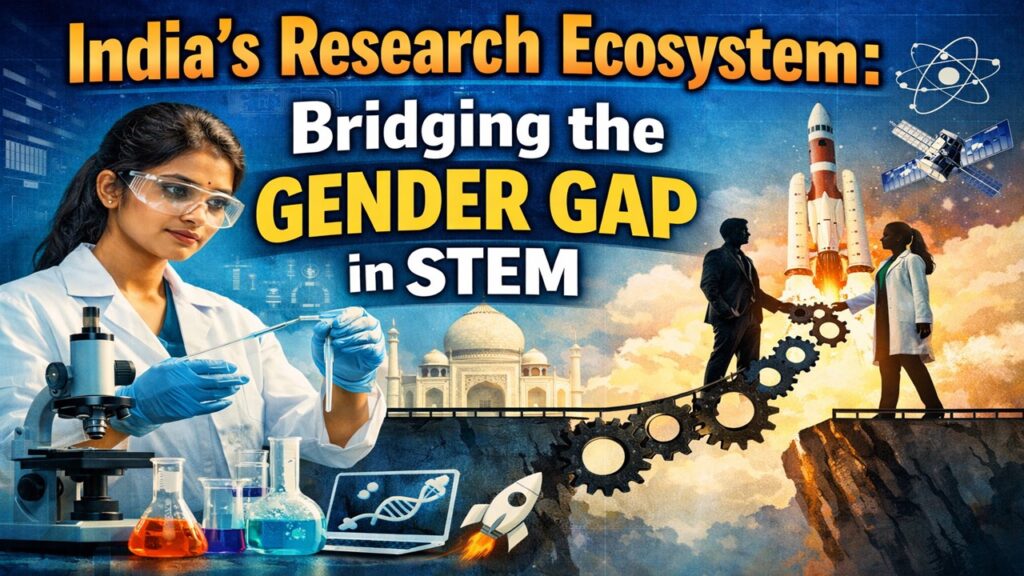
Context: Despite India producing the highest share of female STEM graduates in the world at 43%, recent reports highlight a “leaky pipeline” in the research ecosystem, where women constitute only around 18% of the R&D workforce. This indicates structural gaps between education, employment, and leadership positions in India’s research ecosystem.
India and Research Ecosystem
Introduction
Research and Development forms the intellectual foundation of India’s Viksit Bharat @ 2047 vision. India’s research ecosystem is transitioning from conventional academic inquiry toward an innovation-driven model integrating basic sciences, frontier technologies such as Artificial Intelligence and Quantum Computing, and indigenous capabilities in defence, biotechnology and space technology. Strengthening research capacity is therefore essential for transforming India into a global knowledge and technology hub.
Status of Research in India
Global Standing in Research Output
• India ranks 3rd globally in the number of PhDs awarded annually.
• India also ranks 3rd globally in the volume of scientific publications, reflecting the expansion of the academic research ecosystem.
Female Participation in STEM Education
• India records 43% female graduates in STEM disciplines, one of the highest proportions globally.
• This percentage is significantly higher than many developed countries.
Gender Disparity in Research Workforce
• Women constitute only around 18% of the R&D workforce in India.
• Women hold less than 30% of positions in national research agencies.
• Representation remains particularly low in premier institutions:
• DRDO – around 14% women scientists
• IISc Bengaluru – about 8% women faculty
Low R&D Expenditure
• India’s Gross Expenditure on Research and Development (GERD) remains about 0.64–0.7% of GDP.
• This is lower compared to major innovation economies such as USA, South Korea, and Israel.
• Increasing private sector participation in research funding is a key policy priority.
Opportunities for Research in India
Space and Satellite Technology
• Liberalization of the space sector has opened opportunities for private startups and deep-tech research.
• It encourages innovation in satellite manufacturing, launch services, and space applications.
Example:
• The success of Chandrayaan-3 and the upcoming Gaganyaan mission has accelerated research in aerospace engineering and space sciences.
Green Energy and Climate Technologies
• India’s commitment to Net Zero emissions by 2070 requires extensive research in renewable energy technologies.
• Research areas include green hydrogen, solar efficiency, battery storage, and carbon capture.
Example:
• The National Green Hydrogen Mission is promoting indigenous electrolyzer technology to reduce import dependence.
Digital Public Infrastructure and Artificial Intelligence
• India’s large digital ecosystem provides an ideal environment for AI innovation and data-driven research.
• Focus areas include vernacular AI, fintech, governance technology, and digital inclusion.
Example:
• The Bhashini initiative supports real-time translation across Indian languages using AI.
Biotechnology and Pharmaceutical Innovation
• India is transitioning from being the “Pharmacy of the World” producing generic medicines to becoming a global research hub for drug discovery.
• Research focus includes vaccines, genomics, biopharmaceuticals and precision medicine.
Example:
• Development of iNCOVACC, the world’s first intranasal COVID-19 vaccine, highlights India’s growing clinical research capacity.
Government Initiatives to Promote Research
Anusandhan National Research Foundation (ANRF)
• Provides strategic direction for national research funding.
• Strengthens industry–academia collaboration.
• Aims to significantly increase overall R&D investment in India.
Vigyan Jyoti Scheme
• Initiative of the Department of Science and Technology (DST).
• Encourages school girls to pursue STEM education and careers.
• Addresses the gender imbalance in science and technology fields.
GATI Framework (Gender Advancement for Transforming Institutions)
• Institutional framework to assess gender equality in STEM institutions.
• Encourages inclusive policies and institutional reforms.
KIRAN Scheme
• Provides career opportunities and fellowships for women scientists.
• Supports re-entry of women researchers after career breaks.
Challenges Associated with Research in India
Position Gap for Women Scientists
• Women researchers often remain in temporary or contractual roles without long-term career security.
• Representation in permanent academic positions remains low.
Example:
• In institutions such as IITs and IISc, women constitute only 8–13% of permanent faculty positions.
Low Private Sector Participation in R&D
• More than 60% of India’s R&D expenditure is government-funded.
• Limited industry investment slows innovation and commercialization of research.
Example:
• Many deep-tech startups in Bengaluru struggle to obtain long-term patient capital for research commercialization.
Rigid Age Criteria in Recruitment
• Government research institutions often impose strict age limits for recruitment.
• These rules conflict with family responsibilities and maternity-related career breaks.
Example:
• Entry-level scientist positions in national laboratories typically have an age cap of 30–35 years.
Weak Lab-to-Market Linkages
• Many academic research outputs remain confined to publications rather than patents or products.
• This limits India’s innovation capacity.
Example:
• Although India ranks 3rd in scientific publications, it ranks lower in the Global Innovation Index due to weak commercialization of research.
Way Forward
Flexible Recruitment Policies
• Introduce relaxed age limits for women scientists.
• Establish structured re-entry fellowships and tenure opportunities.
Enhancing Corporate R&D Investment
• Encourage private companies to allocate a portion of profits toward research collaboration with universities.
• Promote industry–academia partnerships.
Institutional Accountability for Gender Equity
• Link institutional funding to Gender Parity Scores under the GATI framework.
• Promote long-term recruitment and leadership opportunities for women scientists.
Strengthening Industry–Academia Collaboration
• Create stronger mechanisms to convert academic research into patents, startups, and technologies.
Effective Implementation of ANRF
• Ensure the National Research Foundation bridges the gap between academic research and industrial needs.
Conclusion
India possesses a strong base of scientific talent and one of the highest proportions of female STEM graduates globally. However, structural barriers such as gender disparities in research positions, low private sector investment, and weak commercialization mechanisms restrict the full potential of India’s research ecosystem. Addressing these challenges through inclusive policies, higher R&D investment, and stronger industry collaboration will be crucial for transforming India into a global science and innovation leader by 2047.
Source : The HINDU