
India’s Skill Development Framework: Structural Constraints and Policy Reforms
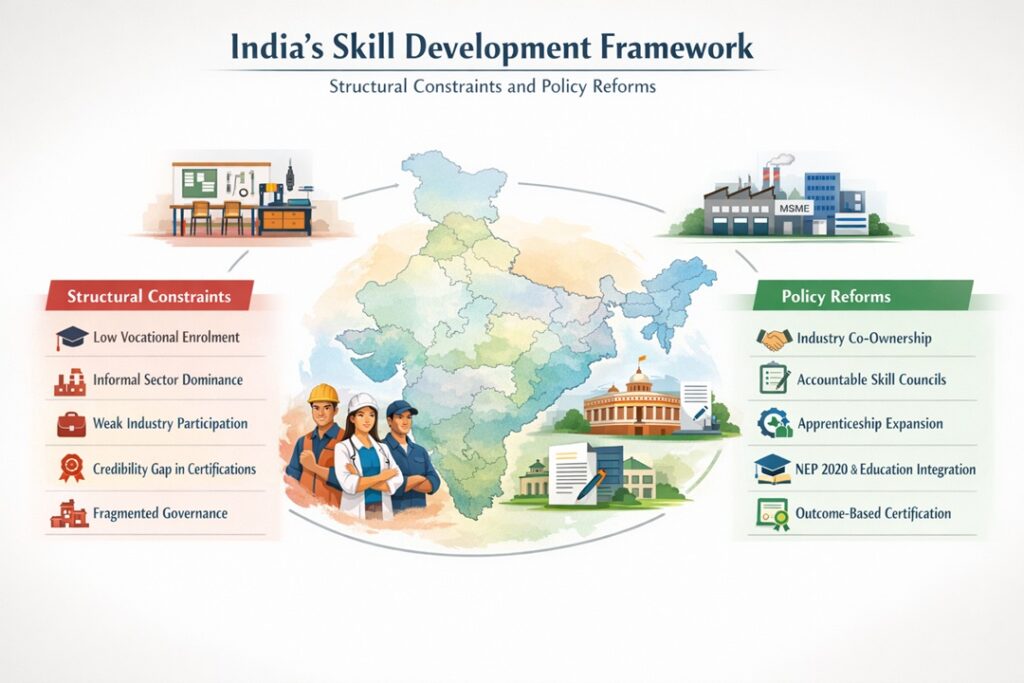
Context
India has created one of the largest skilling frameworks globally over the last decade through schemes like PMKVY. However, vocational education has not yet emerged as a mainstream or aspirational choice for Indian youth.
Current Skilling Landscape
Flagship Schemes
. PMKVY aims to train and certify around 1.40 crore candidates (2015–2025)
. Focus on short-term, outcome-based skill certification
Training Coverage
. Only 4.1% of India’s workforce has received formal vocational training
. Indicates weak penetration despite sustained public investment
Labour Market Outcomes
. As per PLFS, wage gains from vocational training are modest and inconsistent
. Informal sector dominance limits returns to skilling
Global Comparison
. Countries like Austria, Finland, Netherlands report 44%–70% enrolment in vocational education at upper-secondary level
. Highlights India’s relative lag
Social Perception
. Vocational education is still viewed as a secondary or fallback option
. Academic degrees continue to dominate career aspirations
Key Challenges in the Skilling Ecosystem
Aspirational Disconnect
. Strong preference for conventional degrees over skill-based pathways
. Low social prestige attached to vocational education
Employment Insecurity
. Absence of assured wage premium and job stability
. Informal sector absorption discourages skilled youth
Low Industry Participation
. Employers prefer in-house training or private platforms
. Public skilling certifications seen as less relevant
Weak Apprenticeship Impact
. NAPS has expanded coverage
. Impact remains uneven, especially among large firms
Fragmented Governance
. Sector Skill Councils suffer from weak accountability
. Poor alignment between certification and job readiness
Credibility Gap
. Public certifications lack employer trust
. Private certifications by AWS, Microsoft, Google enjoy higher market value
Poor Education Integration
. Skilling remains detached from mainstream education
. Reinforces perception of vocational education as inferior
Way Forward
Industry Co-Ownership
. Incentivise industry participation in curriculum, certification, and assessment
. Use fiscal and regulatory support to deepen engagement
Accountable Sector Skill Councils
. Evaluate SSCs on employment outcomes, not just training numbers
. Strengthen performance-linked accountability
Education Integration
. Implement NEP 2020 vision of embedding vocational education within higher education
. Enable acquisition of academic degrees alongside employable skills
Conclusion
India’s skilling gap is rooted in weak industry ownership, fragmented governance, and low credibility, not lack of funding. Treating skilling as a core pillar of economic empowerment is essential to convert the demographic dividend into quality employment and sustained growth.
Source : The Hindu