
India’s Space Ambitions and the Challenge of Scaling ISRO
Context
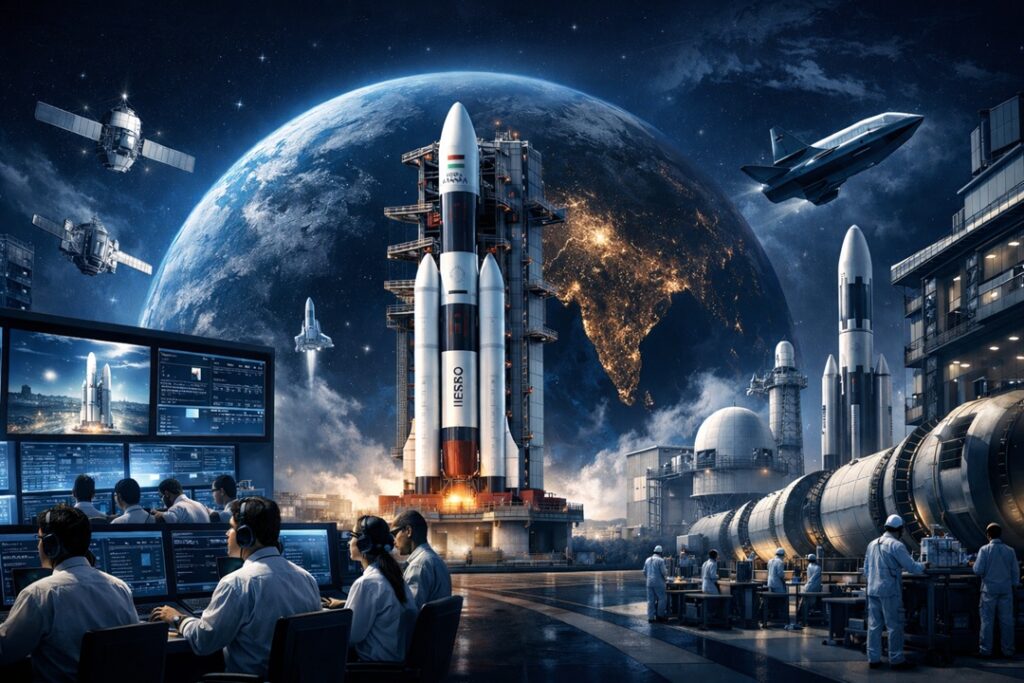
Over the past decade, the Indian Space Research Organisation (ISRO) has achieved global recognition through high-impact missions despite limited financial and human resources. As India expands its space ambitions, the central challenge now is to translate these individual mission successes into a scalable, high-frequency, and industrially robust space ecosystem.
Major Milestones in Recent Years
- Proven Launch Reliability: ISRO’s launch vehicles, particularly the Polar Satellite Launch Vehicle (PSLV), have delivered consistent, cost-effective, and reliable access to multiple orbits, establishing India as a dependable launch service provider.
- Chandrayaan-3 (2023): India successfully executed a soft landing on the Moon on August 23, 2023, becoming the fourth nation to demonstrate indigenous lunar landing capability.
- Aditya-L1 Mission (2024): India’s first space-based solar observatory was placed in a halo orbit around the L1 Lagrange point on January 6, 2024, marking a significant expansion of ISRO’s scientific capabilities.
- NISAR Mission (2025): A landmark NASA–ISRO collaboration, launched in July 2025, aimed at advanced Earth observation for climate monitoring, disaster management, and environmental studies.
- SpaDeX Mission (2025): India’s first autonomous space docking experiment, where two satellites successfully demonstrated in-orbit docking, enhancing future human spaceflight and on-orbit servicing capabilities.
Operational and Structural Constraints
- Multiple Mission Pressures: ISRO is concurrently managing human spaceflight, complex scientific missions, satellite replenishment, and development of the Next-Generation Launch Vehicle (NGLV), stretching institutional capacity.
- Incomplete Industry Offloading: Private space startups remain heavily dependent on ISRO’s test facilities, launch infrastructure, and expertise, limiting effective decentralisation.
- Launch Vehicle Limitations: LVM-3 (Gaganyaan vehicle) remains a reliable but medium-lift platform, inadequate for future heavy and deep-space missions.
- Low Launch Cadence: In 2025, ISRO conducted only five launches, underscoring constraints in production, integration, and testing capacity.
- Infrastructure Bottlenecks: Shortages of test stands, integration bays, and mature industrial supply chains continue to delay timelines.
Institutional and Legal Challenges
- Partial Reform Implementation: Although post-2020 reforms created new entities such as IN-SPACe and NSIL, their roles remain insufficiently empowered in practice.
- Absence of a National Space Law: The lack of a comprehensive legal framework creates uncertainty around licensing, liability, insurance, and dispute resolution.
- Third-Party Liability Issues: In the absence of legal clarity, ISRO often becomes the default liability holder in commercial or private missions.
- Regulatory Overreach: Without statutory authority, ISRO continues to perform regulatory and supervisory functions, diluting its core research focus.
Competitiveness in a Changing Global Space Economy
- Global Shift: Leading space powers are moving towards high-frequency launches, reusable vehicles, and mass satellite production, increasing competitive pressure.
- NGLV Vision: India’s proposed Next-Generation Launch Vehicle, capable of lifting up to 30 tonnes to Low Earth Orbit, reflects a shift towards economy and reusability.
- Industrial Readiness Gap: Achieving this vision requires deep manufacturing capacity, advanced materials, skilled manpower, and large-scale capital investment.
- Investment Slowdown: In 2024, space-sector investments declined, reflecting global financial uncertainty and the long-gestation nature of space hardware projects.
Policy and Institutional Way Forward
- Redefining ISRO’s Role: ISRO must transition from being the single-point designer, integrator, and operator to a technology leader supported by industry.
- Enacting a National Space Law: A statutory framework would protect innovation, clarify liability, and insulate ISRO from ad hoc regulatory responsibilities.
- Strengthening IN-SPACe and NSIL:
- IN-SPACe requires legal authority as the authorising body.
- NSIL needs clear liability norms to function effectively as the commercial interface.
- Operational Scaling: Expansion of integration facilities, test infrastructure, and resilient workflows to support parallel missions.
- Industrial Capacity Building: Separate resource allocation for R&D and operational launches, deeper supply chains, and improved risk absorption.
The Road Ahead
ISRO’s earlier achievements have established credibility and public confidence. However, India’s future as a major space power will depend on its ability to institutionalise execution, clarify governance, and industrialise space activities. The transition from mission-centric excellence to system-level capability will determine whether India can sustain competitiveness in the rapidly evolving global space economy.
Source : The Hindu