
India’s Strategic Stakes in West Asia Amid the 2026 Conflict
Introduction
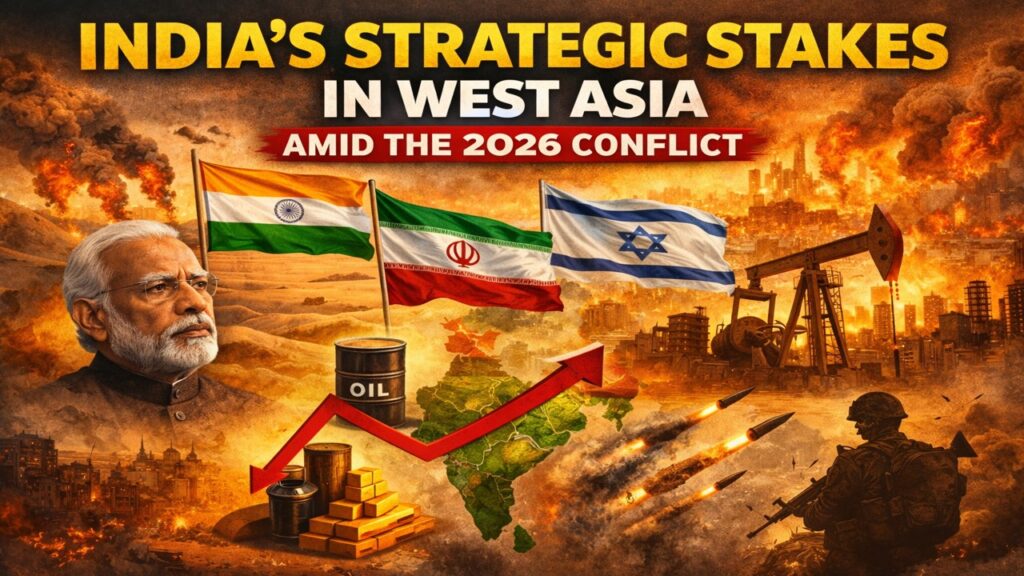
Context: The ongoing conflict in West Asia following the February 2026 strikes on Tehran has intensified geopolitical tensions in the region. Indian leaders, including Shashi Tharoor, have warned that the escalating war could disrupt regional stability and directly threaten India’s energy security, diaspora safety, and economic interests. Given India’s deep economic and strategic linkages with West Asia, instability in the region can have immediate domestic economic consequences.
Intro: West Asia occupies a crucial place in India’s foreign policy due to its importance for energy imports, trade, remittances, and strategic connectivity. Therefore, any conflict in the region significantly affects India’s economic stability and national security.
Body
Nature of India’s Stakes in West Asia:
India’s engagement with West Asia reflects a multidimensional dependence involving energy security, remittances, trade, and workforce mobility. Instability in the region can directly influence inflation, foreign exchange reserves, and employment in India.
Energy Dependence:
West Asia supplies nearly 49–55 percent of India’s crude oil imports and around 70 percent of its natural gas requirements. This high dependence exposes India to supply shocks and rising global oil prices during conflicts.
Strategic Maritime Chokepoint:
Nearly 40–50 percent of India’s crude oil imports pass through the Strait of Hormuz, one of the world’s most critical maritime chokepoints. Any blockade or disruption in this route can severely affect India’s energy supply and shipping costs.
Indian Diaspora Presence:
Around 9 million to 1 crore Indians live and work in Gulf countries, making it one of the largest expatriate communities in the world. Their safety becomes a major diplomatic and humanitarian priority during regional conflicts.
Remittance Contribution:
West Asia contributes nearly 38 percent of India’s global remittance inflows, with about 19 percent coming from the UAE alone. These remittances support millions of households, particularly in Kerala, Uttar Pradesh, and Bihar.
Agricultural Export Market:
West Asia is a key destination for India’s agricultural exports such as Basmati rice and spices. Due to the conflict, over 400,000 tonnes of Basmati rice were reportedly stuck at ports in March 2026, highlighting the vulnerability of trade routes.
Fertilizer Import Dependence:
India imports nearly 40 percent of its Urea and NPK fertilizers from West Asia. Disruptions in supply chains may increase the government’s subsidy burden and trigger food inflation.
Importance of India for West Asia
Economic Reconstruction Partner:
India is considered a reliable partner in infrastructure development and post-conflict reconstruction. Indian companies have investments in projects such as the Zahedan railway line and Farzad-B gas field in Iran.
Diplomatic Balancing Role:
India maintains strong relations with both Israel and Iran, positioning itself as a credible diplomatic bridge during regional tensions.
Human Resource Backbone:
Indian workers form a critical part of the construction, healthcare, retail, and service sectors in Gulf economies, making them an essential pillar of regional growth.
Maritime Security Provider:
The Indian Navy acts as a net security provider in the Indian Ocean region. Naval missions such as Operation Sankalp help protect commercial vessels and ensure safe maritime trade routes.
Challenges for India
Diplomatic Balancing Challenge:
India must balance its relations between the US–Israel strategic axis and energy partner Iran, which requires careful diplomatic management.
Energy Supply Vulnerability:
Any disruption in the Strait of Hormuz, through which nearly half of India’s oil imports pass, could severely impact India’s energy security.
Connectivity Project Disruptions:
Major connectivity initiatives such as the India–Middle East–Europe Corridor (IMEC) face uncertainty due to escalating regional tensions.
Diaspora Evacuation Challenge:
The presence of millions of Indian nationals in the Gulf makes any emergency evacuation operation extremely complex and resource intensive.
Way Forward
Energy Diversification:
India should diversify crude imports by increasing sourcing from Africa, the Americas, and Eurasia, while strengthening Strategic Petroleum Reserves.
Strengthening Maritime Security:
Institutionalizing a permanent maritime escort system for commercial vessels in sensitive sea lanes can ensure safer energy transportation.
Active Diplomatic Engagement:
India should leverage platforms such as G20 and BRICS to promote dialogue, de-escalation, and peaceful conflict resolution in West Asia.
Alternative Financial Mechanisms:
Expanding rupee-based trade settlement systems can help India continue trade even during sanctions or financial disruptions.
Strategic Autonomy:
India should maintain its balanced and independent foreign policy, enabling it to engage with all regional actors and promote stability.
Conclusion
West Asia remains a strategic lifeline for India’s energy security, trade networks, and diaspora welfare. The 2026 conflict demonstrates how instability in the region can directly affect India’s economy and national interests. By pursuing energy diversification, proactive diplomacy, and stronger maritime security, India can safeguard its interests while contributing to long-term stability in West Asia.
Source : Indian Express