
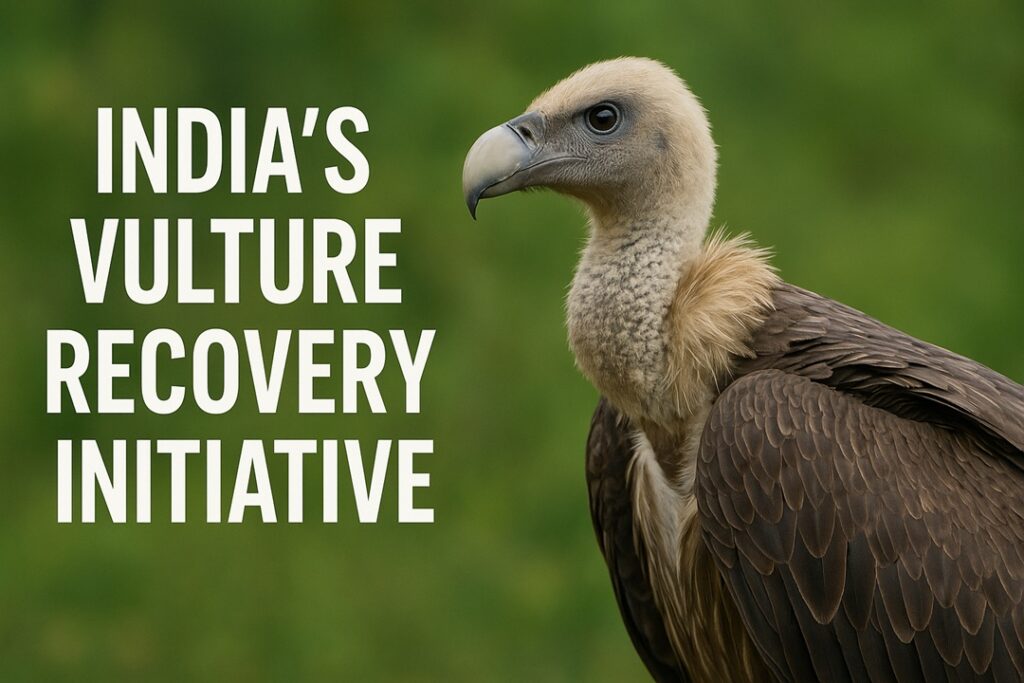
India’s Vulture Recovery Initiative: BNHS to Release Critically Endangered Species
Context
BNHS will release six critically endangered vultures (slender-billed and white-rumped) into the wild in Assam in January 2026 as part of India’s long-term vulture recovery programme.
About Slender-billed Vulture (Gyps tenuirostris)
Habitat
Found in the Gangetic plains, Assam, northern Bangladesh, southern Nepal, Myanmar, and Cambodia.
Prefers tall nesting trees in open landscapes near human settlements, slaughterhouses, and riverine ecosystems.
Conservation Status
Listed as Critically Endangered since 2002 with fewer than 870 mature individuals.
Key Characteristics
Length 80–95 cm, wingspan 196–258 cm.
Distinct slender bill, dark head, long bare neck, grey plumage with pale rump.
Slow breeder with one egg per clutch; solitary nesting behaviour.
Primarily scavenges on carrion.
About White-rumped Vulture (Gyps bengalensis)
Habitat
Occurs across cities, villages, plains, and open fields; nests on large trees or cliffs.
Often roosts near human habitation due to ready access to carcasses.
Conservation Status
Classified as Critically Endangered following drastic population crashes caused by diclofenac-contaminated livestock carcasses.
Key Characteristics
Length 75–85 cm, wingspan 180–210 cm, weight 3.5–7.5 kg.
Dark body with white neck ruff and prominent white rump patch.
Breeds from October to March, laying one thick-shelled egg.
Feeds on carcasses, often in mixed-species groups.
Conclusion
The planned release by BNHS represents a significant step in India’s long-term vulture conservation strategy, aimed at restoring populations of critically endangered scavenger species crucial for ecological balance. Successful rehabilitation will strengthen vulture breeding, survival, and ecosystem health in the northeastern landscape.
Source : The Hindu