India’s Water Crisis and Gender Inequality
Context
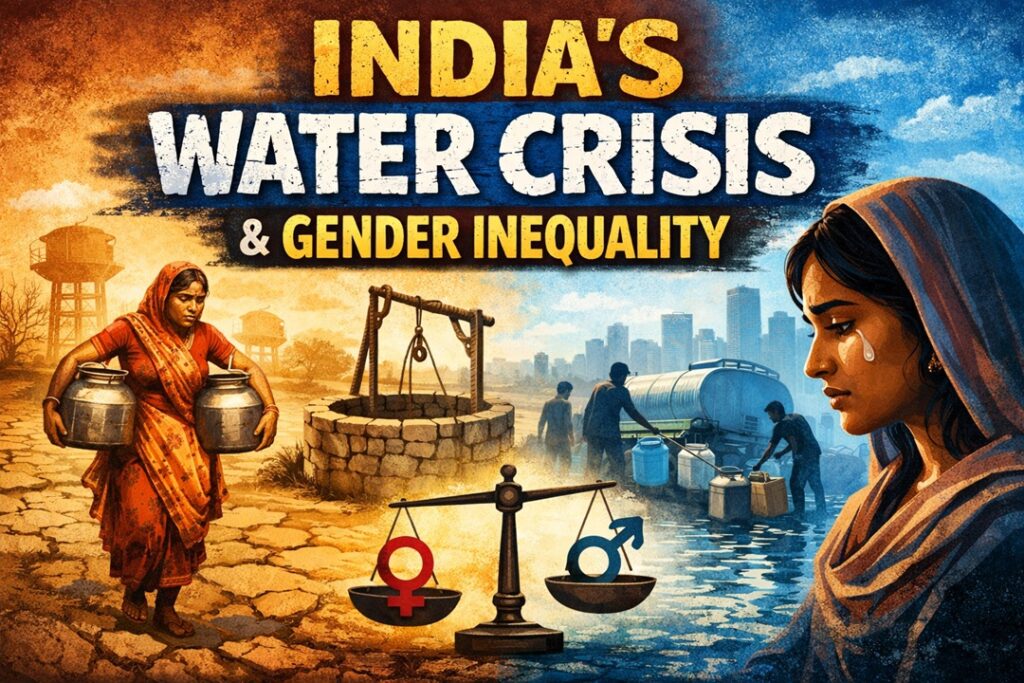
India is confronting a deepening freshwater stress, with the crisis becoming more severe due to pronounced gender inequalities in water access and management.
How Severe is India’s Water Stress?
Nature of scarcity – India experiences both physical shortages (limited availability) and economic scarcity (inadequate access infrastructure).
Threshold concern – Water stress is defined globally when per capita availability falls below 1,000 cubic metres annually, a level India is rapidly nearing.
Current scenario
- About 600 million people face high to extreme water stress.
- Nearly 2 lakh deaths annually are linked to unsafe water access.
Access vs reliability gap
- Drinking water coverage has improved to nearly 95%, yet
- Many households face irregular supply, poor maintenance, and dependence on alternate sources.
Structural pressure – With 18% of global population but only 4% freshwater resources, India’s water systems remain under severe strain.
Future outlook – Per capita availability is projected to decline to critical levels by 2050, posing risks to long-term sustainability.
What are the Social and Economic Impacts?
Urban–rural imbalance – Cities benefit from better infrastructure, whereas rural areas depend on distant and unreliable water sources.
Inequality burden – Poor households spend disproportionately on purchased water, worsening economic vulnerability.
Health consequences – Scarcity intensifies water-borne diseases, especially in disaster-prone regions.
Education disruption – Children, particularly girls, are withdrawn from schools for water collection duties, raising dropout rates.
How Does Water Scarcity Affect Women?
Primary responsibility – Women manage water collection in nearly 71% of rural households.
Time poverty – Daily collection (30–40 minutes or more) results in significant loss of productive time.
Health and safety risks
- Physical strain: musculoskeletal disorders, fatigue
- Psychological stress
- Exposure to harassment and unsafe conditions
Restricted opportunities – Time spent limits women’s access to:
- Education
- Employment
- Participation in governance
What are Emerging Gendered Distortions?
“Water wives” practice – In drought-hit regions of Maharashtra, some men marry multiple women to increase water-fetching labour, reflecting:
- Exploitation of vulnerable women
- Denial of marital and inheritance rights
Agricultural stress link – Water-intensive crops like sugarcane exacerbate scarcity:
- Female workers face dual burden of farm and domestic labour
- Poor sanitation leads to serious reproductive health issues
Are Women Just Victims? No — They are Change-Makers
Collective mobilisation – Women farmers have demanded fair irrigation access, challenging entrenched power structures.
Community leadership
- “Jal Sahelis” groups restoring water bodies
- Women in Himalayan regions reviving drying springs
Local knowledge systems – Women demonstrate practical expertise in sustainable water use and conservation.
What is the Policy Framework and its Limitations?
Government efforts – Schemes like the Jal Jeevan Mission aim for universal tap water access.
Persistent gaps
- Lack of reliable and functional supply
- Weak gender-sensitive implementation
Policy blind spots
- Focus on efficiency and output
- Neglect of:
- Women’s unpaid labour
- Their role in water governance
- Structural barriers like land ownership
Why is Gender-Responsive Water Governance Needed?
Recognition imperative – Women must be acknowledged as:
- Key stakeholders
- Knowledge holders
- Decision-makers
Institutional reforms
- Ensure women’s representation in water bodies
- Improve land and resource rights
- Introduce gender budgeting in water policies
Reducing drudgery
- Strengthen local water infrastructure
- Promote decentralized systems
- Ensure consistent household-level supply
Agricultural transition
- Shift away from water-intensive crops
- Promote crop diversification and efficient irrigation
Way Forward
India’s water challenge extends beyond ecology into social justice and gender equity.
Core insight – Unequal access, control, and decision-making structures deepen the crisis.
Opportunity – Women, despite being disproportionately affected, are central to sustainable solutions.
Policy direction – A holistic approach combining:
- Gender-sensitive governance
- Equitable resource allocation
- Recognition of women’s agency
Source : The Indian Express