
INSV Kaundinya: Reconnecting India with Its Maritime Civilisation
Context
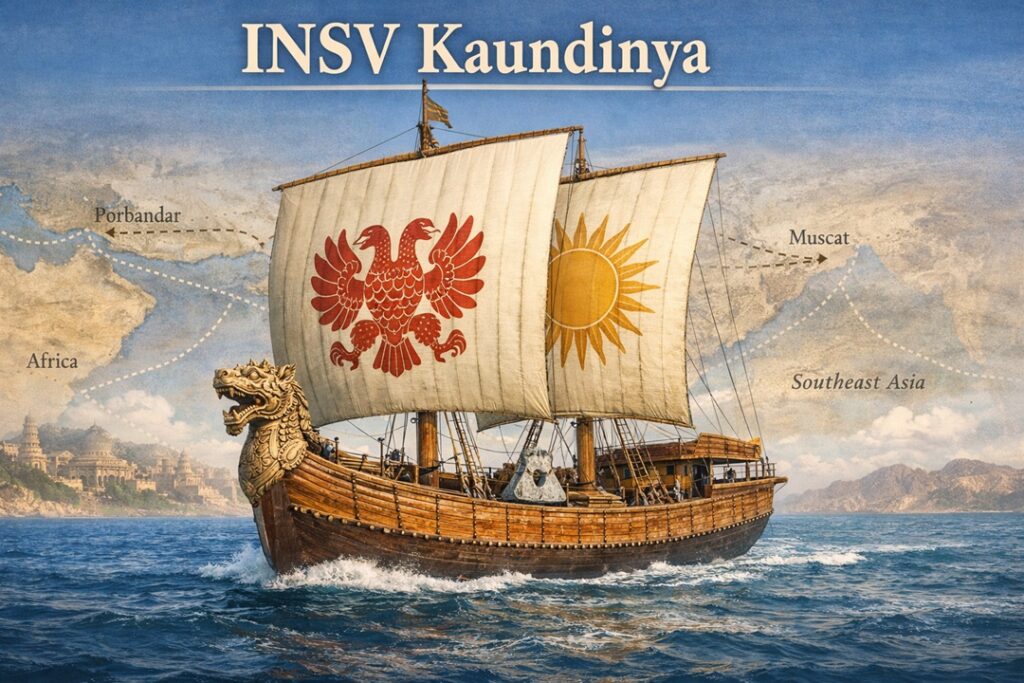
The Prime Minister has lauded INSV Kaundinya on its maiden voyage from Porbandar to Muscat, symbolically retracing India’s ancient maritime trade routes and highlighting the revival of indigenous shipbuilding traditions.
About INSV Kaundinya
Nature of Vessel
INSV Kaundinya is an Indian Naval Sailing Vessel recreated from a 5th-century CE ship depicted in the Ajanta Cave paintings, reflecting India’s ancient ocean-going capability.
Institutional Support
Built by the Indian Navy in collaboration with the Ministry of Culture, aligning defence capabilities with cultural preservation.
Key Features of the Vessel
Shipbuilding Technique
Features a stitched wooden hull, where planks are stitched rather than nailed, showcasing ancient Indian naval engineering.
Materials Used
Constructed using coconut coir rope, natural resin and wooden planks, avoiding modern metal fastenings.
Cultural Symbolism
Carries Gandabherunda and Sun motifs on sails, a Simha Yali on the bow, and a Harappan-style stone anchor on deck, reflecting civilisational continuity.
Seaworthiness
Designed and tested for long-distance ocean navigation, proving the scientific soundness of traditional knowledge.
Historic Identity
Named after Kaundinya, a legendary mariner linked to early Indian maritime links with Southeast Asia.
Ancient Indian Stitched-Ship Technique
Core Concept
An indigenous Indian shipbuilding method where wooden planks are stitched using natural fibres, widely used along India’s coastline in ancient times.
Technical Advantages
Provides flexibility and shock absorption, making ships resilient in rough seas and long voyages.
Sustainability Aspect
Relies on organic and eco-friendly materials, reflecting sustainable technological practices of ancient India.
Maritime Reach
Enabled Indian traders to reach West Asia, Africa and Southeast Asia, supporting India’s role in early global trade networks.
Conclusion
INSV Kaundinya represents the integration of heritage, technology and diplomacy, reaffirming India’s ancient maritime prowess, revival of indigenous knowledge systems, and its relevance to modern nation-building and cultural diplomacy.
Source : PIB