
International Year of Rangelands and Pastoralists: Policy and Ecological Imperatives
Context
The United Nations has declared 2026 as the International Year for Rangelands and Pastoralists to highlight the global importance of grasslands. Climate negotiations remain forest-centric, emphasizing the need to integrate grasslands into national climate plans and NDCs.
Grasslands: Definition and Extent
Definition
- Grasslands are open ecosystems dominated by grasses with sparse or no trees
- Found in savannahs, steppes, prairies, and rangelands
Extent and Importance
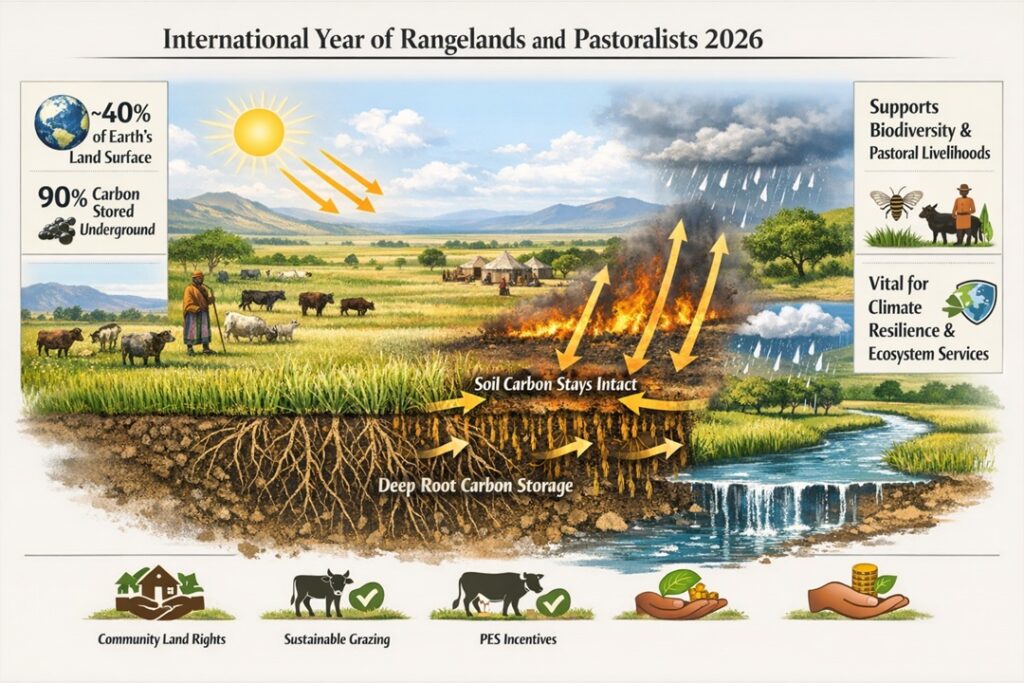
- Cover ~40% of Earth’s land surface
- Support pastoral livelihoods, biodiversity, and soil-based carbon storage
Climate Significance of Grasslands
Carbon Sequestration
- 90% of grassland carbon stored underground in roots, resistant to surface disturbances
- Example: Stanford University (2025) found soil carbon uptake rose 8% under higher CO₂
Fire Resilience
- Grassland fires leave soil carbon intact, allowing rapid ecological recovery
- Example: Western US prairie studies (2024–25) show grasslands remain net carbon sinks
Albedo Effect and Cooling
- Reflect more sunlight than forests, reducing local heat absorption
- Example: IPBES Land Report (2025) highlights grasslands’ cooling in semi-arid zones
Hydrological Regulation
- Dense roots improve groundwater recharge and reduce runoff during heavy rainfall
- Example: Senegal (2025) restored 2 million hectares of grasslands to buffer drought–flood cycles
Global Policy Bias
Forest-Centric Climate Finance
- Climate funds mainly target forests, sidelining grasslands
- Example: COP30, Belém, Brazil focused on forests via TFFF
Institutional Silos
- UN conventions (UNFCCC, CBD, UNCCD) operate separately, fragmenting grassland governance
- Example: Grasslands get stronger recognition under UNCCD COP16 (Saudi Arabia) than UNFCCC
Exclusion from NDCs
- Most countries mention forests but omit grasslands as carbon sinks
- Example: India’s NDCs target 2.5–3 billion tonnes CO₂ via forests, excluding grasslands
Misclassification as Wastelands
- Productive grasslands labelled degraded, facilitating conversion
- Example: India’s Wasteland Atlas included grazing commons and savannahs
Implications of Declining Grasslands
Biodiversity Loss
- Open-habitat species face “extinction by afforestation”
- Example: Brazil’s Cerrado loses grassland area twice as fast as the Amazon
Reduced Climate Resilience
- Degraded grasslands increase desertification and flood–drought risks
- Example: Australia’s desert rangelands (2024–25) show rising climate volatility
Loss of Pollination Services
- Grasslands support pollinators critical for ~35% of global crop production
- Example: FAO estimates
Displacement of Pastoral Communities
- Conversion restricts mobility and traditional livelihoods
- Example: Charanka Solar Park, Gujarat (2025) displaced semi-nomadic herders
Way Forward
Recognition as Open Natural Ecosystems (ONEs)
- Replace “wasteland” terminology with ecologically valuable systems
- Example: India (2026) moving toward ONE classification
Inclusion in NDCs
- Unlocks climate finance and policy priority
- Example: Brazilian researchers (2025) urged inclusion of Cerrado grasslands
Ecosystem-Based Climate Planning
- Balance forests, grasslands, wetlands, and mangroves in mitigation strategies
- Example: WWF–IUCN COP30 report recommended cross-biome carbon accounting
Community Land Rights and Stewardship
- Indigenous management improves ecological outcomes
- Example: Indigenous Desert Alliance (Australia) uses cultural burning to protect desert grasslands
Sustainable Grazing and PES Models
- Reward soil carbon enhancement via pastoral practices
- Example: India’s National Rangeland Utilisation Policy (2025–26) aims to restore 120 million hectares
Conclusion
Grasslands are climate-critical ecosystems storing carbon, sustaining biodiversity, and supporting livelihoods. A forest-only climate strategy is incomplete and socially unjust. Integrating grasslands into NDCs and climate finance is essential for resilient and inclusive climate action.
Source : The Hindu