
Judicial Diversity and Decentralisation of the Supreme Court
Context
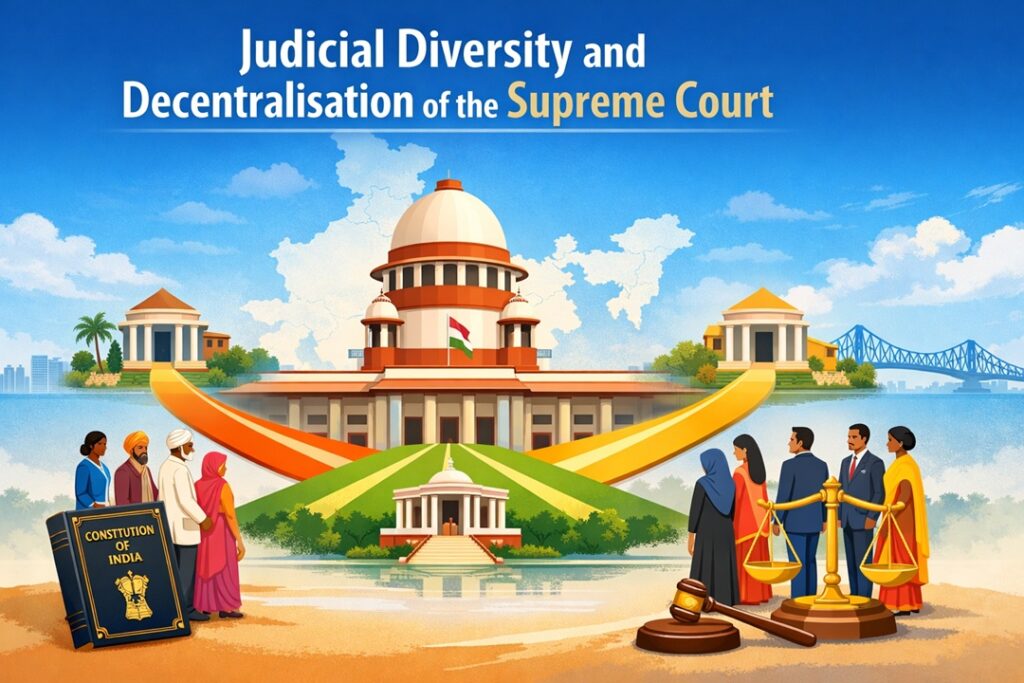
In a recent legislative development, Rajya Sabha MP P. Wilson has introduced a private member’s Bill titled the Constitution (Amendment) Bill, 2026. The Bill seeks to promote social and gender diversity in the higher judiciary and proposes the establishment of regional benches of the Supreme Court to improve accessibility, reduce pendency, and ensure equitable justice delivery across India.
Understanding Judicial Representativeness
Concept Explained:
Judicial representativeness refers to the inclusion of judges from diverse social, gender, regional, and minority backgrounds. A representative judiciary enhances constitutional legitimacy by ensuring that courts reflect the plural nature of Indian society and incorporate varied lived experiences in legal interpretation.
Snapshot of Representation in Higher Courts
Social Composition: Data from 2018–2024 indicates that nearly four-fifths of High Court appointees came from upper-caste backgrounds, while Scheduled Castes and Scheduled Tribes together formed barely a tenth.
Gender Imbalance: Women constitute only about 14% of High Court judges as of August 2024, and the Supreme Court currently has just one woman judge.
Minority Presence: Appointments from religious minority communities have remained below 5% in the last six years.
Case Backlog: As of January 2026, the Supreme Court faces pendency exceeding 90,000 cases, many originating from High Courts located near Delhi.
Judicial Vacancies: Nearly one-third of High Court positions remain vacant, weakening the efficiency of justice delivery.
Legal and Constitutional Basis
Appointment Framework: Articles 124 and 217 outline the procedure for appointing judges to the Supreme Court and High Courts.
Decentralisation Provision: Article 130 empowers the Chief Justice of India, with Presidential consent, to establish Supreme Court benches outside Delhi, providing constitutional backing for regional benches.
Rationale for a More Inclusive Judiciary
Strengthening Democratic Legitimacy: Courts gain public confidence when their composition mirrors societal diversity.
Illustration: The elevation of Justice B.R. Gavai was widely viewed as a positive step towards inclusivity.
Context-sensitive Adjudication: Diverse backgrounds enrich judicial reasoning and social understanding.
Illustration: Greater sensitivity in gender-justice rulings has been associated with the presence of women judges.
Correcting Historical Exclusion: Inclusion addresses long-standing under-representation in constitutional offices.
Illustration: India’s continued absence of a woman Chief Justice reflects enduring systemic barriers.
Broadening the Legal Profession: Visible diversity at senior levels encourages wider participation in litigation careers.
Advancing Social Justice: A representative bench aligns adjudication with constitutional values of equality and fairness.
Barriers to Achieving Diversity
Opaque Appointment Processes: Limited transparency in the collegium system can reinforce elite dominance.
Informal Power Structures: Male-dominated professional networks restrict upward mobility for women and marginalized lawyers.
Absence of Mandated Inclusion: Higher judiciary appointments lack formal diversity norms.
Regional Disadvantages: Centralisation in Delhi limits opportunities for advocates from distant states.
Institutional Gaps for Women: Inadequate infrastructure and support systems affect retention and progression.
Reform Pathways Suggested
Revisiting Appointment Mechanisms: Introduce greater transparency and accountability while preserving judicial independence.
Decentralised Supreme Court Structure: Establish permanent regional benches in major zones of the country.
Formal Diversity Benchmarks: Integrate inclusivity indicators into the Memorandum of Procedure.
Fixed Timelines: Impose statutory deadlines for appointment clearances.
Capacity-building Measures: Create mentorship pipelines for first-generation and underrepresented lawyers.
Conclusion
Judicial diversity and decentralisation are essential for building a justice system that is accessible, credible, and constitutionally responsive. Far from undermining merit, inclusivity strengthens judicial decision-making by incorporating India’s social complexity. Advancing these reforms can help transform the judiciary into a more representative guardian of constitutional values.
Source : The Hindu