
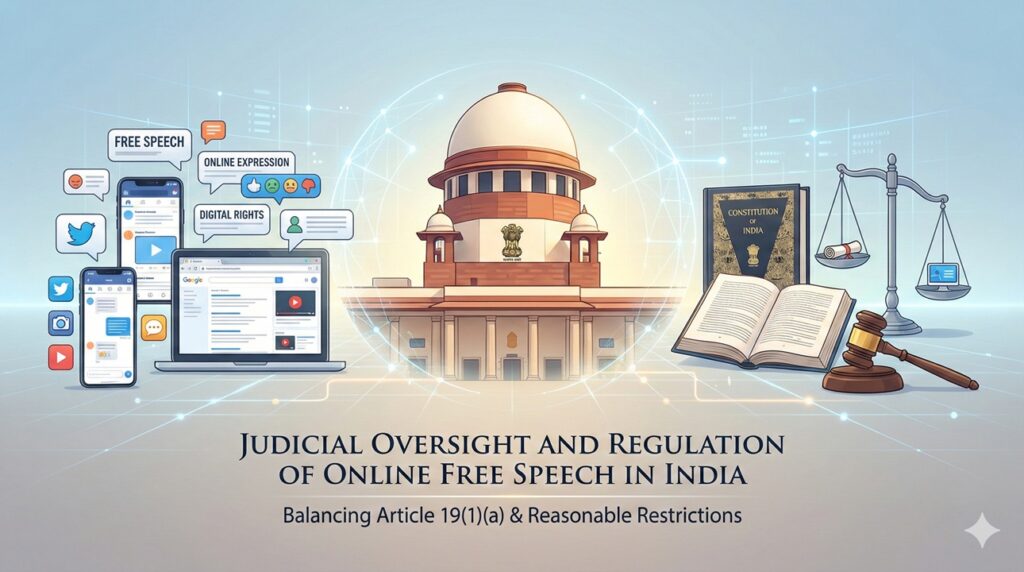
Judicial Oversight and Regulation of Online Free Speech in India
Context
Recently, during proceedings in Ranveer Allahbadia vs Union of India and connected cases, the Supreme Court observed that self-styled bodies are inadequate for regulating online content. It suggested the creation of neutral and autonomous regulatory bodies and recommended that the Government publish draft guidelines and invite public comments, raising concerns on digital free speech regulation.
Existing Legal Framework on Free Speech and Online Content
Obscenity Laws
Section 67 of the IT Act, 2000 and Sections 294, 295 and 296 of the Bharatiya Nyaya Sanhita penalise obscenity.
Online Offences Regulation
Section 66 of the IT Act deals with computer-related offences, while Section 66E penalises violation of privacy through unauthorised publication of images.
Cyber Terrorism
Section 66F of the IT Act provides punishment for cyber terrorism.
Intermediary Guidelines Rules, 2021
The IT Rules, 2021 regulate digital platforms but are criticised for executive overreach, penal provisions and indirect prior restraint.
Oversight Mechanism
The Rules establish a centralised government-controlled oversight mechanism, raising concerns about independence.
Constitutional Provisions and Judicial Stand
Article 19(2) Framework
The Constitution provides exhaustive grounds for restricting free speech, including sovereignty, security of the State, public order, morality and defamation.
Judicial Self-Restraint Principle
In Common Cause vs Union of India 2008, the Court cautioned against judicial overreach due to institutional and technical limitations.
Pre-Censorship and Media Freedom
In Sahara India vs SEBI 2012, the Court held that pre-censorship must be avoided and postponement of reporting should be a last resort.
Limits on Additional Restrictions
In Kaushal Kishor case 2023, a Constitution Bench ruled that no restrictions beyond Article 19(2) are permissible, even when balancing fundamental rights.
Role of Judiciary
In Adarsh Co-operative Housing Society case 2018, the Court reaffirmed that content regulation lies with statutory bodies, not the judiciary.
Constituent Assembly Vision
Pandit Thakur Dass Bhargava 1948 emphasised that the Supreme Court is the final arbiter on the reasonableness of restrictions, not a law-making authority.
International Experience in Online Regulation
European Union Model
The Digital Services Act 2022 prescribes structured content removal protocols.
Germany
The Network Enforcement Act 2017 ensures prompt action against harmful content while safeguarding speech.
United Kingdom
The Online Safety Act 2023 focuses on content removal and imposes financial penalties.
Australia
The Online Safety Act 2021 provides regulatory compliance backed by fines.
Authoritarian Approaches
Countries like China and Russia rely on surveillance and pre-censorship, severely restricting online freedoms.
Conclusion
Despite existing laws, repeated calls for stricter internet regulation pose risks to freedom of speech and democratic values. Any future regulation must strictly adhere to Article 19(2) and respect constitutional limits, judicial restraint and civil liberties, ensuring that regulation does not become censorship.
Source : The Hindu