
Kathputli Puppetry: A Millennium-Old Folk Tradition of Rajasthan
Context:
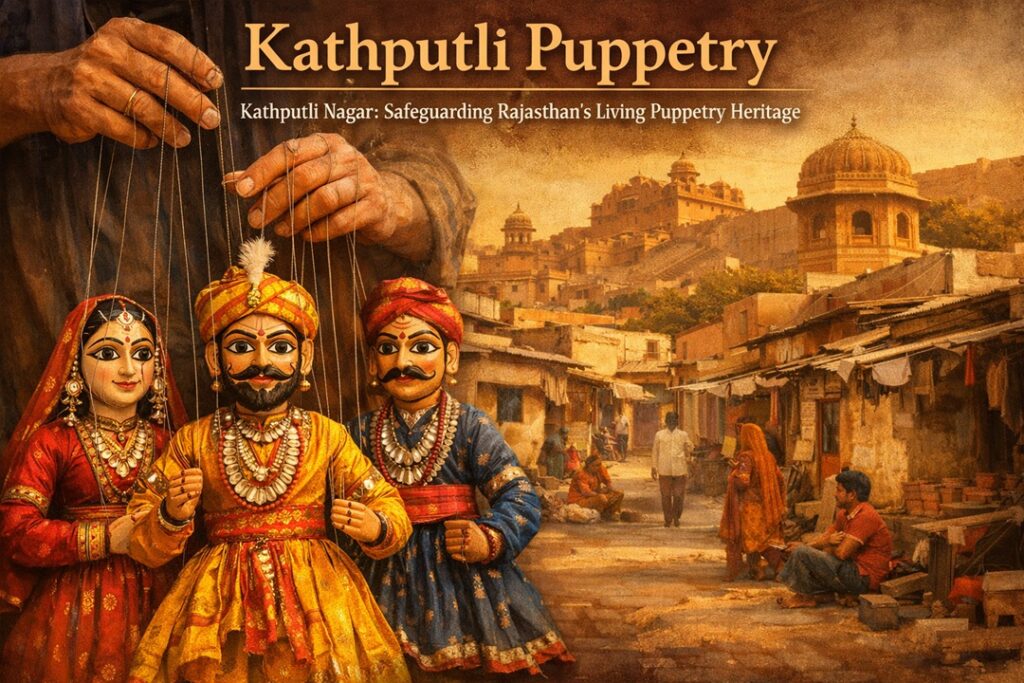
Jaipur’s Kathputli Nagar, inhabited by nearly 250 families of hereditary puppeteers, has come into focus as a rare urban settlement sustaining one of Rajasthan’s most ancient performing art traditions.
Art Form Explained: Kathputli is a classical Rajasthani string-puppetry tradition in which handcrafted wooden figures, adorned in bright traditional attire, are manipulated through strings to depict historical episodes, folklore, heroic legends and ethical narratives.
Geographical Spread: The tradition emerged in Rajasthan and continues to flourish mainly in Jaipur, Nagaur, Churu and Sikar, with Kathputli Nagar in Jaipur recognised as its most prominent surviving cluster.
Evolution Over Time: With origins tracing back over 1,000 years, Kathputli performances were historically staged by nomadic Bhat and Nat communities during village gatherings, religious festivals and royal durbars, serving both educative and entertainment purposes.
Distinctive Characteristics:
- Design: Stylised wooden puppets featuring prominent eyes and expressive facial forms.
- Attire: Multicoloured costumes reflecting Rajasthan’s royal heritage and desert culture.
- Performance Style: Storytelling supported by live folk music using instruments like dholak and harmonium.
- Content: Narratives drawn from Rajput history, folk heroes, moral fables and social critique.
Pan-Indian Puppetry Traditions (Overview):
- Tamil Nadu: Tolu Bommalatam (shadow), Bommalatam (string–rod), Pava Koothu (glove)
- Kerala: Tolpava Koothu (shadow), Pavakathakali (glove), Nool Pavakoothu (string)
- Andhra Pradesh: Tolu Bommalata (shadow), Koyya/Keelu/Sutram Bommalata (string)
- Karnataka: Togalu Gombeyata (shadow), Sutrada & Yakshagana Gombeyata (string), Salaki Gombeyata (rod–string), Chinni Patti (glove)
- Maharashtra: Chamdyacha Bahulya (shadow), Kalasutri Bahulya (string), Chitrakathi (illustrated narration)
- Rajasthan: Kathputli ka Khel (string)
- Uttar Pradesh: Gulabo–Sitabo (glove)
- Odisha: Ravanachhaya (shadow), Gopalila Kundhei (string), Sakhi Kundhei (glove), Kathi Kundhei Nacha (rod)
- West Bengal: Tarer Putul Nach (string), Danger Putul Nach (rod), Benir Putul (glove)
- Tripura: Putul Nach (string)
- Assam: Putala / Putul Nach (string)
- Manipur: Laithibi Jagoi (string)
Significance:
Kathputli represents India’s rich intangible cultural heritage and highlights the need for sustained community-led preservation in the face of urbanisation and socio-economic change.
Source : The Hindu