
Left-Wing Extremism in India: Retreat of an Insurgency
Context
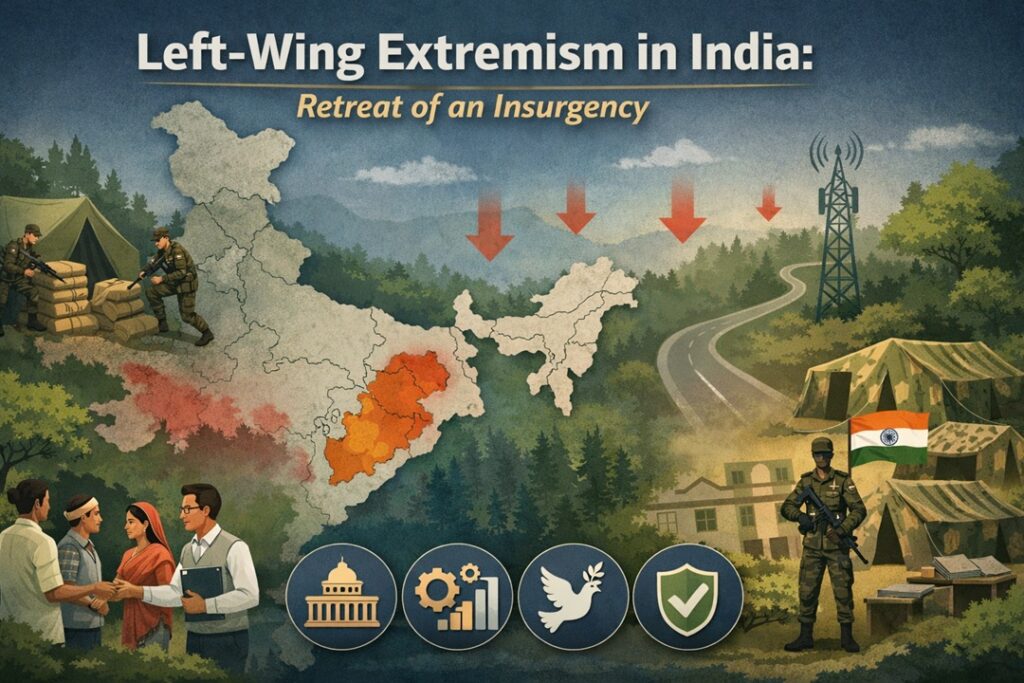
In recent years, India has recorded a marked decline in Left-Wing Extremism. A sustained reduction in extremist violence, particularly during the past two years, has geographically confined the movement to limited areas, largely within the Bastar region of Chhattisgarh.
Understanding Maoist Ideology
Doctrinal roots: Maoism represents a revolutionary strand of communism conceptualised by Mao Zedong.
Strategic objective: The ideology advocates seizure of political power through armed struggle, popular mobilisation, and tactical alliances.
Operational toolkit: Alongside violence, Maoist groups rely on propaganda, misinformation, and psychological warfare to delegitimise state institutions.
Current Scenario of Left-Wing Extremism
Dramatic fall in violence: Official figures indicate nearly a 90% fall in Maoist-linked incidents between 2010 and 2025.
Contraction of affected geography: LWE-impacted districts reduced sharply from 126 in 2018 to only 11 by October 2025.
Erosion of leadership: Continuous surrenders of senior leaders and cadres have weakened the movement’s organisational coherence.
Residual strongholds: Bijapur, Narayanpur, and Sukma districts in southern Bastar remain the most impacted pockets.
Drivers Behind the Spread of Maoism
Physical isolation: The movement initially gained ground in remote forested and hilly tracts with minimal administrative reach.
Natural defensive advantages: Dense vegetation and hostile terrain facilitated guerrilla tactics and concealment.
Illustration – Dandakaranya belt: Spanning parts of Andhra Pradesh, Chhattisgarh, Maharashtra, Odisha, and Telangana, this region—especially Bastar—served as the Maoists’ core operational base.
Socio-economic vulnerability: Chronic deprivation, displacement, and lack of essential services among tribal populations enabled Maoist recruitment.
Restrictive governance frameworks: Exclusive tribal area policies curtailed external engagement, slowing development interventions.
Administrative absence: Weak governance structures allowed Maoists to establish parallel systems of control.
Political-economic grievances: Land dispossession, corruption, and delayed reforms intensified local alienation.
Determinants of the Maoist Decline
Administrative outreach: Expansion of civil governance into previously inaccessible areas undermined Maoist dominance.
Forward security deployment: Establishment of permanent security camps in remote regions proved a turning point.
Community response: Although initially opposed, local resistance diminished once tangible security and development benefits became visible.
Impact of Security Camp Expansion
Strengthened state presence: Enhanced police deployment restricted Maoist operational freedom.
Operational agility: Faster emergency response placed insurgents on the defensive and improved force morale.
Psychological shift: Visible state authority eroded Maoist influence and boosted public confidence in government institutions.
Intelligence gains: Improved trust with locals strengthened human intelligence networks.
Connectivity and infrastructure: Roads and mobile towers developed around camps altered socio-economic conditions.
Governance penetration: Camps became nodal points for extending administration into remote interiors.
Last-mile service delivery: Regular visits by district officials ensured direct engagement with citizens.
Development continuity: Sustained security enabled uninterrupted governance and welfare implementation.
Net result: Maoist capabilities in recruitment, arms procurement, and financing have weakened significantly, with large-scale surrenders and neutralisation indicating the near-collapse of the insurgency’s physical presence.
Persisting Concerns
Foundational challenges: Long-term peace depends on resolving entrenched socio-economic and governance shortcomings.
Rising rights consciousness: With increased exposure, demands related to land ownership, livelihoods, and tribal rights are likely to intensify.
Evolving strategies of former leaders: Some surrendered Maoists seek to advance tribal causes through constitutional and democratic avenues.
Policy responsibility: The state must adopt a balanced, transparent, and empathetic approach to avoid relapse.
Future Course of Action
Rights-based governance: Effective enforcement of PESA and the Forest Rights Act should underpin future interventions.
Rebuilding administration: Civil governance in previously neglected regions must be institutionally strengthened.
Strategic horizon: A long-term roadmap till 2047, aligned with the Viksit Bharat vision, should be framed through a dedicated task force.
Recognising security forces: The sustained efforts and sacrifices of security personnel have created the foundation for lasting peace and inclusive development.
Source : The Hindu