
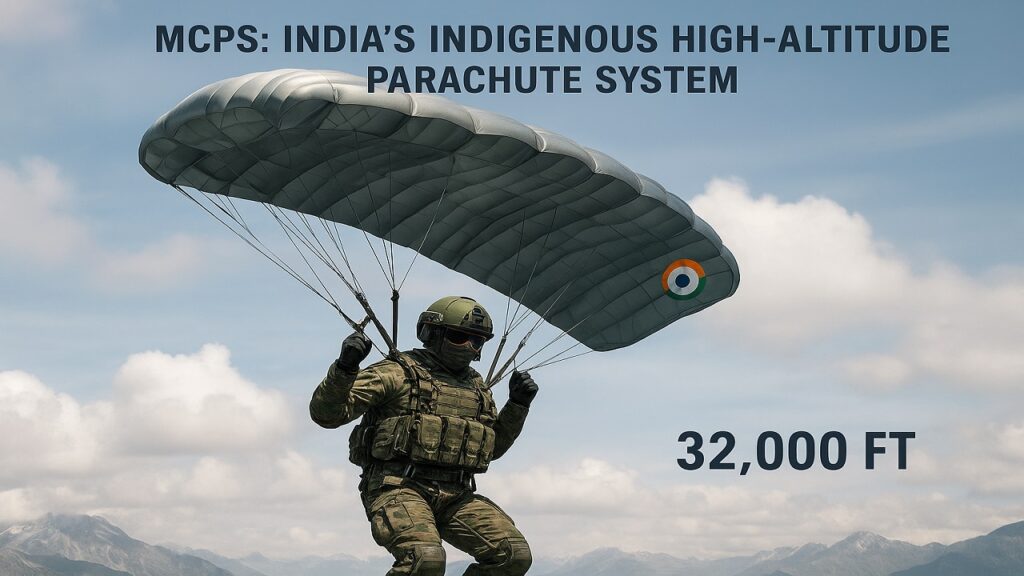
MCPS: India’s First High-Altitude Indigenous Parachute
Context:
- The Military Combat Parachute System (MCPS), indigenously developed by DRDO, was successfully tested at an altitude of 32,000 feet, making it the first Indian parachute system capable of deployment above 25,000 feet.
- This achievement highlights India’s progress in self-reliant defence technology and strengthens strategic autonomy in airborne operations.
1. What It Is:
- The MCPS is an advanced high-altitude military parachute system designed for combat freefall operations by special forces and paratroopers.
- It ensures safe, controlled, and precise landings from high altitudes during tactical missions in extreme conditions.
2. Developed By:
- Jointly developed by ADRDE (Aerial Delivery Research and Development Establishment), Agra and DEBEL (Defence Bioengineering and Electromedical Laboratory), Bengaluru.
3. Aim:
- To establish a fully indigenous, high-performance aerial delivery system.
- To enhance India’s strategic and operational autonomy by reducing reliance on imported parachutes for special operations.
4. Key Features:
- High-Altitude Capability: Operates efficiently above 25,000 ft, tested successfully at 32,000 ft — highest for any Indian system.
- Enhanced Safety: Features a lower rate of descent and superior steering control, ensuring stable and accurate landings.
- Navigation Compatibility: Integrated with NaVIC (Navigation with Indian Constellation) for precise geolocation without dependence on foreign satellites.
- Operational Flexibility: Allows pre-determined altitude deployment and accurate zone navigation under combat conditions.
- Maintenance Advantage: Quick turnaround and easy repairability, offering longer lifetime utility than imported systems.
Conclusion / Significance:
- Marks a major step in Atmanirbhar Bharat (self-reliance) in aerial delivery technology.
- Reduces strategic vulnerabilities by eliminating dependence on foreign suppliers for critical airborne combat gear.
- Strengthens the capabilities of Indian special forces, enabling safer, high-precision high-altitude operations.
Source : PIB