
Mental Healthcare in India: Progress, Gaps, and Future Directions
Context
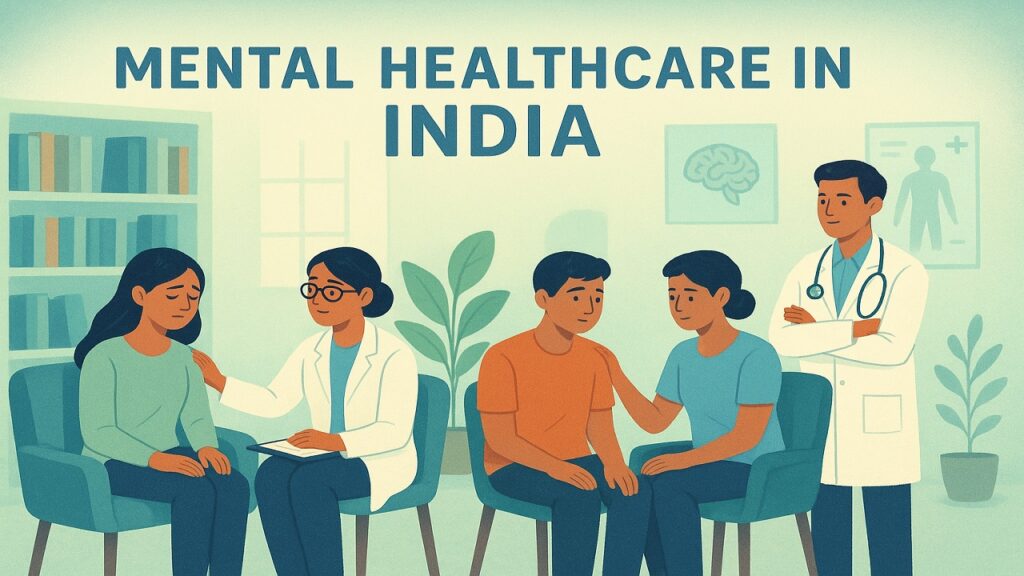
Recently, there has been a notable improvement in the mental health of people in India due to multiple initiatives and interventions undertaken by the Government of India. These efforts aim to enhance awareness, infrastructure, digital services, and policies to make mental healthcare more accessible, inclusive, and effective.
What is Mental Health?
- Definition: Mental health refers to an individual’s emotional, psychological, and social well-being.
- It influences how people think, feel, and act in daily life, affecting decision-making, stress management, and relationships.
- WHO Definition: Mental health is a state of well-being where individuals can cope with life’s stresses, realize their potential, work productively, learn effectively, and contribute to their community.
Impacts of Poor Mental Health
- Workplace Productivity: Leads to lower performance, absenteeism, and reduced efficiency.
- Social & Emotional Well-being: Affects relationships, self-confidence, and social interactions.
- Economic Impact: Untreated mental disorders contribute to a high global economic burden, according to WHO.
Mental Health Scenario in India
- Burden of Disease:
- 2443 DALYs per 10,000 population (WHO estimate).
- Age-adjusted suicide rate: 21.1 per 100,000 population.
- Prevalence:
- 10.6% of adults suffer from mental disorders (NMHS 2015-16).
- Lifetime prevalence: 13.7%.
- 15% of adults require intervention.
- Urban prevalence: 13.5%, Rural: 6.9%.
- Economic Loss: Estimated USD 1.03 trillion (2012–2030) due to mental health conditions.
- Treatment Gap: 70–92% do not receive care due to lack of awareness, stigma, and shortage of professionals.
- Mental Health Workforce: 0.75 psychiatrists per 100,000, WHO recommends 3 per 100,000.
Economic Survey 2024-25 Recommendations:
- Enhance Mental Health Education in Schools – Early intervention for anxiety, stress, and behavioral issues.
- Improve Workplace Mental Health Policies – Address job stress, long working hours, and burnout.
- Expand Digital Mental Health Services – Strengthen Tele MANAS and integrate AI-based solutions.
Mental Health Infrastructure in India
- Centres of Excellence: 25 centres sanctioned in 2024 under NMHP for advanced treatment and postgraduate training.
- PG Departments: 47 departments established/upgraded in 19 government medical colleges.
- AIIMS Integration: Mental health services introduced in 22 newly established AIIMS.
- Government Mental Hospitals: 47 institutions, including:
- NIMHANS, Bengaluru
- Lokopriya Gopinath Bordoloi Institute, Tezpur
- Central Institute of Psychiatry, Ranchi
- Health & Wellness Centres (HWCs):
- Integration under Ayushman Bharat.
- Upgraded 1.73 lakh SHCs and PHCs to Ayushman Arogya Mandirs.
- Provide basic counselling, psychiatric medications, physician training, and referral linkages.
This ensures community-based mental healthcare in both urban and rural areas.
Key Policies and Schemes
National Mental Health Programme (NMHP), 1982
- Integrates mental healthcare into general health systems.
- District Mental Health Programme (DMHP): Covers 767 districts, offering counselling, outpatient care, suicide prevention, and 10-bedded inpatient facilities.
NIMHANS Act, 2012
- Declared NIMHANS, Bengaluru as an Institute of National Importance.
- Expanded academic, research, and treatment capabilities.
Rights of Persons with Disabilities (RPwD) Act, 2016
- Expanded definition to include mental illness.
- Ensures legal protections, equality, and dignity.
- Aligns with UNCRPD.
Mental Healthcare Act, 2017
- Guarantees right to mental healthcare and protection of dignity.
- Introduced affordable care and decriminalized suicide.
National Health Policy, 2017
- Integrates mental healthcare into primary healthcare, improves human resources and treatment access.
- PHCs and HWCs provide psychological services under Ayushman Bharat.
iGOT-Diksha Collaboration
- Digital training for healthcare workers to enhance mental health capacity at the grassroots.
Tele MANAS (2022)
- 24/7 free helpline (14416 / 1800-89-14416) in 20 languages.
- Handled over 1.81 million calls since launch.
- Provides tele-counselling, referral support, awareness campaigns, and mobile interventions.
- Tele MANAS App (2024): Offers self-care tools and video consultations.
- Praised by WHO as a scalable solution.
KIRAN Helpline Integration
- Merged into Tele MANAS in 2022 for efficient, integrated mental health support.
COVID-19 Mental Health Interventions
- 24/7 helpline, online training, media awareness campaigns, and official guidelines supported mental well-being during the pandemic.
National Suicide Prevention Strategy (NSPS), 2022
- Goal: Reduce suicide mortality by 10% by 2030.
- Focuses on early intervention, crisis management, and mental health promotion.
- Targets students, farmers, and young adults.
Conclusion
Moving forward, India must:
- Strengthen awareness campaigns to reduce stigma.
- Expand workforce training in mental healthcare.
- Invest in digital solutions like Tele MANAS and AI-based tools.
A mentally healthier India is essential for individual well-being, economic growth, and national development, requiring a whole-of-society approach to make mental healthcare accessible, inclusive, and stigma-free.