
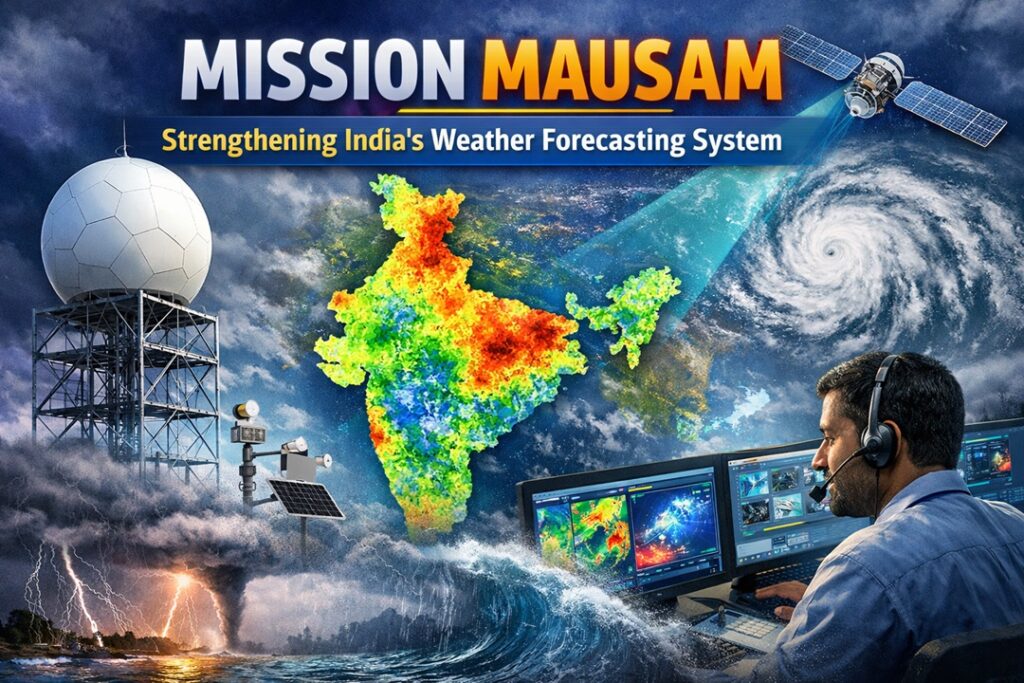
Mission Mausam: Strengthening India’s Weather Forecasting System
Context
Parliament was recently apprised of the progress made in implementing Mission Mausam, aimed at transforming India’s meteorological capabilities and service delivery.
Purpose
It seeks to upgrade meteorological infrastructure, enhance precision forecasting, and deliver impact-oriented weather advisories to citizens through timely and reliable alerts.
Scheme Nature
A fully Union-funded Central Sector initiative with 100% financial support from the Government of India.
Timeline
Initiated in November 2024 and formally dedicated to the nation by Prime Minister Narendra Modi on 14 January 2025, commemorating 150 years of IMD.
Administrative Framework
Lead Ministry – Ministry of Earth Sciences
Key Agencies Involved
- India Meteorological Department – Real-time forecasting
- National Centre for Medium Range Weather Forecasting – Medium-term modelling
- Indian Institute of Tropical Meteorology – Scientific research
- Indian Space Research Organisation – Satellite-based inputs
Geographical Reach
Covers entire India and adjoining regions, including polar research bases such as Maitri and Bharati in Antarctica.
Core Goals
- Achieve high-resolution forecasts (5 km × 5 km scale)
- Enhance prediction accuracy by 10–15%
- Promote impact-based and risk-centric warnings
- Enable last-mile connectivity, aiming for household-level access by 2030
Target Beneficiaries
Focused on vulnerable and weather-sensitive groups such as:
- Farmers
- Fisherfolk
- Populations in disaster-prone areas
Key Components
Observation Infrastructure
- Expansion of Doppler Weather Radars for rainfall and wind tracking
- Deployment of Radiosondes for upper-atmospheric data
- Advanced tools: Disdrometers, LiDAR, Radiometers
Computational Advancement
- Integration of High-Performance Computing systems (Pratyush & Mihir)
- Adoption of Artificial Intelligence and Machine Learning for predictive modelling
Forecasting Strategy
- Transition from traditional forecasts to impact-based and risk-informed alerts
Nowcasting Enhancement
- Increased frequency of short-term forecasts from 3-hour intervals to hourly updates
Information Dissemination
- Mobile platforms: Meghdoot (agriculture) and Damini (lightning alerts)
- Real-time alerts via SMS (Common Alerting Protocol)
- Satellite communication through ISRO
- Coordination with disaster management authorities
Source : PIB