
NASA Loses Contact with MAVEN Spacecraft
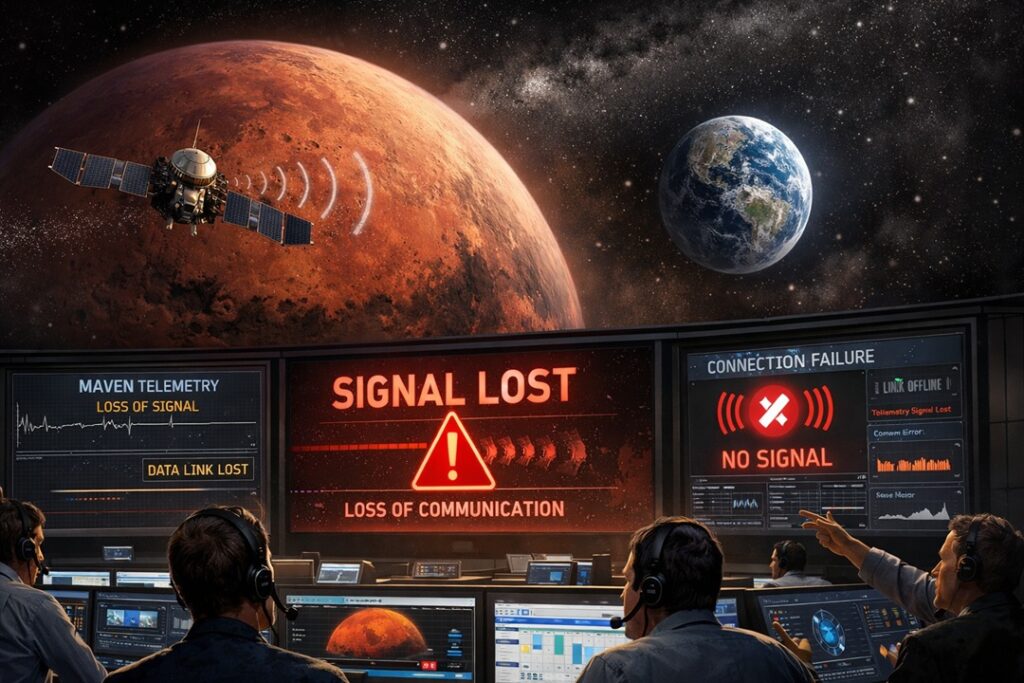
In early December 2025, NASA lost communication with the Mars Atmosphere and Volatile Evolution (MAVEN) spacecraft after it went silent following a routine communication blackout. MAVEN has been crucial in studying the Martian atmosphere and supporting surface missions.
About MAVEN Spacecraft
Mission Overview
- MAVEN is a NASA Mars orbiter mission focused on the upper atmosphere, ionosphere, and atmospheric escape processes of Mars.
- Launch date: November 18, 2013
- Objective: Understand how Mars transformed from a warm, wet planet to a cold, dry one
Mission Objectives
- Atmospheric Loss: Determine how and at what rate Mars lost its atmosphere
- Solar Influence: Study the role of the Sun and solar wind in atmospheric escape
- Support for Surface Missions: Act as a data relay satellite for rovers like Curiosity and Perseverance
Key Features of MAVEN
Orbiter Mission
- Follows a highly elliptical orbit sampling multiple altitudes to study daily, seasonal, and solar-driven atmospheric changes
Upper Atmosphere Focus
- Studies neutral gases, charged ions, solar wind, and magnetic fields in the region where atmospheric escape occurs
Scientific Instruments
- Equipped with eight specialized payloads including mass spectrometers and plasma sensors for detailed atmospheric analysis
Imaging Ultraviolet Spectrograph (IUVS)
- Maps the global structure and composition of Mars’ upper atmosphere in ultraviolet light
Communications Relay Role
- Functions as an interplanetary relay, transmitting data from surface rovers back to Earth
Highly Elliptical Orbit
- Allows close passes through the upper atmosphere and distant observations to enable vertical profiling of atmospheric processes
Major Discoveries and Contributions
Atmospheric Loss Quantified
- Confirmed that solar wind stripping has been a dominant mechanism removing Mars’ atmosphere over billions of years
Water Loss Pathways
- Showed how water vapor splits into hydrogen and oxygen, with lightweight hydrogen escaping irreversibly into space
Impact of Solar Storms
- Observed that solar flares and coronal mass ejections sharply increase atmospheric escape rates during extreme space-weather events
Conclusion
The MAVEN mission has been pivotal in understanding the evolution of Mars’ atmosphere, the role of solar wind, and water loss mechanisms. Losing contact with MAVEN represents a significant challenge for ongoing Martian atmospheric studies and data relay support for surface missions.
Source : The Hindu