
National Monetisation Pipeline 2.0: Scaling Asset Recycling for Infrastructure Financing
Context
The Union Government has announced National Monetisation Pipeline 2.0 (NMP 2.0) as a key initiative to augment infrastructure financing by systematically monetising existing public sector assets.
Programme Overview
NMP 2.0 represents the expanded continuation of India’s asset monetisation drive, offering a medium-term operational framework for leveraging functional public infrastructure assets. The programme focuses on converting brownfield assets into financial resources to support fresh infrastructure investments.
Policy Architecture
The framework has been prepared by NITI Aayog in consultation with sectoral infrastructure ministries. Overall execution is anchored in the Ministry of Finance, with strategic supervision by the Core Group of Secretaries on Asset Monetisation.
Strategic Intent
- Resource Mobilisation: Generate non-debt capital for infrastructure expansion through structured asset recycling.
- Investment Certainty: Improve transparency and pipeline visibility to attract sustained private participation.
Operational Design
- Estimated Value: Asset monetisation potential of ₹16.72 lakh crore during FY 2026–2030, with nearly ₹5.8 lakh crore expected from private investment.
- Reference Framework: Serves as a guiding document outlining timelines, modalities and sector-wise priorities.
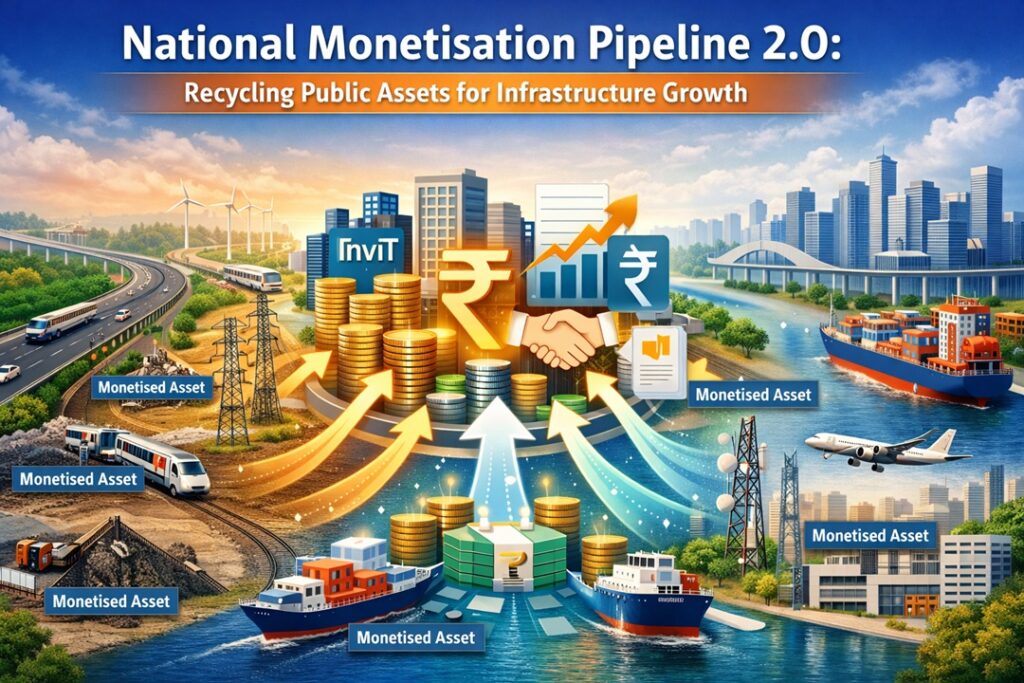
- Transaction Structures: Deployment of PPP-based concessions, InvIT platforms, revenue securitisation, strategic bidding and selective equity dilution.
- Use of Proceeds: Funds flow into the Consolidated Fund of India, respective PSUs, State Consolidated Funds, or are reinvested via private channels.
- Sectoral Outreach: Covers transport, energy, logistics, mining, telecom, aviation, tourism and urban infrastructure.
- Process Rationalisation: Emphasis on simplified procedures and predictable timelines, drawing from NMP 1.0 experience.
- Oversight Mechanism: Periodic review by a high-level inter-ministerial committee chaired by the Cabinet Secretary.
Major Contributing Sectors (FY 2026–30)
- Roads, MMLPs & Ropeways: 26% (₹4.42 lakh crore)
- Power Sector: 17% (₹2.76 lakh crore)
- Rail Infrastructure: 16% (₹2.62 lakh crore)
- Ports: 16% (₹2.63 lakh crore)
- Coal Assets: 13% (₹2.16 lakh crore)
Why it Matters
- Infrastructure Financing: Enables sustained funding for new projects without escalating public debt.
- Budgetary Relief: Lowers pressure on direct government CAPEX.
- PPP Strengthening: Enhances the role of long-term private and institutional investors.
Source : PIB