
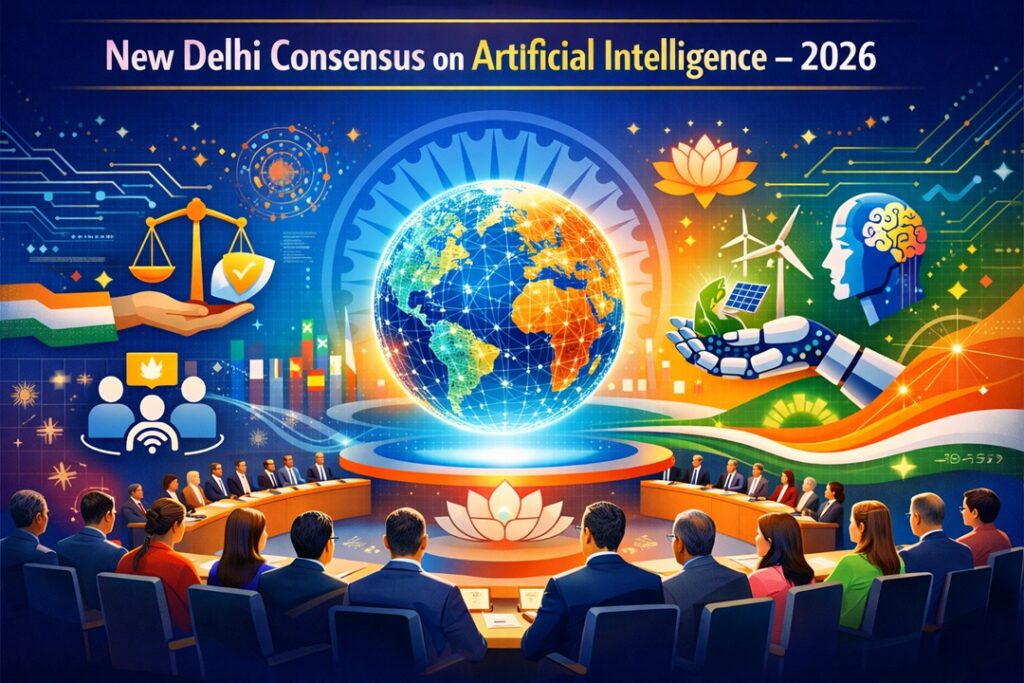
New Delhi Consensus on Artificial Intelligence – 2026
Context
The Global AI Impact Summit hosted in New Delhi concluded with participation from 89 countries and several international institutions, resulting in the adoption of the New Delhi Consensus on Artificial Intelligence.
The consensus articulates a shared international vision for inclusive, ethical, and development-oriented governance of Artificial Intelligence.
New Delhi Consensus on Artificial Intelligence – 2026
Nature of the Agreement:
The New Delhi Consensus is a multilateral understanding providing guiding principles for the responsible design, deployment, and regulation of Artificial Intelligence systems.
Anchored in the Indian philosophy of Sarvajan Hitaya, Sarvajan Sukhaya, it functions as a voluntary framework for global coordination on AI governance.
Core Objective:
The agreement seeks to reduce global disparities in AI access by promoting equitable distribution of critical AI enablers such as data, computational infrastructure, and innovation capabilities for shared economic and social progress.
Salient Provisions
Seven-Dimension Governance Architecture:
The framework is structured around seven interlinked dimensions covering inclusive access, AI safety, skills development, scientific advancement, and system resilience.
Shared Global AI Platforms:
The consensus proposes collaborative mechanisms such as the Global AI Impact Commons, Trusted AI Commons, and an AI for Societal Transformation Platform to encourage cross-border learning and cooperation.
Global AI Impact Commons:
A voluntary, opt-in platform enabling countries to exchange successful AI applications and replicate high-impact use-cases across regions and sectors.
Trusted AI Commons:
A non-binding global repository of AI benchmarks, governance templates, technical tools, and best practices aimed at strengthening trustworthy AI adoption.
International AI for Science Consortium:
A global network connecting scientific and research institutions to share AI infrastructure, datasets, and expertise, accelerating AI-driven scientific discoveries.
Equitable AI Access Charter:
Promotes affordable and widespread access to foundational AI technologies while supporting locally relevant innovation ecosystems.
Safe and Accountable AI Systems:
Encourages voluntary adherence to safety standards, performance benchmarks, and ethical design principles for responsible AI deployment.
Future-ready Workforce Strategy:
Introduces guiding frameworks for AI skill development, workforce transition, and large-scale reskilling in emerging digital economies.
Sustainable AI Infrastructure:
Highlights the importance of energy-efficient, resource-conscious, and climate-resilient AI systems.
Respect for National Autonomy:
Advocates a cooperative, multistakeholder approach that respects national sovereignty and domestic policy frameworks.
Source : PIB