
New Labour Codes: Ensuring Health, Safety and Dignity of Workers
Context
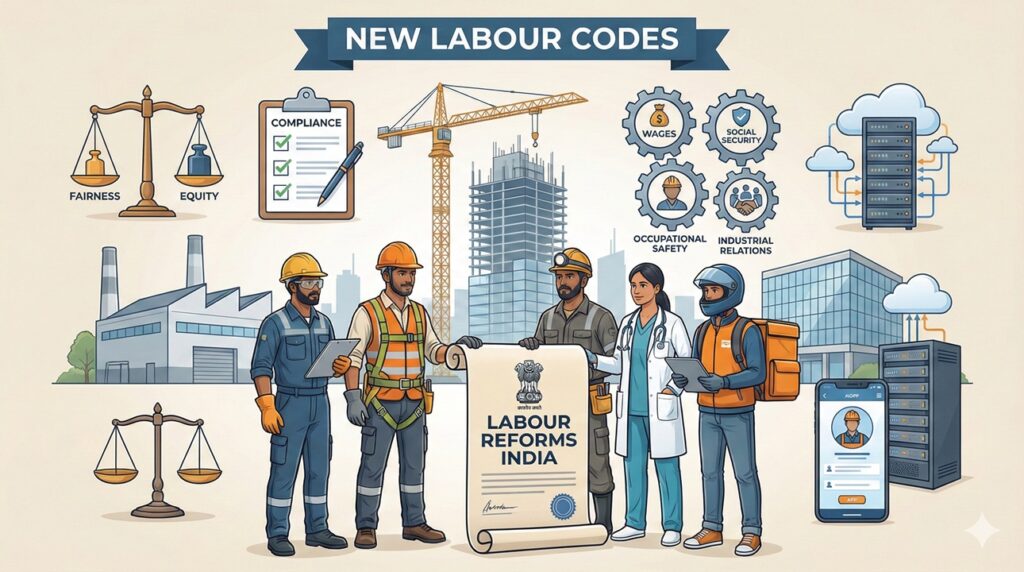
The Government of India has initiated a comprehensive labour law reform by consolidating 29 Central labour laws into four Labour Codes. Among these, the Occupational Safety, Health and Working Conditions Code, 2020 (OSH&WC Code) is particularly significant for workers employed in hazardous industries. These sectors, including mining, petroleum, metallurgy, chemicals, and heavy manufacturing, are vital to India’s economic growth but expose workers to serious chemical, physical, and biological risks. The new framework seeks to address long-standing gaps in safety, health protection, and social security.
Need for Regulation
Workers in hazardous industries often operate in high-risk environments with exposure to toxic substances, extreme temperatures, and unsafe machinery. Earlier, fragmented and outdated laws resulted in weak enforcement, poor emergency preparedness, and limited health monitoring. Recognising the need for a future-ready, preventive, and uniform safety architecture, the government introduced the new Labour Codes.
Overview of the New Labour Codes
The labour law reform consolidates 29 Central laws into four Codes:
Labour Code on Wages, 2019
Industrial Relations Code, 2020
Social Security Code, 2020
Occupational Safety, Health and Working Conditions Code, 2020
The OSH&WC Code, 2020 establishes an integrated safety framework based on prevention, risk assessment, and accountability.
Objectives of the OSH&WC Code
The Code aims to strengthen safety standards, ensure risk mitigation, and enhance employer responsibility, while simplifying compliance for enterprises.
It seeks to guarantee safer workplaces, stronger legal protections, and dignified working conditions for workers engaged in hazardous processes.
Key Provisions and Benefits for Workers
Safety Standards
The Code prescribes uniform national standards for the use, handling, storage, and transport of hazardous substances. Employers must carry out risk assessments, obtain prior approvals, and maintain emergency response mechanisms.
Health and Medical Protection
Mandatory pre-employment, periodic, and post-exposure medical examinations are introduced.
All workers are entitled to a free annual health check-up.
Health records are to be digitised and portable, improving transparency and long-term tracking of occupational diseases.
Protective and Welfare Measures
Employers are required to provide and maintain personal protective equipment (PPE) such as helmets, gloves, respirators, and goggles.
Improved sanitation and welfare facilities are mandated, including canteens, rest shelters, washing facilities, first aid, ambulance rooms, and cooling areas in high-temperature workplaces.
Working hours are capped at 8 hours per day and 48 hours per week.
Training and Awareness
Mandatory training on the safe handling, storage, transport, and disposal of hazardous materials is introduced to ensure uniform safety awareness across industries.
Social Security Coverage
Under the Social Security Code, 2020, workers are assured immediate compensation for occupational accidents and diseases through ESIC.
Benefits include medical care, injury and disability compensation, dependents’ benefits, provident fund, gratuity, maternity benefits, and old-age pension, supported by digital and portable records.
Special Rights and Protections
Workers are explicitly granted the right to refuse dangerous work likely to cause serious injury or death, without fear of penalty, subject to employer investigation.
Pregnant women and adolescents are strictly prohibited from hazardous processes, and safety supervision for women workers is mandatory in permitted tasks.
Comparative Perspective: Earlier Laws vs New Labour Codes
Legal Framework
Earlier, occupational safety was governed by fragmented laws such as the Factories Act, Mines Act, Dock Workers Act, and BOCW Act, each with separate definitions and standards.
The OSH&WC Code now provides uniform definitions and a national framework for occupational safety and health.
Identification of Hazardous Processes
Previously, multiple lists under different laws led to inconsistent enforcement.
The new Code contains a consolidated Schedule of hazardous processes, including asbestos, toxic chemicals, pesticides, and radioactive materials, with mandatory risk assessment and prior intimation.
Emergency and Disaster Preparedness
Earlier systems lacked a unified emergency response mechanism.
The Code mandates on-site emergency plans, six-monthly mock drills, and coordination with local Disaster Management Authorities.
Inspection and Enforcement
Multiple inspectorates with overlapping jurisdictions have been replaced by a unified Inspector-cum-Facilitator system, supported by risk-based digital inspections, joint audits, and stringent penalties.
Way Forward
The new Labour Codes represent a decisive shift towards safer, fairer, and more accountable workplaces, especially in hazardous sectors. By integrating strong safety standards, comprehensive social security, welfare facilities, and emergency preparedness, India is progressing towards a labour ecosystem where worker safety and dignity are guaranteed rights, aligning with the vision of Shramev Jayate and a productive, inclusive, future-ready economy.
Source : PIB