
Nuclear Energy and India’s Long-Term Energy Transition
Context
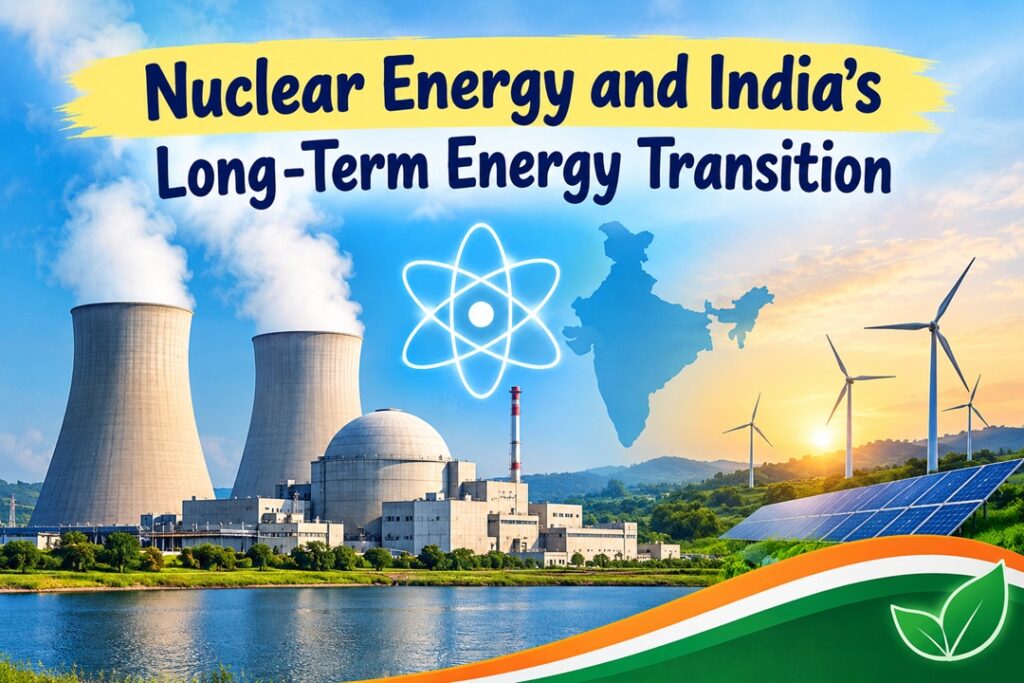
India’s rising electricity demand, climate commitments and the need for reliable low-carbon power have increased the importance of nuclear energy in the country’s long-term energy strategy. India’s nuclear programme is also closely linked with its efforts towards energy security, technological self-reliance and greater use of domestic thorium resources.
Nuclear Energy and Its Significance
Nuclear power generates electricity through controlled nuclear fission. The heat released during fission converts water into steam, which drives turbines connected to generators. Multiple engineered safety barriers and regulatory mechanisms are used throughout the process.
Nuclear fuel may be fissile, capable of sustaining a chain reaction directly, or fertile, which can be converted into fissile material. Globally, Light Water Reactors commonly use Low-Enriched Uranium (LEU), while India predominantly relies on natural uranium in Pressurised Heavy Water Reactors (PHWRs). India also uses Mixed Oxide (MOX) fuel in its Prototype Fast Breeder Reactor (PFBR).
India has relatively limited uranium resources but possesses substantial thorium reserves. Thorium-232 is fertile and can be converted into fissile Uranium-233 inside a reactor. This resource profile forms the basis of India’s distinctive three-stage nuclear programme.
Nuclear power can support India’s energy transition in several ways:
- It provides dependable baseload electricity for industries, hospitals, railways, communication networks and other essential services.
- Its operational greenhouse-gas emissions are low, supporting India’s long-term climate objectives.
- It can reduce dependence on imported fossil fuels and strengthen energy security.
- Nuclear plants have high power-generation capacity relative to their land requirements.
- Expansion of the sector can promote domestic manufacturing, engineering, research and specialised employment.
- Nuclear generation can complement variable renewable sources such as solar and wind, contributing to grid stability.
India’s Nuclear Power Status
India currently operates 24 nuclear reactors with an installed capacity of 8.78 GW. Nine additional reactors, totalling 7.5 GW, are under construction. The government has also approved 10 indigenous PHWRs in fleet mode and initiated pre-project activities for two 500 MW Fast Breeder Reactors.
The Nuclear Energy Mission announced in the Union Budget 2025–26 and the SHANTI Act, 2025, are intended to support capacity expansion, indigenous technology, manufacturing and wider participation in the nuclear sector. India has set a target of achieving 100 GW of nuclear capacity by 2047.
India’s Three-Stage Nuclear Programme
India’s nuclear strategy is designed around its limited uranium resources and substantial thorium availability.
Stage I – PHWRs:
Natural uranium is used in PHWRs, with heavy water serving as moderator and coolant. The spent fuel contains plutonium, which can be recovered through reprocessing for use in the next stage.
Stage II – Fast Breeder Reactors:
Fast Breeder Reactors use plutonium-based fuel and are designed to generate electricity while producing additional fissile material. The PFBR at Kalpakkam attained first criticality in April 2026. Developed under IGCAR leadership with extensive Indian industrial participation, nearly 90% of its equipment and systems were domestically manufactured.
Stage III – Thorium-Based Reactors:
The final stage seeks to utilise India’s abundant thorium-232. After absorbing a neutron, thorium can ultimately be converted into Uranium-233, which is fissile. Progress in the first two stages therefore provides the technological foundation for eventually expanding thorium utilisation.
Small Modular Reactors: An Emerging Opportunity
India is also exploring Small Modular Reactors (SMRs), generally designed with capacities of up to 300 MWe. Their modular approach could support standardisation and potentially reduce construction time.
The Nuclear Energy Mission provides ₹20,000 crore for research, design, development and deployment of indigenous SMRs. Technologies under development include the 220 MWe Bharat Small Modular Reactor, the 55 MWe SMR-55 and a High-Temperature Gas-Cooled Reactor. Besides grid electricity, SMRs could serve remote regions, replace retiring coal plants, provide industrial heat and support hydrogen production.
Challenges
Despite its potential, nuclear expansion faces several constraints. Nuclear projects require substantial initial investment and long construction periods, while delays can considerably increase costs. India also needs sustained investment in research, skilled manpower and domestic manufacturing.
Radioactive waste management and nuclear safety require strong institutions and continued public confidence. Expansion will also depend on secure nuclear-fuel supplies and resilient supply chains. At the system level, nuclear power needs to be coordinated with renewable energy, storage and modern transmission infrastructure rather than developed independently.
Way Forward
India should pursue nuclear and renewable energy as complementary components of a diversified low-carbon electricity system. Accelerating indigenous PHWR deployment, advancing breeder technology, continuing research on thorium-based systems and developing SMRs can strengthen the nuclear ecosystem.
This expansion should be accompanied by greater investment in R&D, skilled human resources and domestic manufacturing, along with appropriate regulatory reforms. Above all, nuclear development must retain a strong focus on safety, transparent risk communication, effective emergency preparedness and public confidence.
Conclusion
India’s proposed expansion to 100 GW of nuclear capacity by 2047 reflects the role nuclear power can play alongside renewables in meeting rising electricity demand while pursuing lower-carbon growth. A combination of indigenous technology, strong safety institutions, scientific innovation and responsible regulation can help nuclear energy contribute to a more secure and self-reliant energy system.
Source : PIB