
PAC Flags Implementation Gaps in SANKALP Skill Development Programme
Context
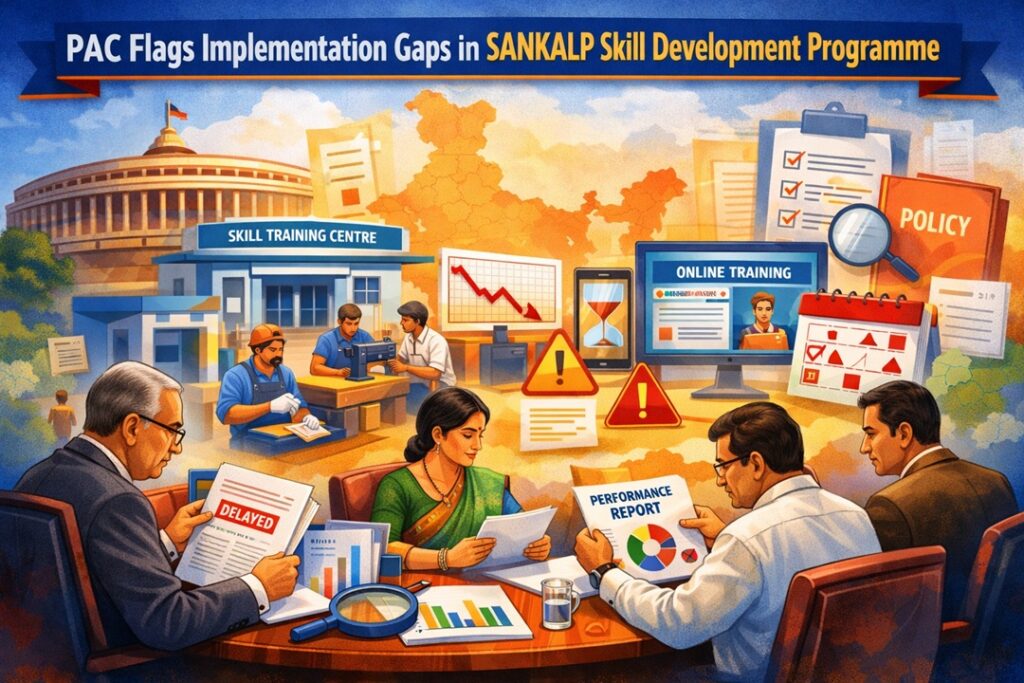
The Public Accounts Committee (PAC) has raised concerns over the slow and uneven implementation of the SANKALP programme, citing administrative delays, weak outcome tracking and inadequate monitoring mechanisms.
SANKALP Programme at a Glance
Programme overview: SANKALP (Skill Acquisition and Knowledge Awareness for Livelihood Promotion) is a national skill reform initiative aimed at enhancing the effectiveness, relevance and credibility of short-term skill training in India. The programme focuses on institutional capacity building, industry alignment and social inclusion.
Timeline: The programme was launched on 19 January 2018. It was originally scheduled to conclude in March 2023 but has since been extended.
Administrative framework: The scheme is administered by the Ministry of Skill Development and Entrepreneurship (MSDE) with financial assistance from the World Bank. Implementation is undertaken in collaboration with State governments and industry partners.
Core objectives:
Strengthening training ecosystems: To improve governance structures, institutional capacity and quality assurance in short-term skill development.
Expanding employability access: To increase livelihood opportunities for disadvantaged and under-represented sections through targeted skilling interventions.
Major components
Funding architecture: The programme has a total financial outlay of ₹4,455 crore, supported by multilateral funding to enable systemic reforms in the skilling ecosystem.
Capacity enhancement: Emphasis on strengthening the administrative and operational capabilities of skill institutions at national, state and district levels.
Standards and evaluation: Introduction of performance benchmarks, assessment norms and monitoring tools aligned with labour market requirements.
Market linkage: Promotion of structured partnerships with industry to ensure demand-driven training and improved employment outcomes.
Equity orientation: Focus on inclusion of marginalised groups to address regional and social disparities in access to skills.
Outcome-based monitoring: Adoption of results frameworks and performance-linked indicators to track progress and link fund release with outcomes.
Source : TH