
Pennaiyar River Dispute: Supreme Court Orders Inter-State Tribunal
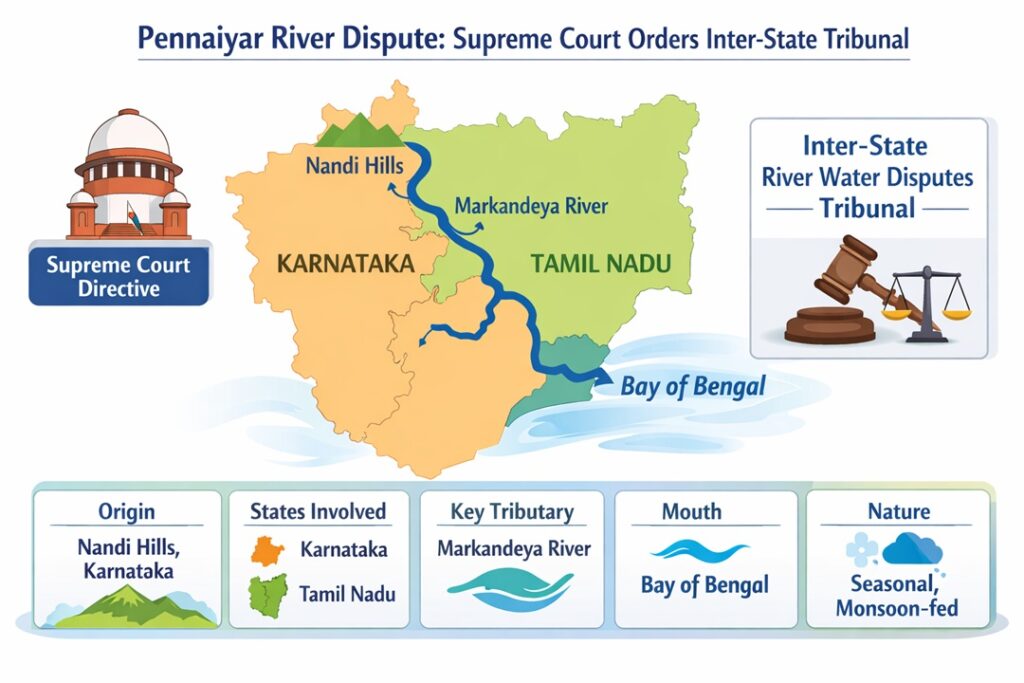
Context
The Supreme Court of India has instructed the Union Government to set up an Inter-State River Water Disputes Tribunal within a month to address the long-pending Pennaiyar river water conflict between Tamil Nadu and Karnataka.
Judicial Route
The direction followed an original suit filed by Tamil Nadu under Article 131 of the Constitution, seeking recourse under the Inter-State River Water Disputes Act, 1956.
Pennaiyar (Thenpennai / Ponnaiyar / Dakshina Pinakini) River: Key Facts
River Profile: An important eastward-draining inter-state river of southern India, crucial for agriculture, industry, and domestic water supply.
Source Region: Emerges from the Nandi Hills in Chikkaballapura district, Karnataka, associated with the Eastern Ghats physiographic system.
Basin Sharing States:
- Karnataka – Upstream state
- Tamil Nadu – Downstream state
(Higher dependence of Tamil Nadu heightens concerns over assured downstream flows.)
Important Tributaries: Markandeya River, Varaha Nadhi, Pambar River, Pampar River
(Dispute largely revolves around the Markandeya sub-basin.)
Outfall: Enters the Bay of Bengal near Cuddalore, forming a small deltaic region.
River Extent: Approximately 497 km long; among the longest rivers in Tamil Nadu.
Flow Regime: Predominantly monsoon-fed (South-West and North-East monsoons).
Major Storage Structures: Krishnagiri Dam, Kelavarapalli Dam, Sathanur Dam (largest reservoir; ~7.3 TMC).
Socio-Economic Role: Irrigation lifeline for parts of Karnataka (Chikkaballapura, Kolar, Bengaluru Rural/Urban) and Tamil Nadu (Krishnagiri, Dharmapuri, Tiruvannamalai, Villupuram, Cuddalore).
Ecological Challenges: Industrial effluents, excessive sand extraction, and progressive reduction in perennial flow.
Heritage Value: References in Sangam-era works and Tevaram hymns; several historic temples situated along its banks.
Source : DH