
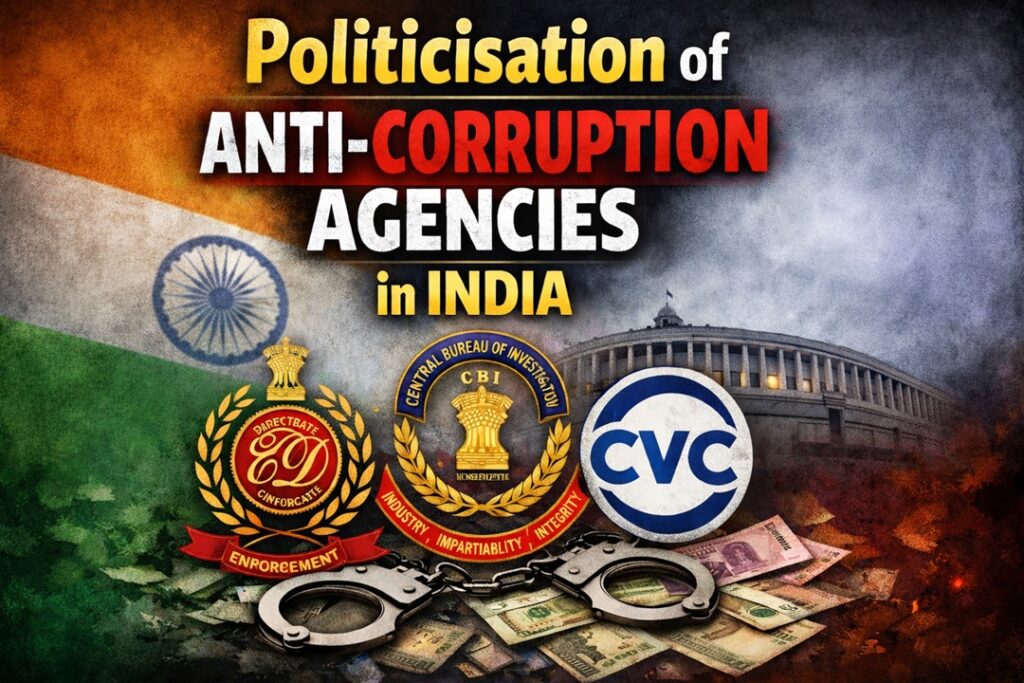
Politicisation of Anti-Corruption Agencies in India
Context
The recent collapse of the Delhi excise policy corruption case, where a trial court refused to frame charges due to lack of prima facie evidence, has raised serious concerns regarding the credibility and neutrality of anti-corruption agencies.
Understanding Anti-Graft Institutions
Anti-corruption institutions are specialized mechanisms aimed at preventing, detecting, and prosecuting corruption across sectors. In India, key bodies include:
- Central Bureau of Investigation (CBI): Handles major corruption and economic offences.
- Enforcement Directorate (ED): Investigates money laundering and foreign exchange violations.
- Central Vigilance Commission (CVC): Supervises vigilance administration in central government institutions.
- Lokpal of India / Lokayuktas: Address corruption complaints against public officials.
Drivers of Institutional Bias
- Politically Influenced Case Initiation: Investigations may begin under political pressure rather than evidentiary merit.
Illustration: The Delhi excise case collapsed early despite prolonged public narrative building. - Executive Control Over Agencies: Structural dependence reduces autonomy and weakens credibility.
Illustration: Arrests of leaders like Arvind Kejriwal and Manish Sisodia influenced political discourse before trial. - Criminal Law as Political Instrument: Legal processes are perceived as tools for electoral advantage.
Illustration: High-profile arrests often coincide with election cycles. - Weak Evidence-Based Prosecution: Heavy reliance on assumptions rather than financial proof.
Illustration: Failure to establish conspiracy or bribery in the excise case.
Consequences for Governance
- Credibility Deficit: Frequent case collapses erode trust in investigative institutions.
- Public Distrust: Repeated allegations without convictions deepen cynicism toward governance systems.
- Individual Hardship: Prolonged detention and reputational damage occur even before guilt is proven.
- Resource Diversion: Focus on weak cases reduces attention to genuine economic and governance priorities.
Barriers in Addressing Politicisation
- Complex Nature of Corruption: Modern corruption operates through indirect channels like shell firms and regulatory favours.
- Judicial Prudence in Policy Matters: Courts avoid criminalising policy decisions without clear mala fide intent.
Reference: Supreme Court of India maintains high evidentiary standards. - Limited Technical Expertise: Agencies often lack advanced forensic and financial investigation tools.
- Inter-Agency Fragmentation: Poor coordination between bodies like CBI and ED hampers efficiency.
Reform Imperatives
- Enhance Forensic Investigation: Adopt data analytics and forensic accounting to track illicit financial flows.
- Ensure Operational Autonomy: Shield agencies from political interference in case registration and prosecution.
- Strict Evidentiary Thresholds: Align investigations with judicial standards of proof.
- Promote Political Restraint: Avoid misuse of criminal law for partisan competition.
- Integrated Investigative Framework: Foster coordination and specialization on lines of global best practices.
Conclusion
The Delhi excise case episode underscores the dangers of prioritising political narratives over evidentiary rigor. Restoring institutional credibility requires a decisive shift toward independent, forensic-driven investigations where the rule of law prevails over political expediency.
Source : The Hindu