
Protecting the Great Indian Bustard Amid Renewable Energy Infrastructure
Context
The Supreme Court has strengthened conservation safeguards for the Critically Endangered Great Indian Bustard GIB while allowing revised transmission alignments under the Green Energy Corridor GEC in Rajasthan and Gujarat, aiming to balance biodiversity protection with renewable energy expansion.
Great Indian Bustard GIB Overview
Identity
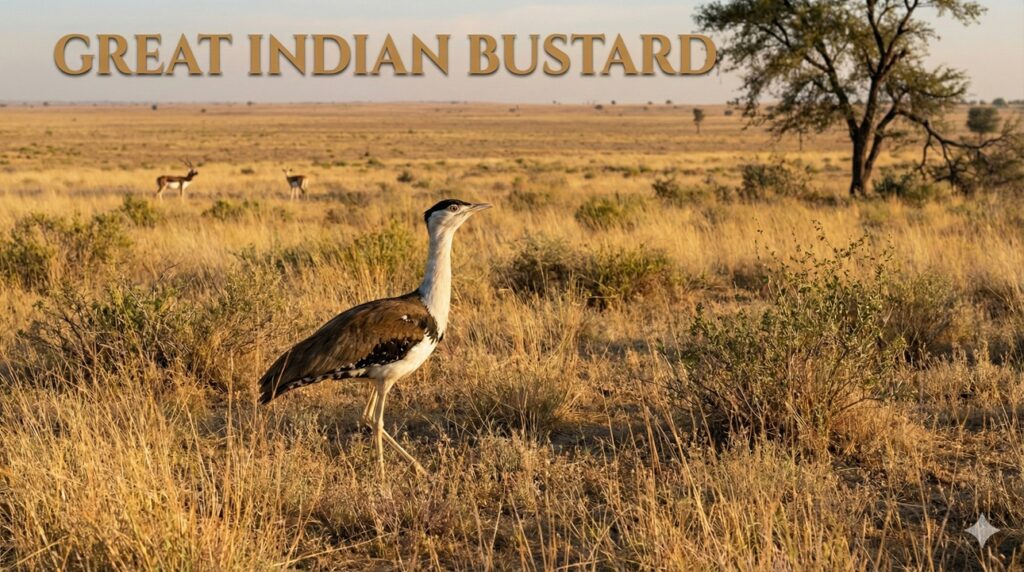
The Great Indian Bustard Ardeotis nigriceps is one of the heaviest flying birds in the world and the state bird of Rajasthan. It is a flagship grassland species and an indicator of arid and semi arid ecosystem health.
Conservation Status
Global Status
IUCN Red List status is Critically Endangered.
Legal Protection
Listed under Schedule I of the Wildlife Protection Act 1972 providing the highest level of protection.
International Protection
Included in CITES Appendix I and listed under the CMS Bonn Convention.
Population
Estimated global population is around 200 individuals.
Habitat and Distribution
Preferred Habitat
Inhabits open flat grasslands and scrub landscapes with minimal disturbance.
Geographical Spread
Earlier found across 11 Indian states and parts of Pakistan.
Present Distribution
Now largely confined to Rajasthan and Gujarat with small pockets in Maharashtra Karnataka and Andhra Pradesh.
Key Habitat
Major stronghold includes Desert National Park and surrounding agro grassland mosaics.
Key Characteristics and Threats
Physical Features
Tall bird of about 1 metre height with brownish body and black crown in males.
Flight Capacity
Wingspan ranges from 210 to 250 cm and weight from 15 to 18 kg.
Breeding Behaviour
A ground nesting species laying a single egg during the monsoon.
Major Threats
High mortality due to overhead power lines, habitat fragmentation, vehicular collisions and free ranging dogs.
Green Energy Corridor GEC
Concept
The Green Energy Corridor is a national transmission programme to evacuate large scale solar and wind energy from generation zones to state and national grids.
Strategic Importance
Crucial for achieving India’s renewable energy targets and ensuring grid integration of renewable power.
Geographical Focus
Primarily located in renewable rich states like Rajasthan and Gujarat, especially desert and wind solar regions overlapping with GIB habitats.
Conclusion
The Supreme Court’s intervention highlights the need for ecologically sensitive renewable infrastructure planning, ensuring that clean energy transition does not come at the cost of irreversible biodiversity loss, particularly of species like the Great Indian Bustard.
Source : Down To Earth