
Prototype Fast Breeder Reactor (PFBR) and India’s Nuclear Leap
Context
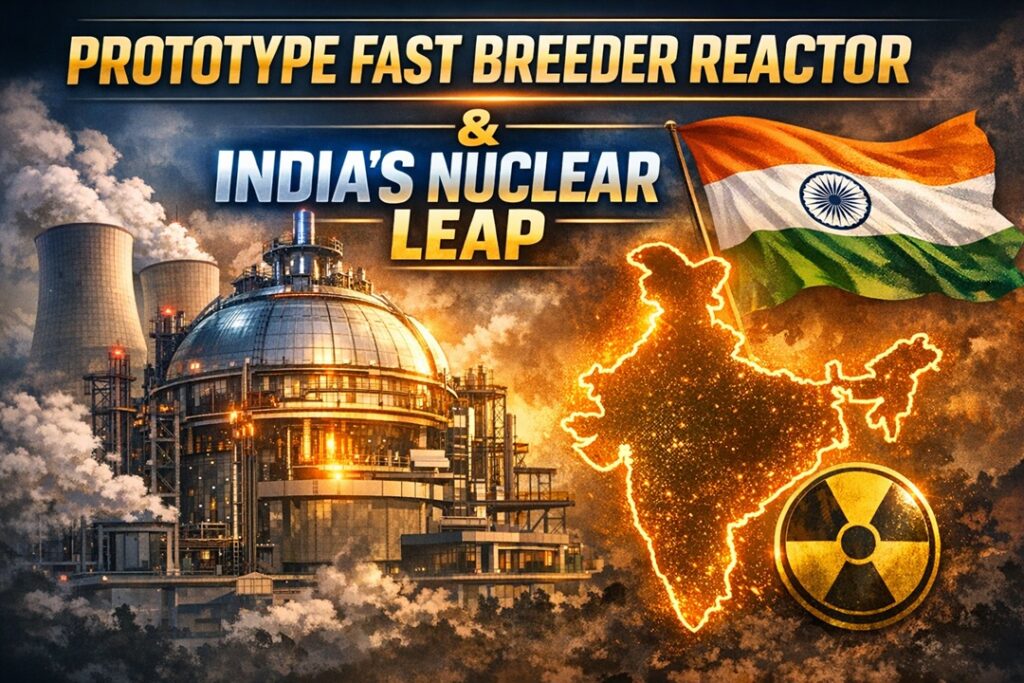
India marked a crucial advancement in its nuclear power roadmap as the Prototype Fast Breeder Reactor (PFBR) at Kalpakkam reached the stage of criticality, signalling the start of sustained nuclear chain reactions.
Understanding Fast Breeder Reactor Technology
Conceptual Overview
A Fast Breeder Reactor (FBR) is an advanced nuclear system that produces more fissile fuel than it consumes by using high-energy neutrons. It primarily relies on plutonium-based fuel and converts non-fissile uranium into usable fuel.
Core Characteristics
- Uses fast neutrons instead of moderated (slow) neutrons.
- Employs plutonium-239 as the main fuel.
- Includes a uranium-238 blanket to generate additional fuel.
- Designed for fuel multiplication and sustainability.
Strategic Importance for India
Link in Nuclear Roadmap
FBRs form the second stage of India’s three-stage nuclear programme, enabling transition toward thorium-based reactors.
Energy Resource Optimization
- India has limited uranium but abundant thorium reserves.
- FBRs help convert available materials into long-term fuel sources.
Improved Fuel Efficiency
- Higher fuel burn-up (~10%) compared to conventional reactors (~1%).
- Ensures better utilization of nuclear materials.
Waste-to-Resource Conversion
- Reuses plutonium and depleted uranium from earlier stages.
- Reduces nuclear waste burden.
Towards Energy Independence
- Supports a closed fuel cycle, reducing reliance on imports.
Operational Mechanism
Fuel Core Composition
The reactor core contains plutonium-based mixed oxide fuel.
Breeding Process
- Surrounding uranium-238 absorbs fast neutrons.
- Converts into plutonium-239 through nuclear reactions.
Neutron Dynamics
Absence of moderators allows fast neutron reactions, enabling breeding.
Coolant System
Liquid sodium is used as coolant due to:
- High thermal conductivity
- Operation at atmospheric pressure
Key Challenges
Technical Risks
- Sodium coolant is highly reactive with air and water.
- Requires advanced safety and leak-proof systems.
Cost Constraints
- High capital and operational expenditure.
- Less competitive compared to conventional reactors.
Fuel Cycle Limitations
- Need for robust reprocessing and fabrication facilities.
Project Delays
- Significant time and cost overruns since inception.
Regulatory Preparedness
- Lack of globally standardized frameworks for breeder reactors.
Future Course of Action
Testing Phase
- Gradual low-power operations to assess reactor behavior.
Performance Assessment
- Data-driven refinement of safety and efficiency systems.
Regulatory Approval
- Certification by Atomic Energy Regulatory Board for full-scale operations.
Fuel Cycle Development
- Expansion of reprocessing infrastructure by the Department of Atomic Energy.
Expansion Strategy
- Planning additional breeder reactors to scale up nuclear capacity.
Conclusion
The PFBR’s criticality marks a transformative step in India’s nuclear journey, aligning with Homi Jehangir Bhabha’s vision of long-term energy security. While technological and economic challenges persist, its success strengthens the foundation for a self-reliant, thorium-based nuclear future.
Source : The Hindu