
PSLV-C62 Failure: Concerns over ISRO’s Workhorse Launcher
Context:
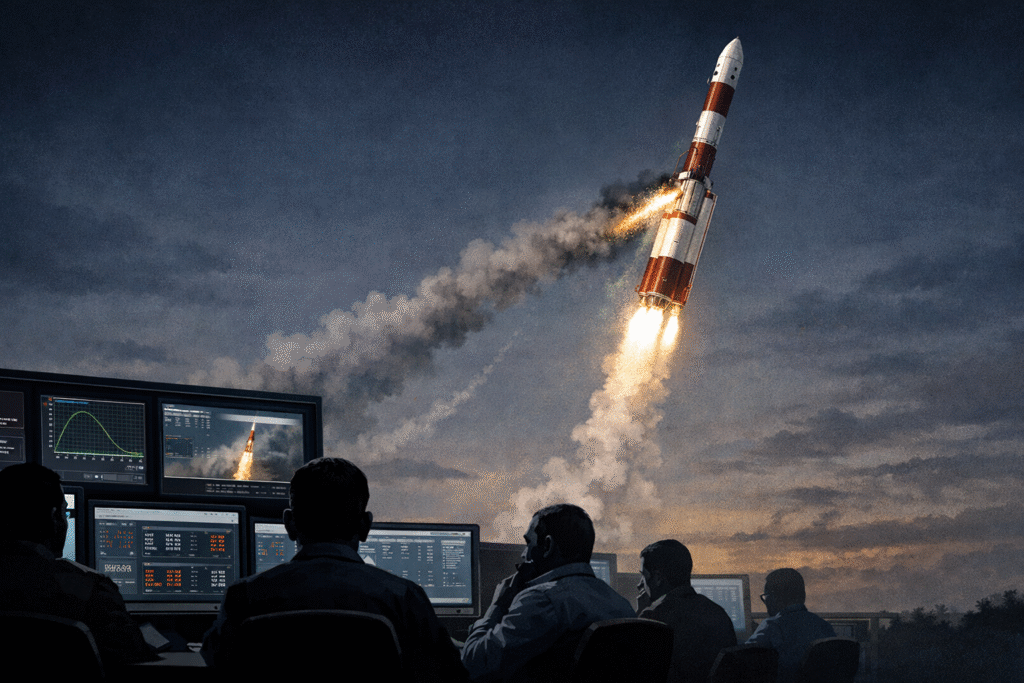
ISRO’s PSLV-C62 mission failed due to an anomaly in the third stage (PS3), marking the second consecutive PSLV failure after PSLV-C61 (May 2025), raising concerns over the reliability of India’s workhorse launch vehicle.
What is PSLV?
- The Polar Satellite Launch Vehicle (PSLV) is India’s third-generation orbital launch vehicle.
- Primarily designed for Polar and Sun-Synchronous Orbits (SSO).
- Globally recognised as ISRO’s workhorse rocket.
Developed by:
- Designed, developed and operated by ISRO.
- Key centres involved: Vikram Sarabhai Space Centre (VSSC) and Liquid Propulsion Systems Centre (LPSC).
Key Stages of PSLV:
- PS1 – First Stage (Lift-off):
- Solid motor S139 with strap-on boosters
- Fuel: HTPB
- Provides initial thrust to overcome gravity and dense atmosphere
- PS2 – Second Stage (Control):
- Vikas liquid engine
- Fuel: UDMH + Nitrogen Tetroxide
- Ensures controlled thrust and trajectory stability
- PS3 – Third Stage (High-speed booster):
- Solid motor S7
- Fuel: HTPB
- Provides major velocity gain to reach near-orbital speed
- PS4 – Fourth Stage (Precision):
- Twin liquid engines
- Fuel: MMH + MON
- Enables precise orbital insertion and fine adjustments
Functions of PSLV:
- Launches Earth observation, navigation and communication satellites.
- Places payloads in LEO, Polar Orbit and GTO.
- Supports strategic, scientific and commercial missions.
- Backbone of India’s space commercialisation via NSIL.
Conclusion:
The PSLV-C62 failure, following PSLV-C61, highlights the need for thorough review and corrective measures, especially in the PS3 stage, to restore confidence in PSLV’s reliability and sustain India’s expanding space ambitions.