
R&D in India: From Talent Abundance to Innovation Deficit
Context
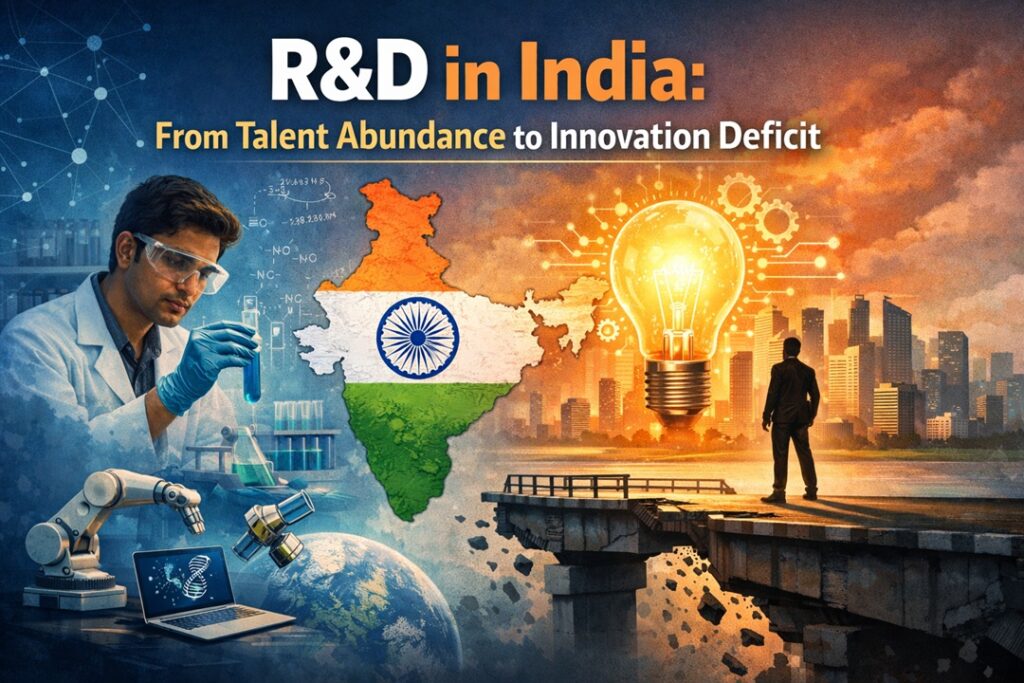
India’s persistently low investment in research and development at around 0.6–0.7% of GDP, despite its global ambitions and large talent base, has raised concerns about innovation capacity, technological self-reliance, and long-term economic competitiveness when compared with China 2.4%, USA 3.5%, and Israel 5.4% of GDP spending on R&D.
India’s Research Deficit
Meaning
• Chronic underinvestment in R&D
• Weak academia–industry linkages
• Low high-end research and innovation output despite large STEM workforce
Key Indicators
R&D Expenditure
• India spends only 0.6–0.7% of GDP on R&D
• Significantly lower than global innovation leaders
Research Output
• 17.5% of global population but only ~3% of global research output
Patents and Innovation Quality
• 64,480 patent filings in 2023, ranking 6th globally
• Only ~1.8% share in global filings and low per capita intensity
Researcher Density
• Around 255 researchers per million people
• Far below global average ~1,198 and South Korea ~7,980
Role of Private Sector
• Government share ~63.6% of R&D spending
• Private sector contribution only ~36.4%
Global Innovation Index
• India ranked 39th in GII 2024
Need for Strong R&D in India
Economic Competitiveness
• Enables shift from assembly-led to design-led manufacturing
• Lack of sub-28 nm semiconductor fabs sustains import dependence
Strategic Autonomy
• Reduces exposure to external technology restrictions
• Dependence on GE-F404 engines reflects aero-engine R&D gaps
Demographic Dividend Utilisation
• 7.6 lakh students went abroad in 2024–25
• 35% surge in AI and renewable-energy PhDs due to domestic infrastructure gaps
Societal and Climate Challenges
• 47°C heatwaves in Delhi (2024–25) exposed limits of global models
• Led to launch of Mission Mausam 2024
Initiatives Taken
Research, Development and Innovation Fund
• ₹1 lakh crore RDI Fund
• ₹20,000 crore initial allocation targeting deep-tech and private R&D
Anusandhan National Research Foundation
• Strengthens academic research and basic science funding
National Technology Missions
• India Semiconductor Mission
• National Quantum Mission
• AI Mission
• Green Energy and Hydrogen initiatives
Challenges Associated
Private Sector Risk Aversion
• India’s GERD ~0.65% of GDP
• Private share 36% versus 70%+ in USA and South Korea
Academia–Industry Disconnect
• Over 80% of patents from smaller institutions unlicensed
• Weak Technology Transfer Offices
Brain Drain
• Despite GII rank 38 in 2025, top STEM talent migrates
• Funding delays and uncertainty in fellowships
Bureaucratic Delays
• DST and SERB disbursals delayed 8–12 months in 2025
• Disrupts experimental continuity
Way Forward
Scaling R&D Investment
• Raise R&D spending to 2% of GDP within 5–7 years
• Ensure ≥50% private-sector contribution
Mission-Mode Research Governance
• Focus on AI, semiconductors, quantum, green energy, advanced materials
• Assured funding and strategic milestones
University and Research Reforms
• Develop research-centric universities
• Expand PhD fellowships and global faculty recruitment
Industry–Academia Integration
• Establish joint labs, industry-funded chairs, professional TTOs
• Bridge lab-to-market gap
Talent Retention and Attraction
• Provide globally competitive pay and mobility grants
• Ensure career stability and scientific autonomy
Conclusion
India’s R&D deficit reflects a systemic investment and institutional gap rather than a talent shortage. Bridging this deficit is critical for achieving Viksit Bharat, technological sovereignty, and sustainable economic leadership.
Source : The Hindu