
Responsible Nations Index (RNI) 2026: Ethics as a Measure of Nationhood
Context
India has launched the Responsible Nations Index (RNI) 2026, creating a new global benchmark to assess countries on ethical governance and responsible nationhood; India is ranked 16th globally.
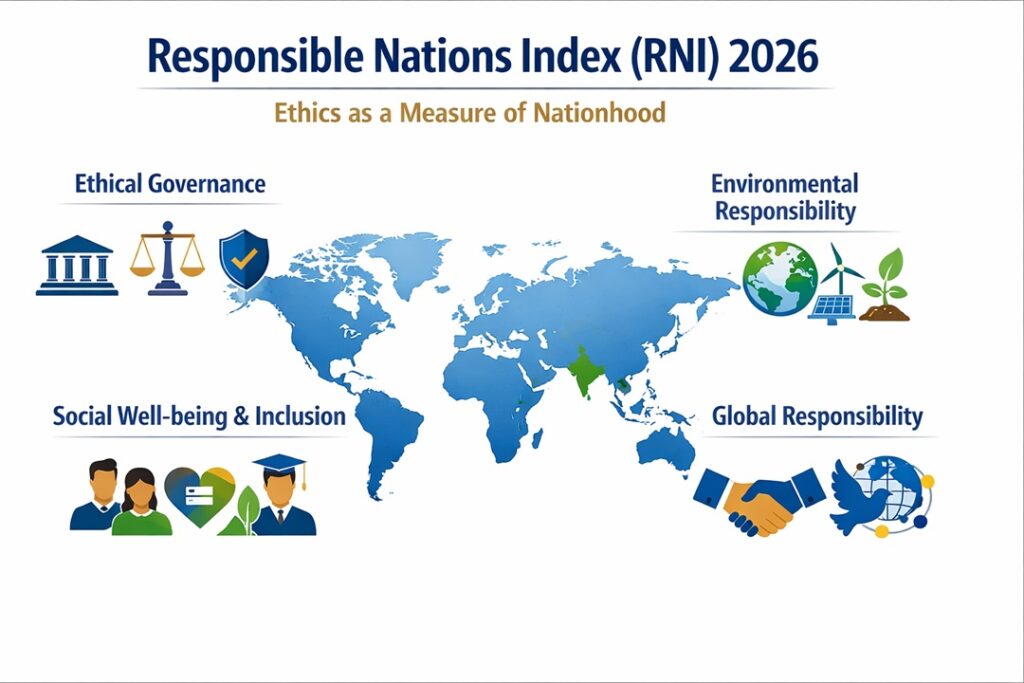
Nature of the Index: The Responsible Nations Index (RNI) is a global composite ranking framework that evaluates nations on ethical leadership, societal welfare, environmental care, and international responsibility, moving beyond conventional GDP- and power-based indicators.
Institutional Backing: Released under the aegis of the World Intellectual Foundation (WIF).
Core Objective: To redefine national progress by integrating ethical accountability, social inclusion, sustainability, and multilateral cooperation into nation-level assessments.
Evaluation Parameters
Countries are assessed across four core dimensions—
• Integrity and quality of governance
• Social equity and human development
• Environmental stewardship and sustainability practices
• Global responsibility and cooperative international behaviour
Salient Characteristics
• Ethics-first framework rather than influence-driven rankings
• Combines institutional performance, moral responsibility, and humanitarian impact
• Promotes self-assessment and ethical policy benchmarking among nations
• Consultative and dialogue-oriented, discouraging zero-sum competition
• Supported by an annual Responsible Nations Index publication
Performance Snapshot (RNI 2026)
• Top Performers: Singapore (1), Switzerland (2), Denmark (3), Cyprus (4), Sweden (5)
• India: Rank 16, Composite Score 0.5515; highest-ranked Asian country
• India placed ahead of South Korea (21), Kyrgyzstan (22), and Thailand (24)
• Lowest Rank: Central African Republic — Rank 154, Score 0.35715
• Regional Pattern: 9 of the top 10 countries are European, reflecting strong ethical institutions
Broader Relevance
• Represents a paradigm shift in global benchmarking by prioritising ethics over dominance
• Reinforces alignment with SDGs, climate commitments, and inclusive governance goals
Source : PIB