
South Atlantic Anomaly (SAA) Expands: ESA Swarm Mission Findings
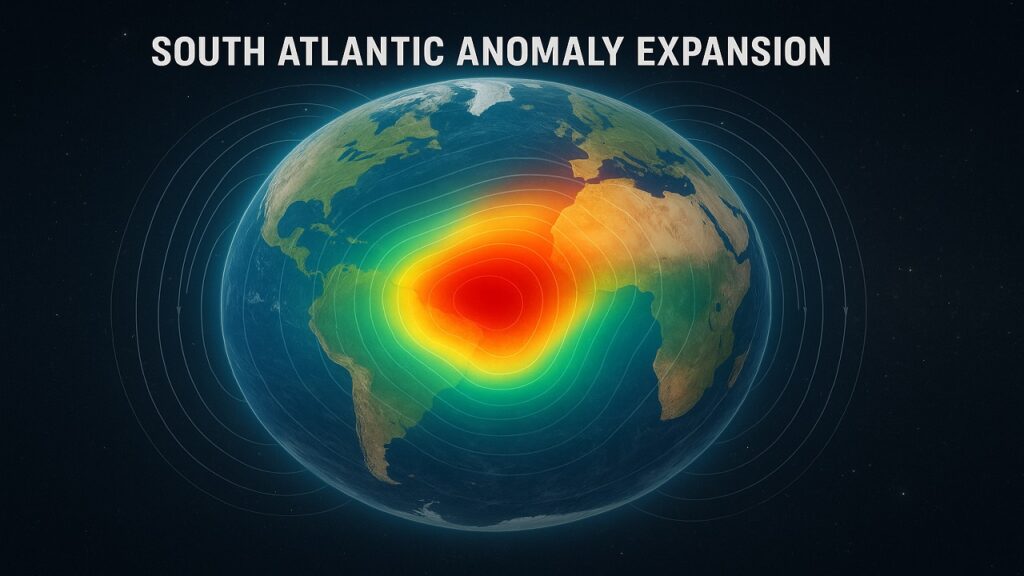
Context:
- Recent observations from the European Space Agency’s (ESA) Swarm mission reveal that the South Atlantic Anomaly (SAA) — the region of weakest intensity in Earth’s magnetic field — has expanded by nearly 0.9% since 2014.
- This expansion highlights the dynamic changes in Earth’s magnetic environment, which can have significant implications for satellites, navigation systems, and space weather phenomena.
1. About the South Atlantic Anomaly (SAA):
- Definition: A zone of weakened geomagnetic intensity located over South America and the southern Atlantic Ocean, where the magnetic field is much lower than the global average.
- Historical Identification: First observed in the 19th century, with continuous mapping by ESA’s Swarm satellites launched in 2013.
- Causes:
- Irregular Core Flow: Non-uniform circulation of molten iron and nickel in Earth’s outer core disrupts the geo-dynamo, responsible for generating the magnetic field.
- Reverse Flux Patches: Magnetic field lines re-enter the Earth instead of exiting, weakening local magnetic strength.
- Core–Mantle Interactions: Complex interactions create spatial variations in magnetic intensity, forming the SAA.
- Key Features:
- Location: Covers parts of South America, the southern Atlantic Ocean, and southwest Africa.
- Expansion: Grew by 0.9% since 2014 and continues to move westward.
- Dual Cell Structure: Since 2020, the SAA split into two weaker sub-cells — one near South America, another near southwest Africa.
2. Magnetic Weak Spots:
- Definition: Localized regions of diminished geomagnetic intensity caused by uneven magnetic flux in Earth’s outer core.
- Formation Factors:
- Uneven Core Flow: Molten metals circulate irregularly, producing weaker magnetic fields in certain zones.
- Reverse Magnetic Flux: Magnetic field lines loop backward into the core, reducing surface strength.
- Core Dynamics: Continuous fluid motion, convection currents, and thermal variations periodically reorganize magnetic intensity zones.
3. Impacts of Magnetic Weak Spots:
- Satellite & Spacecraft Vulnerability: Increased radiation exposure can cause hardware damage, data corruption, or instrument blackouts.
- Navigation Challenges: Magnetic field variations affect magnetic navigation and calibration systems, particularly in low-Earth orbit.
- Space Weather Sensitivity: Weakened magnetic shield allows charged solar particles to reach closer to Earth, increasing space weather risks.
- Regional Variation Effects: Westward drift and expansion of the SAA enlarges risk zones for Earth-observing and communication satellites.
Conclusion:
- The South Atlantic Anomaly is a significant magnetic weak spot demonstrating the dynamic nature of Earth’s geomagnetic field.
- Its expansion, drift, and dual-cell formation pose critical challenges for satellite operations, space missions, and geomagnetic monitoring.
- Continuous observation through missions like ESA’s Swarm satellites is essential for understanding and mitigating the risks posed by such anomalies.
Source : The Hindu