
South Africa’s G20 Presidency: A New Era for the Global South
Context
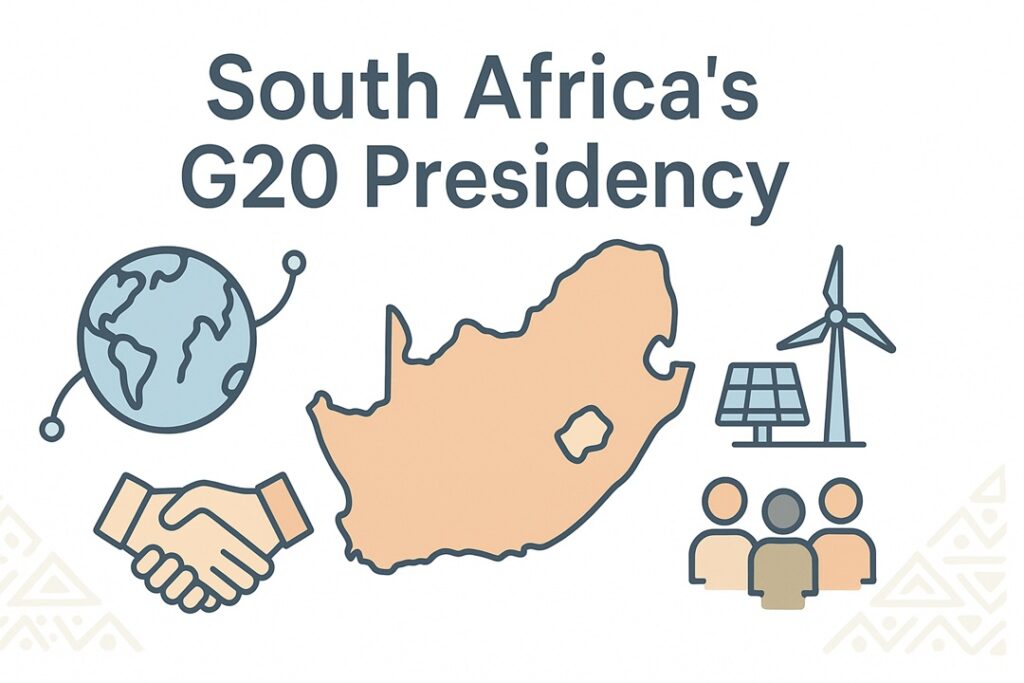
South Africa has taken charge of the G20 Chairmanship for 2025 under the guiding theme “Solidarity, Equality, Sustainability.” The country has outlined priority areas such as strengthening global disaster readiness, addressing debt distress among vulnerable economies, scaling up climate-related funding, and supporting equitable energy transitions.
This is a milestone moment, as it represents the first G20 Summit to be held in Africa, coinciding with the rising voice of the Global South—an agenda strongly promoted by India.
About the G20
What is the G20?
The G20 is the primary forum for international economic steering, enabling leading economies—both developed and emerging—to collaborate on global economic management, development pathways, and governance concerns.
Evolution
- Created in 1999 following the Asian Financial Crisis to convene Finance Ministers and Central Bank Heads.
- Upgraded to a leaders-level platform during 2008–09 to coordinate actions during the global economic downturn.
- Since then, the group’s scope has widened, now covering climate mitigation, public health, energy systems, food security, digital transformation, global taxation architecture, and anti-corruption measures.
Members
- Consists of 19 nations, the European Union, and the African Union.
- Collectively, they contribute around four-fifths of global GDP, account for the majority of international trade, and represent roughly two-thirds of the world population.
G20 Troika (2024–2026)
- Brazil – 2024 (Outgoing Presidency)
- South Africa – 2025 (Current Presidency)
- United States – 2026 (Upcoming Presidency)
This rotating trio ensures continuity in decision-making and thematic direction.
Core Roles of the G20
- Promoting coordination in macroeconomic policies and safeguarding global financial systems.
- Supporting reforms in international financial organisations such as the IMF and multilateral development banks.
- Driving global commitments on climate ambition and enabling fair, sustainable energy transitions.
- Strengthening global health preparedness, disease surveillance, and system resilience.
- Enhancing supply chain robustness, development outcomes, and digital governance norms.
- Building consensus on equitable taxation, anti-corruption frameworks, trade rules, and inclusive economic growth.
Conclusion
South Africa’s stewardship of the G20 marks a significant shift in global governance by placing Africa at the centre of major international decision-making processes. Its presidency aims to amplify the concerns of emerging and developing nations while pushing for fairer global systems in climate action, finance, development, and energy. The 2025 Summit holds the potential to strengthen Global South solidarity and reinforce a more representative multilateral order.
Source : INDIA TODAY