
Space Governance at a Tipping Point
Context
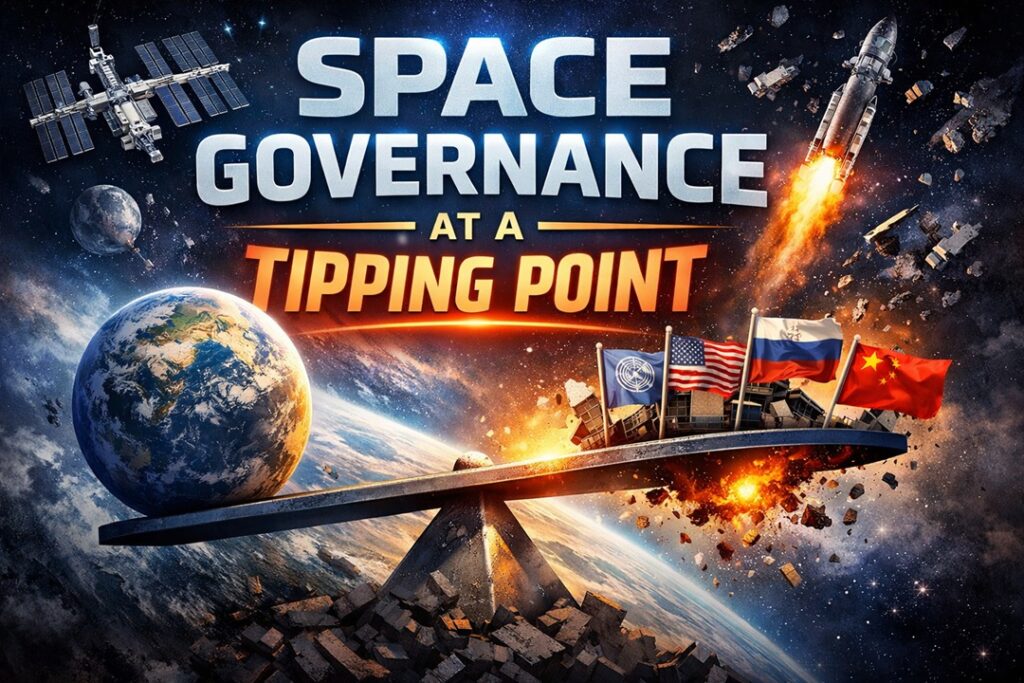
Earth’s orbital space is entering a phase of systemic risk due to rising congestion, debris accumulation, and inadequate regulatory enforcement amid rapid commercialization.
Framework of Cosmic Regulation
Meaning & Scope:
Space governance denotes the institutional architecture of rules, norms, and treaties that regulate human activities beyond Earth. It includes oversight of satellite deployment, debris control, spectrum allocation, and liability mechanisms.
Core Legal Architecture
Foundational Treaty Regime:
The Outer Space Treaty (1967) establishes state accountability for all space activities, including private actors, and fixes liability for damage.
Compensation Mechanism:
The Liability Convention (1972) operationalizes damage claims and compensation procedures arising from space objects.
Domestic Authorization Systems:
National licensing frameworks act as pre-launch regulatory filters, mandating compliance such as safe disposal and orbital sustainability norms.
Why Orbital Regulation Matters
Collision Risk Management:
Effective governance ensures safe maneuvering and de-orbiting, as even micro-debris can cripple satellites.
Systemic Sustainability:
Focus must shift from isolated incidents to cumulative orbital degradation, where cascading collisions threaten usability.
Equity Across Generations:
Borrowing from environmental ethics, governance must ensure non-exclusion of future access to orbital commons.
Safeguarding Critical Infrastructure:
Space-based services like navigation, weather prediction, and communication depend on a stable orbital ecosystem.
Normative Responsibility:
Uniform standards help establish a minimum duty-of-care, preventing irresponsible actors from exploiting regulatory gaps.
Structural Weaknesses in Governance
Compliance Deficit:
Absence of reliable mechanisms to verify post-mission disposal leads to weak enforcement.
Tracking Constraints:
Significant debris remains undetectable or inconsistently tracked, limiting preventive action.
Data Inequality:
Access to orbital data is fragmented and strategically restricted, creating global asymmetry.
Obsolete Legal Paradigm:
Existing treaties reflect a state-centric, slow-innovation era, failing to address private mega-constellations.
Regulatory Arbitrage:
Operators exploit jurisdictional leniency by registering in countries with relaxed norms.
Reform Pathways
Harmonized Licensing Norms:
Adopt globally uniform standards to eliminate regulatory loopholes.
Compulsory Transparency:
Shift from voluntary sharing to legally binding data disclosure regimes.
Quantifiable Safety Benchmarks:
Introduce measurable debris mitigation and disposal obligations.
Environmental Integration:
Embed principles like precaution and sustainability into space governance frameworks.
India as a Norm Entrepreneur:
India can shape global standards by integrating strict orbital accountability into its emerging space legislation.
Conclusion
Earth’s orbit is no longer an infinite frontier but a finite and vulnerable global commons. The transition from voluntary norms to binding, enforceable governance is essential to prevent irreversible orbital degradation and ensure sustainable space access.
Source : The Hindu