
Special Intensive Revision of Electoral Rolls: Strengthening Democracy in India
Context
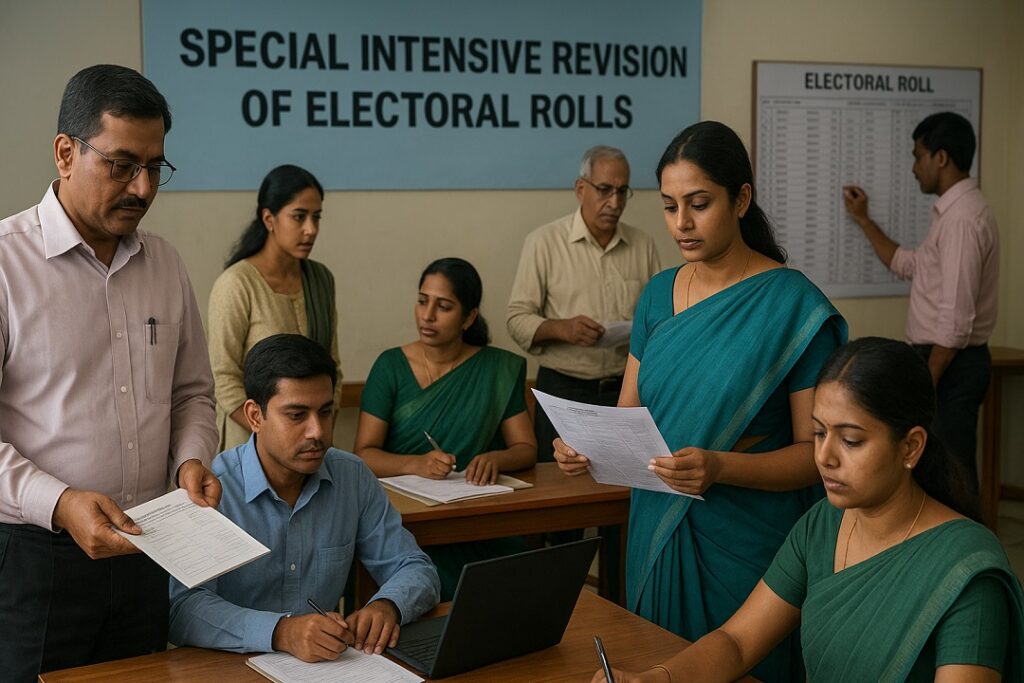
- Recently, the Election Commission of India (EC) concluded the Special Intensive Revision (SIR) of electoral rolls in Bihar, ahead of the upcoming Assembly elections in November 2025.
- The EC has proposed to implement the SIR nationwide in a phased manner, aligned with the Assembly election schedules of various States.
- The move aims to update and clean electoral rolls, ensuring free and fair elections.
1. Legal and Statutory Basis
- Section 21 of the Representation of the People Act, 1950 (RP Act) mandates the preparation and revision of electoral rolls.
- Summary Revision: Conducted before every general election or by-election.
- Special Revision (SIR): EC can carry out revision at any time to maintain accurate voter lists.
- Through an order dated 24 June 2025, the EC decided to conduct SIR across India in phases.
2. SIR Process in Bihar
- Qualifying date: 1 July 2025.
- Key steps involved:
- Submission of enumeration forms by registered voters.
- Submission of eligible documents to prove citizenship (for electors registered after 2003).
- Publication of draft electoral rolls based on submitted forms.
- Filing of claims and objections, verified and disposed by Electoral Registration Officers (EROs).
- Publication of final electoral roll – released on 30 September 2025.
- Judicial intervention:
- SIR faced challenges in the Supreme Court.
- SC interim orders: Allowed Aadhaar as a valid identity proof along with enumeration forms.
- National rollout:
- EC plans phased SIR for all States based on Assembly election schedules.
3. Forms of Electoral Rolls
- Statutory reference: Registration of Electors Rules, 1960 (RER).
- Important forms for citizens:
- New voter registration forms.
- Forms for modification of details (name, address, etc.).
- Forms for claims and objections on existing entries.
4. Conflicting Arguments and Way Forward
- Contrasting viewpoints: Political debates exist both for and against SIR, especially concerning timing and process.
- Need for clean electoral rolls: Accurate voter lists are essential for free and fair elections, a pillar of democracy.
- Future improvements:
- EC may adopt a more spread-out schedule for SIR to allow hassle-free voter participation.
- Aadhaar inclusion likely to continue, following the Supreme Court directive.
- Duties of citizens:
- Verify draft electoral rolls.
- Submit enumeration forms if required.
- New voters and migrated electors should submit relevant forms.
- Political parties and civil society must assist marginalized communities.
- Outcome: Ensures clean electoral rolls while safeguarding the right to vote of every eligible citizen.
Conclusion
- The Special Intensive Revision (SIR) is a critical exercise by the EC to maintain accuracy, transparency, and inclusivity in electoral rolls.
- Its phased implementation across States, adherence to Supreme Court directives, and active participation by citizens will strengthen the integrity of India’s democratic process.
Source : The Hindu