
Supreme Court’s Intervention in Aravalli Protection
Context
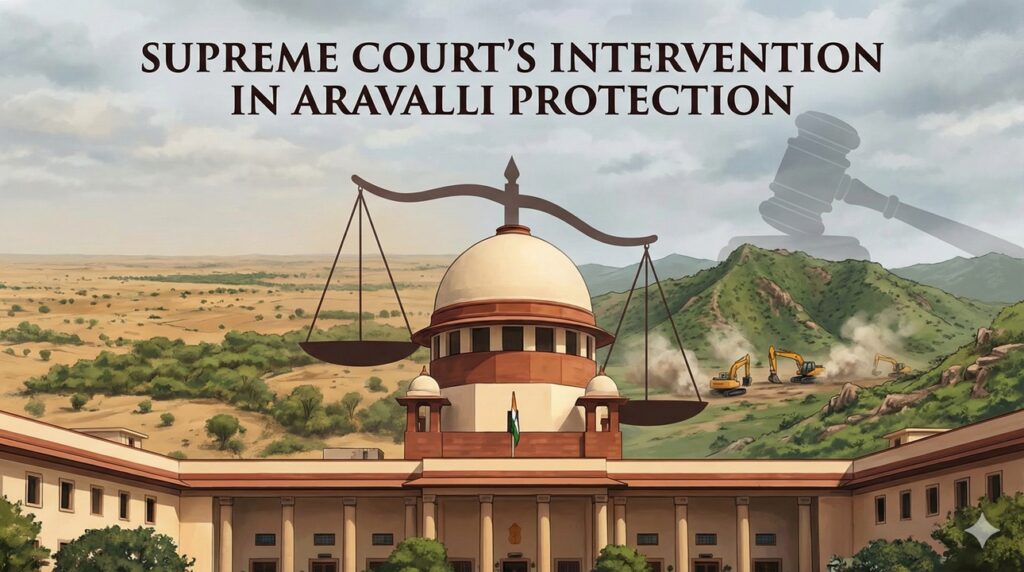
The Supreme Court has settled a uniform definition of the Aravalli Hills and Ranges and paused the grant of fresh mining leases across Delhi, Haryana, Rajasthan and Gujarat to ensure ecological protection and regulated mining.
Significance of the Aravalli Range
Ancient Mountain System
The Aravallis are among the oldest fold mountains in the world, dating back to the Proterozoic era over 2 billion years ago.
Geographical Extent
They extend for about 650 km from Delhi to Gujarat, covering Haryana and Rajasthan, with Guru Shikhar at Mount Abu (1,722 m) as the highest peak.
Climate and Ecological Role
The range acts as a natural barrier against the Thar Desert, helps guide monsoon winds and improves air quality in Delhi NCR by reducing dust pollution.
Biodiversity and Water Security
The Aravallis support rich biodiversity including Sariska and Ranthambore reserves and function as a crucial watershed for rivers like Chambal, Sabarmati and Luni, aiding groundwater recharge.
Mineral Resources and Environmental Stress
The region is rich in limestone, sandstone, marble, granite and minerals like zinc and copper, but excessive quarrying over four decades has caused severe ecological degradation.
Judicial Action on Mining
Regulatory Framework
Since the early 1990s, the Environment Ministry restricted mining to approved projects, though violations were widespread.
Supreme Court Interventions
In 2009, the Court imposed a blanket mining ban in Faridabad, Gurugram and Mewat.
In May 2024, it prohibited new mining leases and renewals and sought a detailed assessment by the Central Empowered Committee.
CEC Recommendations
The committee proposed scientific mapping of the entire Aravalli range, a macro-level environmental impact assessment, and a complete ban on mining in ecologically sensitive areas such as wildlife corridors, aquifer recharge zones and NCR regions.
These were accepted by the Court in November 2025.
Green Wall Initiative
In June 2025, the Centre launched the Aravalli Green Wall Project to expand green cover in a five km buffer across 29 districts, aiming to restore 26 million hectares of degraded land by 2030.
Need for a Uniform Definition
Inconsistent State Criteria
States used erratic and contradictory parameters to identify Aravalli formations, leading to regulatory loopholes.
Expert Differences
Even expert bodies like the Forest Survey of India had varying definitions earlier.
Supreme Court Resolution
A multi-institutional committee submitted its findings in October 2025, and the Court finally ruled that only hills above 100 metres would qualify as Aravalli Hills and Ranges.
Sustainable Mining Approach
Management Plan for Sustainable Mining
The Court directed the preparation of a comprehensive Management Plan for Sustainable Mining to identify no-mining zones, regulate limited mining, assess ecological carrying capacity and ensure restoration and rehabilitation.
Balanced Regulatory Strategy
Recognising that total bans encourage illegal mining and sand mafias, the Court adopted a calibrated approach allowing existing legal mining under strict regulation while keeping ecologically sensitive areas permanently off-limits.
Conclusion
The Supreme Court’s intervention strengthens environmental governance, ensures scientific regulation of mining, and reinforces the Aravallis’ role in climate stability, biodiversity conservation and water security, making it a significant development for sustainable development and UPSC-relevant environmental jurisprudence.
Source : The Hindu