
Tamil Nadu’s GI-Tagged Sarees in Focus
Context
The cultural richness and economic importance of Tamil Nadu’s Geographical Indication (GI)-certified sarees have recently gained renewed attention, highlighting their role in preserving traditional weaving heritage and strengthening artisan livelihoods.
Geographical Indication (GI) – Key Aspects
Definition: A Geographical Indication (GI) is a distinctive sign used on products that originate from a specific region and possess qualities, reputation, or characteristics attributable to that origin.
Coverage: Encompasses agricultural products, handicrafts, food items, and industrial goods. Both natural and man-made products qualify.
Example: Darjeeling Tea became the first Indian product to receive GI status in 2004–05.
Nature of Right: GI operates as a collective Intellectual Property Right (IPR), restricting unauthorized use and protecting genuine producers.
Legal & Global Framework
Legislation in India: Governed by the Geographical Indications of Goods (Registration and Protection) Act, 1999.
Validity Period: Registration is valid for 10 years and can be renewed subsequently.
Eligible Applicants: Associations of producers, cooperatives, or statutory bodies representing the concerned product.
Penalty for Violation: Imprisonment from 6 months to 2 years along with a fine between ₹50,000 and ₹2 lakh.
International Recognition: GI protection is recognized under the TRIPS Agreement administered by the World Trade Organization.
India’s Commitment: India signed the TRIPS Agreement in 1994 and became a WTO member on January 1, 1995.
State-wise Status: Uttar Pradesh (77) holds the highest number of GI products, followed by Tamil Nadu (74) and Karnataka (~45).
GI-Recognised Sarees of Tamil Nadu
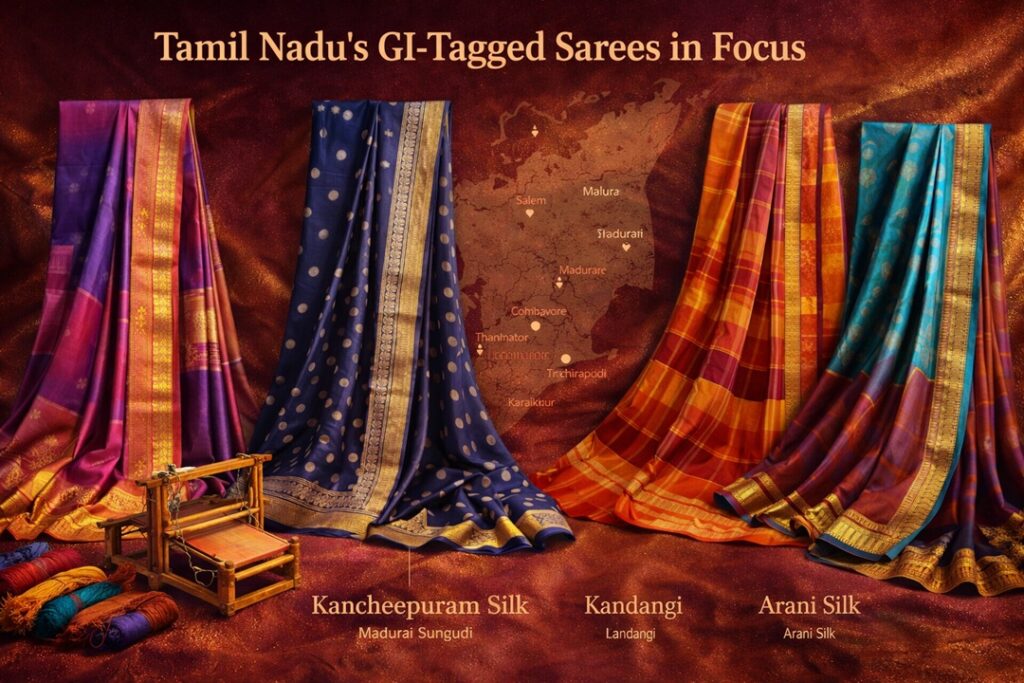
Kancheepuram Silk Saree – Kanchipuram: Crafted from pure mulberry silk; known for rich zari work, temple borders, and vibrant colours.
Madurai Sungudi Saree – Madurai: Cotton saree; characterized by traditional tie-and-dye technique with dotted motifs.
Salem Silk Saree – Salem (Venpattu): Made of pure mulberry silk; valued for sheen and durability.
Kovai Kora Cotton Saree – Coimbatore: Blend of raw silk (Kora) and cotton; lightweight with distinctive texture.
Arani Silk Saree – Arani (Tiruvannamalai district): Pure mulberry silk saree; known for intricate traditional designs.
Thirubuvanam Silk Saree – Thirubuvanam (Thanjavur district): Crafted from pure mulberry silk; features elaborate borders and motifs.
Kandangi Saree – Karaikudi (Sivaganga): Cotton saree; famous for bold checks and contrasting borders.
Negamam Cotton Saree – Negamam (Coimbatore): Traditional cotton handloom saree; appreciated for comfort and simplicity.
Chedibutta Saree – Veeravanallur (Tirunelveli): Art silk and cotton blend; known for distinctive butta patterns.
Woraiyur Cotton Saree – Tiruchirappalli: Cotton saree; reflects a long-standing weaving tradition.
Significance: GI recognition enhances market credibility, prevents imitation, promotes exports, safeguards cultural identity, and supports socio-economic upliftment of weaving communities.
Source : TimesNow