
Transforming Higher Education: HECI Bill 2025 and NEP 2020 Vision
Introduction
The Union Government plans to introduce the Higher Education Commission of India (HECI) Bill, 2025 in the Winter Session of Parliament starting 1 December 2025. The bill is a significant reform aimed at transforming India’s higher education regulatory system to align with the National Education Policy (NEP) 2020.
1. Definition and Objective of HECI Bill, 2025
Definition: The HECI Bill seeks to establish a single regulatory authority for higher education, replacing the University Grants Commission (UGC) and sectoral councils, excluding medical and legal education.
Objective: The bill aims to ensure quality, accountability, institutional autonomy, and implement NEP 2020’s vision on curriculum reforms, academic delivery, and research promotion.
2. Background: 2018 Draft Bill and Public Feedback
The 2018 draft, Higher Education Commission of India (Repeal of UGC Act) Bill, sought public and stakeholder feedback.
- Over 7,500 suggestions were received from parliamentarians, state governments, academics, students, teacher unions, and industry.
- Concerns included:
- Central government-heavy composition, limiting state representation.
- Risk to rural public institutions with limited infrastructure.
- Absence of faculty and student representation in governance.
- Continued command-and-control regulatory approach affecting smaller institutions.
- Lack of clarity on integrating specialist regulators like AICTE and NCTE.
- Insufficient safeguards for institutional autonomy and collegial governance.
The draft was not tabled, and the government decided to rework it in line with NEP 2020.
3. NEP 2020 Vision for HECI
NEP 2020 emphasizes transparency, technology-enabled regulation, institutional autonomy, and conflict-of-interest avoidance.
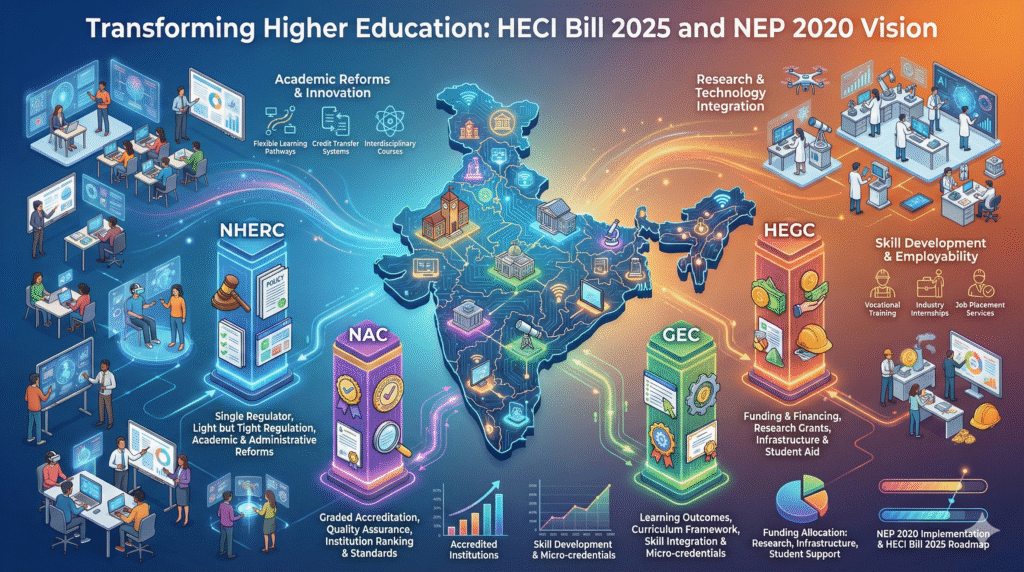
The proposed HECI has four verticals:
- National Higher Education Regulatory Council (NHERC) – compliance and regulation.
- National Accreditation Council (NAC) – accreditation and quality assurance.
- General Education Council (GEC) – academic standards and curriculum.
- Higher Education Grants Council (HEGC) – funding allocation.
The framework provides robust checks and balances, including state representation and peer academic participation.
4. Global and Domestic Developments Since 2018
- COVID-19 led to widespread adoption of online and blended learning.
- Emphasis on skills over knowledge has driven micro-credentials and stackable learning pathways.
- Dr. Radhakrishnan Committee recommended reforms for assessment, accreditation, and ranking, integration of NAAC, NBA, NIRF with NAC, and a One Nation One Data (ONOD) system for transparent governance.
5. Stakeholder Expectations
- State Governments: Clear regulatory division, representation in governance, and protection of constitutional powers.
- Higher Educational Institutions: Time-bound approvals, simplified online compliance, reduced inspection burden, and graded autonomy based on transparent accreditation.
- Smaller/Rural Institutions: Capacity-building support rather than punitive enforcement.
- Industry: Recognition of new-age programs, micro-credentials, and international collaborations while maintaining minimum standards.
6. Implementation Challenges
- Coordination: Over 70% of universities are state-governed, enrolling 94% of students, requiring strong Centre-State collaboration.
- Structural Gaps: Lack of digital infrastructure, qualified faculty, and quality assurance systems.
- Accreditation: Current coverage below 40%, NEP mandates universal accreditation by 2035.
- Faculty and Funding: Need for performance-based recruitment, retention incentives, and transparent merit-linked funding through HEGC.
7. Way Forward
The HECI Bill, 2025 is a historic opportunity to unify India’s fragmented higher education system into a modern, outcome-oriented regulatory framework.
Its success depends on:
- Effective implementation, robust data systems, and sustained funding.
- Centre-State cooperation and stakeholder buy-in.
A well-designed HECI can build a globally competitive higher education ecosystem, enabling India to realize its demographic and economic dividends.
Source : The Hindu