
Tripartite Pact for Frontier Nagaland Territorial Authority (FNTA)
Context
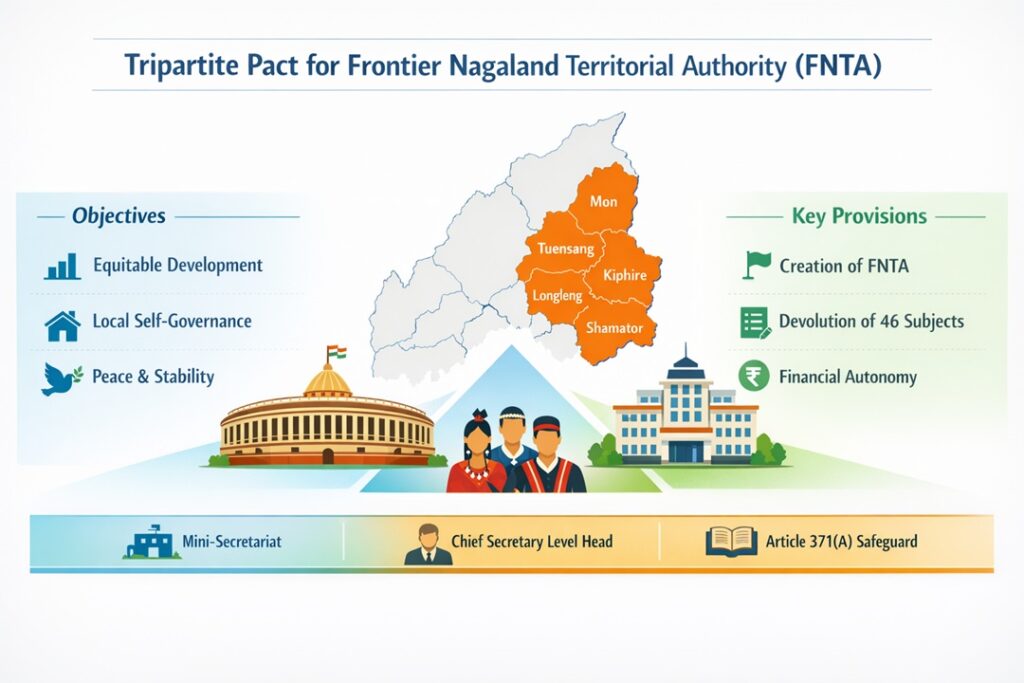
A three-party pact has been concluded between the Government of India, the Government of Nagaland, and the Eastern Nagaland People’s Organisation (ENPO) to institute the Frontier Nagaland Territorial Authority (FNTA), conferring a higher degree of self-governance to select eastern districts of Nagaland.
Nature of the arrangement: The pact envisages the creation of FNTA as a territorially autonomous administrative body for eastern Nagaland, empowered with wide-ranging executive and developmental responsibilities while continuing to function within the state structure.
Stakeholders: Union Government; Nagaland State Government; ENPO (umbrella organisation of eight recognised Naga tribes).
Geographical scope: Tuensang, Mon, Kiphire, Longleng, Noklak, and Shamator districts.
Objectives: To resolve persistent socio-economic and political concerns of eastern Nagaland; to enhance participatory governance and fiscal independence; and to consolidate long-term peace in the region.
Salient provisions
- Establishment of FNTA: Formation of a distinct territorial authority for the covered districts.
- Transfer of functions: Delegation of 46 subjects to FNTA for local administration.
- Fiscal framework: Development funds to be allocated based on population and area; assured annual central support; start-up costs to be met by the Union Ministry of Home Affairs.
- Institutional setup: FNTA to operate through a mini-secretariat under an Additional Chief Secretary/Principal Secretary-rank officer.
- Constitutional continuity: Safeguards under Article 371(A) relating to Naga customs, land, and resources remain intact.
- Consultative evolution: Outcome of sustained consultations, negotiations, and trust-building since 2021–22.
Importance
- Cooperative federalism: Reflects adaptive autonomy mechanisms within the constitutional framework.
- Conflict prevention: Helps contain extremist or secessionist impulses.
- Targeted development: Enables focused planning, quicker infrastructure delivery, and improved welfare outcomes.
Source : PIB