
United Nations Convention on the Law of the Sea: Regulating the Global Commons
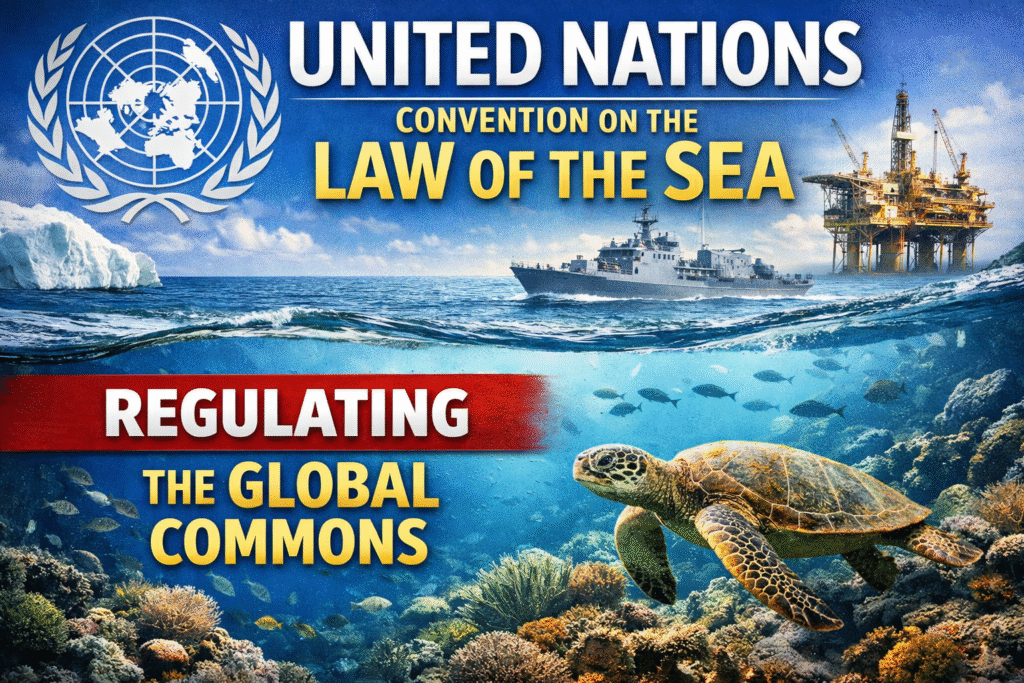
Context: An Iranian warship IRIS Dena was reportedly sunk by a US submarine near the coast of Sri Lanka while returning from the International Fleet Review 2026 at Visakhapatnam, raising questions regarding the legality of military actions in international waters under the United Nations Convention on the Law of the Sea (UNCLOS).
Introduction:
The United Nations Convention on the Law of the Sea (UNCLOS) provides the principal legal framework governing maritime activities, maritime boundaries, and the rights and responsibilities of states in the use of oceans. It plays a crucial role in regulating navigation, resource exploitation, environmental protection, and dispute settlement in maritime spaces.
Nature of the Convention: UNCLOS is a comprehensive international treaty that establishes rules governing the use and management of the world’s oceans and seas. It is often referred to as the “Constitution of the Oceans” as it defines the rights and obligations of states across different maritime zones.
Adoption and Enforcement: The convention was adopted in 1982 at Montego Bay, Jamaica, and entered into force in 1994 after receiving the required number of ratifications.
Membership: UNCLOS currently has 168 parties including the European Union. Major maritime powers such as India are signatories, while the United States has signed but not ratified the convention.
Objectives: The convention aims to ensure the peaceful use of oceans, promote the equitable and efficient use of marine resources, protect the marine environment, and establish a legal framework for maritime boundaries and dispute resolution.
Maritime Zonal Framework: UNCLOS defines several maritime zones including the Territorial Sea, Contiguous Zone, Exclusive Economic Zone (EEZ), and the High Seas, each with specific rights and jurisdictional limits for coastal states.
Navigation Rights: The convention guarantees the freedom of navigation and the right of innocent passage for ships through territorial waters, facilitating international maritime trade and connectivity.
Resource Governance: UNCLOS regulates the exploration and exploitation of marine resources, including fisheries, offshore oil, gas, and seabed minerals, within defined maritime zones.
Marine Environmental Protection: The treaty provides legal provisions to prevent marine pollution, conserve marine biodiversity, and protect fragile marine ecosystems.
Dispute Settlement Mechanisms: UNCLOS establishes institutions such as the International Tribunal for the Law of the Sea (ITLOS) to adjudicate maritime disputes among states.
Seabed Governance: It created the International Seabed Authority (ISA) to regulate mineral resources located in seabed areas beyond national jurisdiction, treating them as the common heritage of mankind.
Concept of International Waters (High Seas)
Definition: International waters, also known as the High Seas, refer to ocean areas located beyond the Exclusive Economic Zone (200 nautical miles) of any coastal state and are not under the sovereignty of any nation.
Freedom of Navigation: All states enjoy the right to navigate ships freely across the high seas without interference from other states.
Freedom of Overflight: Aircraft of all countries are permitted to fly over high seas without restriction, ensuring global connectivity.
Peaceful Use Principle: Under Article 88 of UNCLOS, the high seas must be reserved for peaceful purposes, discouraging militarization or aggressive activities.
Limited Use of Force: Military action in international waters is generally restricted and may only occur under self-defence or with authorization from the United Nations Security Council.
Shared Global Commons: No country can claim sovereignty over international waters, as they are considered shared global commons.
Common Heritage Principle: Resources found in seabed areas beyond national jurisdiction are treated as the common heritage of humankind, managed collectively for global benefit.
Contemporary Relevance: The recent naval incident near Sri Lanka has renewed debates on the legality of the use of force in international waters, particularly concerning the interpretation of self-defence provisions under international law.
Conclusion:
UNCLOS remains the cornerstone of global ocean governance by balancing national interests with collective responsibility for the oceans. Strengthening adherence to its principles is essential for maintaining maritime stability, protecting marine resources, and preventing conflicts in international waters.
Source : Indian Express