
Virtual Water Exports: Threat to India’s Groundwater Security
Context
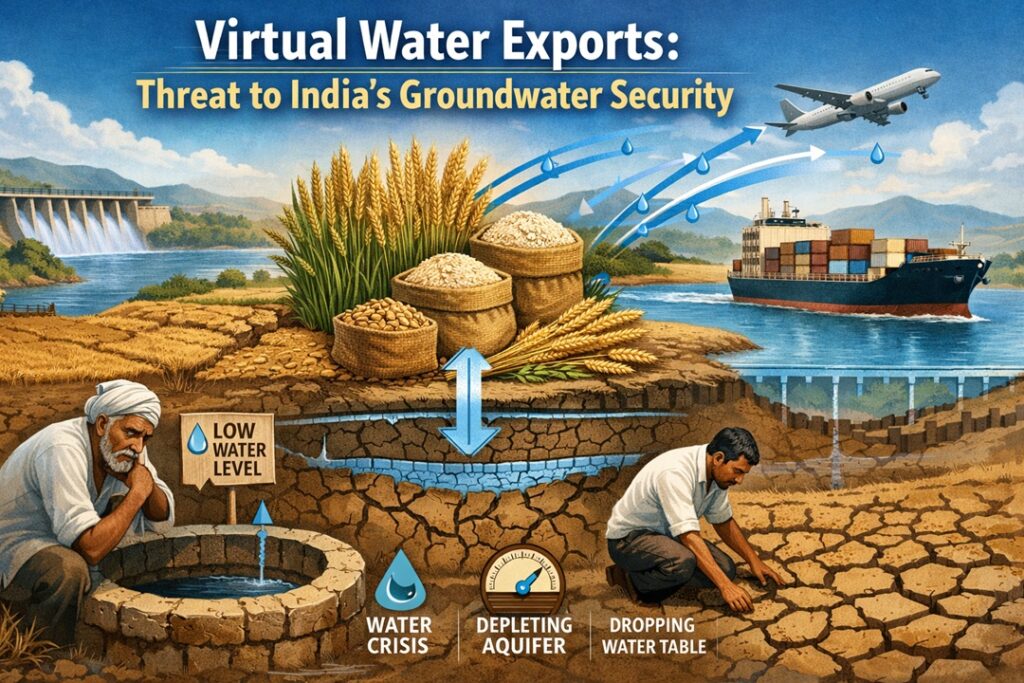
India is the world’s largest rice producer and exporter, contributing nearly 40% of global rice trade. While this strengthens India’s agricultural prominence, it has intensified groundwater depletion in water-stressed regions like Punjab and Haryana. This has brought attention to the “virtual water export challenge”, where scarce groundwater is indirectly exported through water-intensive crops.
Understanding Virtual Water Exports
Virtual water refers to the water embedded in agricultural commodities that is effectively exported when these crops are sold abroad. In India, rice exports translate to billions of cubic metres of groundwater leaving the country, even as aquifers face depletion.
Key Facts
- India exports over 20 million metric tonnes of rice annually.
- Rice cultivation accounts for 34–43% of global irrigation water use.
- Annually, over 24,000 million cubic metres of virtual water are exported through rice trade.
- Northern rice belts increasingly depend on groundwater rather than surface irrigation.
Factors Driving the Crisis
- High water requirements: Rice needs 3,000–4,000 litres per kg, unsustainable in semi-arid regions.
- Subsidy-driven overuse: MSPs for rice and cheap/free electricity encourage excessive groundwater extraction.
- Legacy policies: Green Revolution-era emphasis on rice and wheat ignored water scarcity constraints.
- Poor regulation: Groundwater extraction remains largely unmonitored.
- Export dependence: Policy reforms are politically sensitive due to India’s global rice trade dominance.
Consequences for Agriculture and Ecology
- Depleting aquifers: Borewell depths in Punjab and Haryana have risen from 30 feet to 80–200 feet.
- Farmer distress: Rising debt to finance deeper pumps and electricity costs.
- Climate exposure: Over-extraction prevents aquifer recharge, heightening drought vulnerability.
- Environmental degradation: Declining water tables reduce soil moisture, biodiversity, and long-term productivity.
- Future water insecurity: Exporting vast quantities of virtual water transfers costs to future generations.
Barriers to Reform
- Political challenges: Reducing MSP dependence is highly sensitive.
- Farmer income risks: Short-term crop diversification schemes fail to provide lasting incentives.
- State-level capacity gaps: Groundwater governance varies widely across regions.
- Temporary policy interventions: One-season schemes discourage sustained crop shifts.
- Data limitations: Real-time monitoring of groundwater extraction remains inadequate.
Steps Undertaken So Far
- Jal Shakti Abhiyan: Focused water conservation campaigns in over-exploited districts.
- Atal Bhujal Yojana: Community-led groundwater management initiatives.
- Mission Amrit Sarovar: Rejuvenating local water bodies to enhance recharge.
- Per Drop More Crop: Promoting micro-irrigation for improved water efficiency.
- NAQUIM 2.0: Scientific aquifer mapping for informed groundwater policy.
Pathways for Sustainable Water Use
- Revise MSP and procurement policies: Promote millets with assured income to reduce water use.
- Rationalise water pricing: Limit free electricity, encourage solar pumps with usage caps.
- Support long-term diversification: 5–7 year income guarantees to encourage crop shifts.
- Adopt climate-smart techniques: Direct Seeded Rice (DSR) reduces water use by 15–20%.
- Align trade with water strategy: Factor water footprints into export policy, shift towards less water-intensive crops.
Conclusion
India’s rice export success masks a quiet crisis of groundwater depletion via virtual water exports. Maintaining water-intensive crops in stressed regions threatens both food and water security. Sustainable agriculture demands an integrated approach combining policy reform, water governance, and trade strategy aligned with ecological limits.
Source : The Hindu