
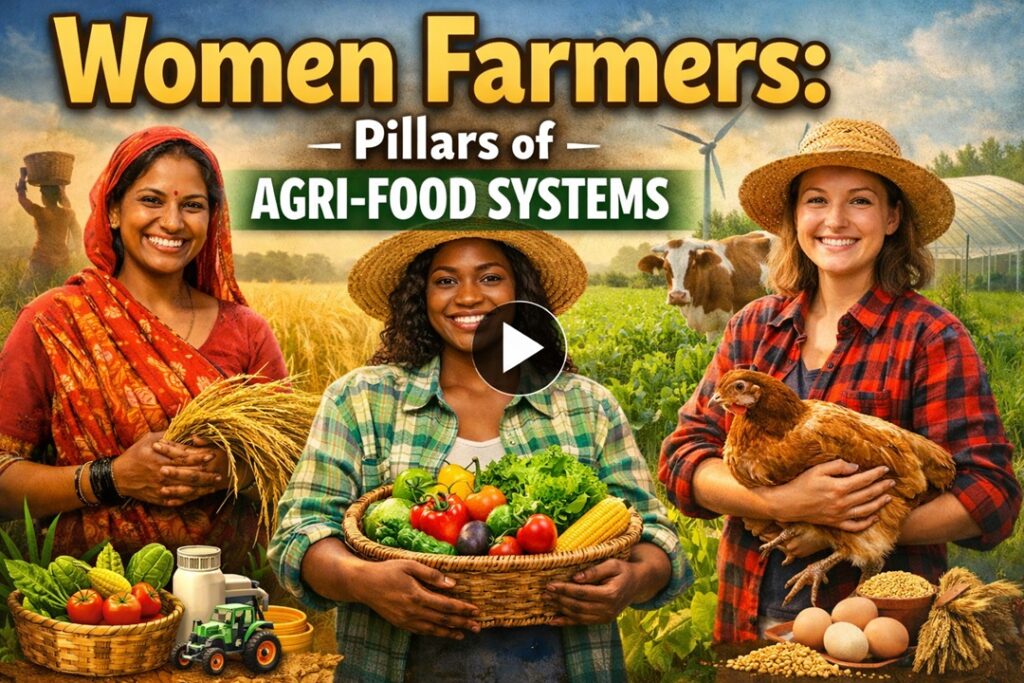
Women Farmers: Pillars of Agri-Food Systems
Context
The United Nations has declared 2026 as the International Year of the Woman Farmer (IYWF 2026) to acknowledge women’s pivotal role in ensuring global food and nutritional security.
India’s Response: India hosted the Global Conference on Women in Agri-Food Systems (GCWAS–2026) in New Delhi to promote gender-responsive agricultural policies and highlight women-led innovations in farming.
Women in Agriculture: Core Understanding
Definition & Scope: Women farmers constitute a critical pillar of the rural economy, actively participating across the agricultural value chain—from production to processing and marketing.
Evolving Identity: They are transitioning from unpaid family workers to agri-entrepreneurs and decision-makers, contributing to household food security and climate resilience.
Key Trends & Empirical Evidence
Employment Share: Nearly 80% of economically active rural women are engaged in agriculture.
Workforce Distribution: Around 33% work as agricultural laborers, while 48% operate as self-employed cultivators.
Access to Welfare: Women account for ~25% of total beneficiaries under PM-KISAN, receiving over ₹1.01 lakh crore cumulatively.
Capacity Building: About 2.58 crore women trained (2022–25) in agro-ecology and livestock practices under DAY-NRLM.
Collective Enterprises: 1,175 women-exclusive Farmer Producer Organizations (FPOs) indicate rising formalization of women-led agri-businesses.
Functional Contributions Across Value Chain
Farm Operations: Women undertake sowing, transplanting, and weeding, ensuring optimal crop productivity.
Animal Husbandry: They dominate dairy, poultry, and small livestock management, strengthening rural incomes.
Post-Harvest Economy: Women-led SHGs engage in processing activities like mushroom cultivation and spice processing, enhancing value addition.
Sustainable Practices: Active involvement in natural farming and biodiversity conservation promotes eco-friendly agriculture.
Technological Integration: Increasing adoption of innovations like drones under the Namo Drone Didi scheme reflects modernization.
Policy Measures & Institutional Support
Mechanization Push: Namo Drone Didi Scheme enables women SHGs with subsidized drones for precision agriculture.
Livelihood Mission Support: Mahila Kisan Sashaktikaran Pariyojana (MKSP) strengthens skills and income generation.
Infrastructure Financing: Agriculture Infrastructure Fund (AIF) provides interest subvention for women-led agri-projects.
Extension Services: Krishi Sakhi Programme trains women as grassroots agri-extension agents.
Research & Innovation: ICAR-CIWA develops gender-friendly tools and technologies to reduce drudgery.
Persistent Structural Constraints
Land Tenure Inequality: Limited land ownership restricts access to institutional benefits and credit.
Work Burden: Use of non-ergonomic tools leads to high physical strain and health issues.
Credit Exclusion: Absence of collateral limits access to formal banking channels.
Information Asymmetry: Extension services often bypass women despite their active farm roles.
Climate Risks: Women face disproportionate vulnerability due to limited adaptive resources.
Strategic Priorities for Reform
Land Record Digitization: Ensuring women’s ownership recognition for better DBT inclusion.
Inclusive Mechanization: Promoting gender-friendly tools and training through FMTTIs.
Scaling Collectives: Expanding women-led FPOs to strengthen bargaining power and market access.
Market Integration: Enhancing women’s access to local and digital agri-markets with targeted subsidies.
Institutionalizing Extension Roles: Formal recognition of Krishi Sakhis as key intermediaries.
Conclusion: Towards Inclusive Agri-Transformation
Women farmers are central to achieving food security, rural prosperity, and climate resilience. Their empowerment through targeted policies, technological access, and institutional recognition is essential for India’s vision of a sustainable and inclusive agri-food system.
Harnessing this potential during IYWF 2026 can position India as a global leader in gender-responsive agriculture and rural transformation.
Source : PIB