
India’s Heat Crisis and the Missing Legal Safeguards for Informal Workers
Context
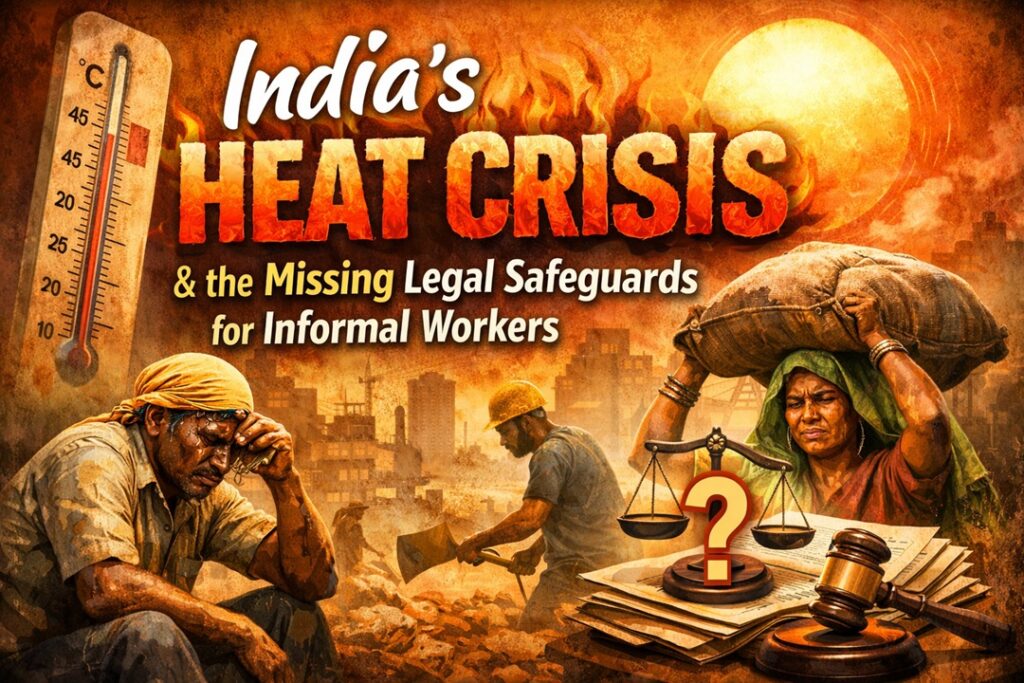
Recent studies reveal a major regulatory gap as nearly 57% of Indian districts are now heat-stressed, while informal outdoor workers remain outside legal protection frameworks.
Understanding the Regulatory Gap in Heat Governance
Definition:
The regulatory gap denotes the lack of mandatory and enforceable legal safeguards for nearly 490 million informal and outdoor workers exposed to extreme heat.
Despite escalating heatwaves, existing laws treat heat protection as advisory, not as part of the Right to Life (Article 21).
Key Evidence and Emerging Trends
Expanding Heat Geography:
Heat stress now affects over 57% districts, including coastal and previously moderate regions.
At-Risk Workforce:
Around 400–490 million informal workers lack access to cooling mechanisms or workplace protections.
Occupational Heat Exposure:
Waste handlers and sanitation workers experience micro-climate heating, often exceeding ambient temperatures.
Economic Trade-offs:
Rising temperatures reduce productivity, forcing workers to choose between health security and livelihood.
Drivers of Intensifying Heat Stress
Climate Variability:
Rising global temperatures have increased frequency and duration of heatwaves.
Urban Thermal Stress:
Unplanned urbanization leads to heat-retaining surfaces, intensifying the Urban Heat Island effect.
Humidity Amplification:
Coastal regions face dangerous Heat Index levels due to temperature-humidity interaction.
Atmospheric Disruptions:
Changes in jet streams and wind patterns prolong heatwave conditions.
Ecological Degradation:
Deforestation reduces natural cooling via evapotranspiration, worsening land heating.
Gaps in Legal and Institutional Frameworks
Limited Coverage of Labour Laws:
The Factories Act, 1948 applies only to indoor settings, excluding outdoor workers.
Dilution under OSHWC Code, 2020:
Fails to explicitly recognize heat as an occupational hazard.
Non-Mandatory Provisions:
Section 23 leaves heat safety standards to government discretion, not obligation.
Disaster Classification Issue:
Heatwaves are not fully recognized as notified disasters, restricting fund allocation (10% cap).
Exclusion of Gig Workforce:
Gig and platform workers remain outside formal employer liability frameworks.
Institutional Measures for Heat Management
Heat Preparedness Plans:
Authorities promote Heat Action Plans (HAPs) for early response and coordination.
Forecasting and Alerts:
Use of graded warning systems (Yellow, Orange, Red alerts) via media and communication channels.
Urban Cooling Initiatives:
Encouragement of cool roofs, shelters, and hydration points in public spaces.
Work Schedule Rationalization:
Advisory to avoid outdoor work during peak heat hours (12 PM–4 PM).
Multi-Agency Coordination:
Integration of health systems, urban bodies, and disaster agencies for mitigation.
Policy Recommendations and Strategic Way Forward
Formal Disaster Recognition:
Include heatwaves in the National Disaster List (2026–31) to enable adequate funding.
Adopt Heat Index Standards:
Shift from temperature-only metrics to Heat Index-based triggers.
Legally Binding Norms:
Mandate work-rest cycles and protective measures under labour codes.
Thermal Rights Framework:
Recognize access to cooling as part of Article 21 (Right to Life).
Income Protection Mechanisms:
Develop heat-risk insurance models to compensate income losses.
Conclusion
India’s heat crisis reflects a shift from seasonal stress to structural inequality. Addressing this requires moving from non-binding advisories to enforceable rights-based protections, ensuring that thermal safety becomes integral to social justice and labour dignity.
Source : The Hindu