
India’s Growth Paradox: Rising Prosperity, Persistent Vulnerability
Context
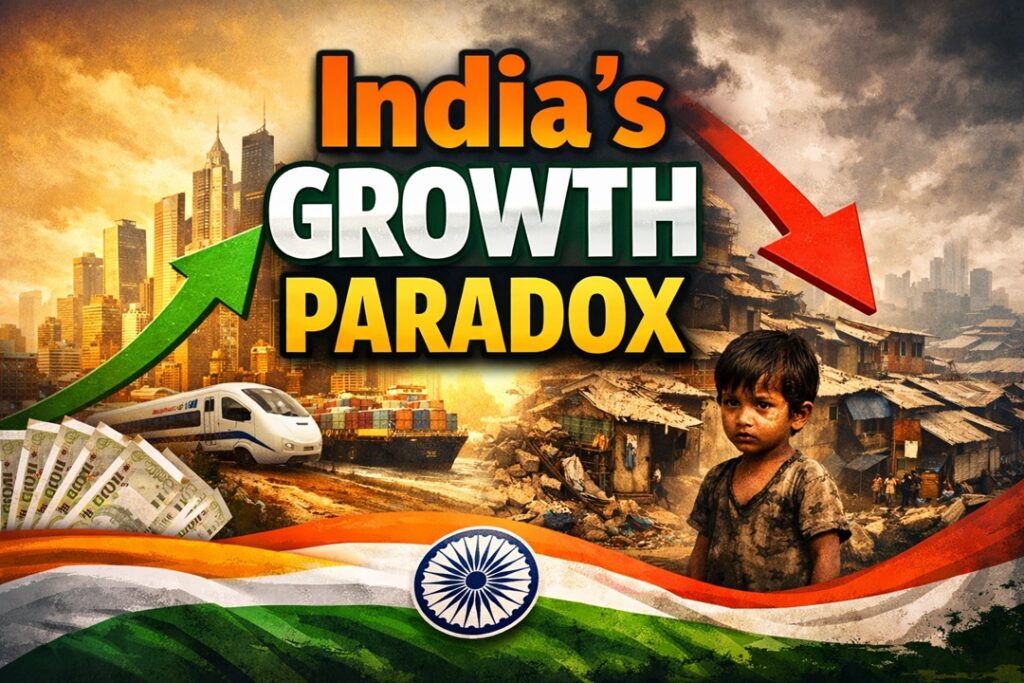
A recent policy note by the World Bank has triggered debate on India’s development trajectory, highlighting that while extreme poverty is declining, a large segment of the population remains precariously placed just above it.
About The Emerging “Precarious Middle” Phenomenon
Concept Explained:
The “precarious middle” describes households that have moved beyond extreme poverty but lack income security, asset buffers, and social protection.
Instead of sustained upward mobility, they remain exposed to shocks—such as job loss, health crises, or inflation—risking a slide back into poverty.
Key Indicators Highlighting the Trend
- Earnings Constraint: Data from the e-Shram database shows nearly 94% of informal workers earn below ₹10,000/month, limiting savings and mobility.
- Structural Job Loss: Around 24 million jobs exited manufacturing (2016–21), pushing labour into low-productivity agriculture.
- Youth Employment Stress: Youth unemployment hovers around 45%, while graduate unemployment is close to 29%, weakening returns to education.
- Household Balance Sheet Stress: Net financial savings declined to ~5% of GDP, while reliance on unsecured borrowing has increased.
Drivers Behind This Fragility
- Jobless Growth Pattern: Expansion led by capital-intensive sectors with limited employment absorption.
- Decoupling of Wages & Output: Productivity gains have not translated into higher real wages.
- Dominance of Informality: Less than 10% of workers have formal employment with social security benefits.
- Industrial Slowdown: Weak manufacturing growth has stalled labour transition to higher-value sectors.
- Rising Inequality: Top 1% captures over one-fifth of national income, concentrating gains.
Government Responses & Policy Efforts
- Welfare Deepening: Large-scale food security and subsidy programs reducing extreme deprivation.
- Digital Governance Stack: Integration of Jan Dhan–Aadhaar–Mobile (JAM) enabling efficient Direct Benefit Transfers.
- Industrial Push: Production Linked Incentive (PLI) schemes to boost domestic manufacturing capacity.
- Labour Database Creation: e-Shram platform to map informal workers and improve policy targeting.
- Skill Enhancement: Skill India initiatives aimed at improving employability of youth.
Barriers to Sustainable Mobility
- Threshold Illusion: Crossing poverty lines does not ensure economic resilience.
- Debt-Led Survival: Households increasingly rely on high-interest credit for consumption.
- Human Capital Deficits: High levels of child stunting (35.5%) and wasting (18.7%) undermine long-term productivity.
- Skill Mismatch: Education outcomes are not aligned with labour market needs.
- Global Headwinds: Automation and volatile global trade patterns may limit job creation.
Strategic Way Forward
- Redefining Metrics: Move beyond binary poverty lines to assess quality of living standards.
- Manufacturing Revival: Enable labour-intensive industrial growth to absorb workforce entrants.
- Universal Social Protection: Extend safety nets to informal workers to stabilize incomes.
- Fair Wage Policies: Ensure productivity gains are reflected in worker compensation.
- Human Capital Investment: Prioritize nutrition, health, and foundational education outcomes.
Conclusion
India’s development challenge is transitioning from poverty reduction to durable prosperity. Without aligning growth with employment and income security, a large “precarious middle” may persist. Bridging the gap between productivity and wages, alongside strengthening social protection, is crucial to ensuring inclusive and resilient economic progress.
Source : The Hindu