
PLI Boost Powers India’s Food Processing Revolution
Context
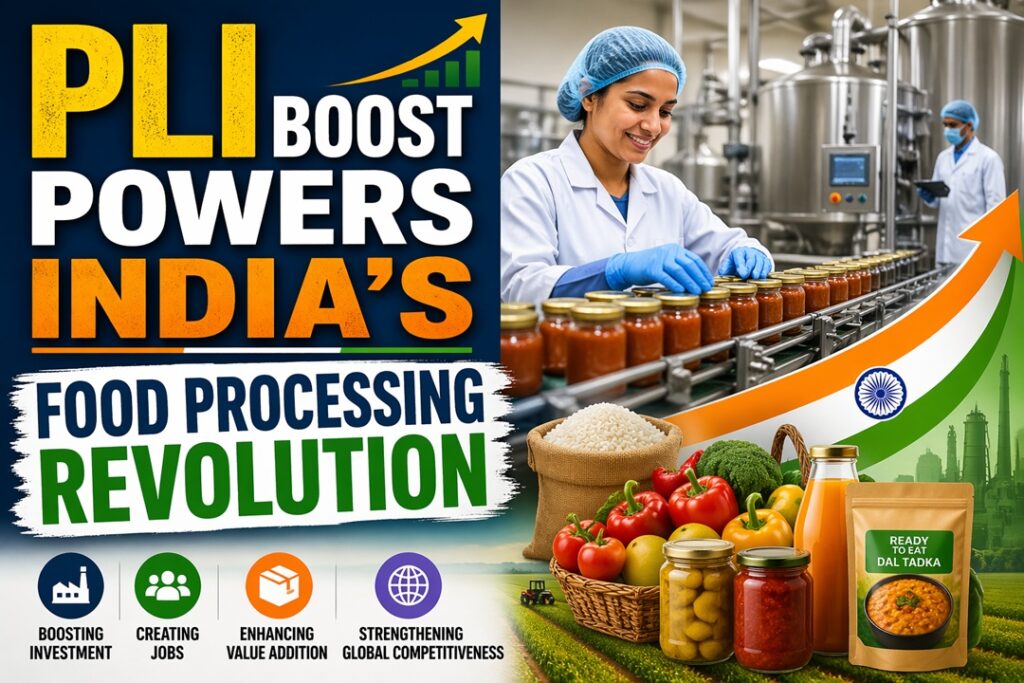
The Ministry of Food Processing Industries has reported that the Production-Linked Incentive (PLI) scheme for the food processing sector has exceeded expectations, generating 3.39 lakh jobs against the targeted 2.5 lakh by 2026, highlighting its strong role in employment generation and industrial growth.
Understanding India’s Agro-Processing Value Chain
Definition and Scope:
The Food Processing Sector serves as a crucial interface between agriculture and industry, transforming raw agricultural, dairy, and marine produce into consumable products. This process enhances shelf life, reduces wastage, and increases value addition.
Key Trends and Performance Indicators
Sectoral Growth:
The Gross Value Added (GVA) increased from ₹1.34 lakh crore in 2014-15 to ₹2.24 lakh crore in 2023-24, reflecting sustained expansion.
Export Transformation:
The share of processed food in total agricultural exports rose from 13.7% to 20.4%, indicating a shift toward higher-value exports.
Infrastructure Augmentation:
Processing and preservation capacity expanded by 34 lakh metric tonnes annually as of 2026.
Investment Inflow:
Private investment of ₹9,207 crore has been mobilized under the PLI framework.
Global Market Reach:
Export sales by PLI-supported companies reached ₹89,053.44 crore between April 2021 and September 2025.
Emerging Growth Drivers
Resource Advantage:
India’s status as the second-largest producer of fruits and vegetables provides a strong raw material base.
Consumption Shift:
Rising urbanization has increased demand for ready-to-eat (RTE) and ready-to-cook (RTC) products.
Health-Oriented Markets:
Global demand for millets and organic foods offers niche export opportunities.
Value Chain Integration:
Greater integration of MSMEs into global value chains, especially in marine and dairy sectors, is a key opportunity.
Technology Infusion:
Adoption of advanced preservation methods like IQF and retort packaging can reduce post-harvest losses.
Policy Measures and Institutional Support
PLI for Food Processing (2021–27):
A ₹10,900 crore scheme aimed at boosting incremental production and promoting global branding.
Millet-Focused Sub-Scheme:
A ₹800 crore component dedicated to promoting millet-based value-added products.
MSME Participation:
Approval of 69 MSMEs and 40 contract manufacturing units ensures inclusive growth.
Export Branding Incentives:
50% reimbursement for international branding and marketing expenses.
Structural Bottlenecks
Cold Chain Deficit:
Inadequate storage and logistics infrastructure leads to significant wastage.
Quality Compliance Issues:
Difficulty in meeting international food safety and phytosanitary standards.
Supply Chain Inefficiencies:
Multiple intermediaries increase costs and reduce efficiency.
Credit Constraints:
Limited access to affordable finance for MSMEs hampers modernization.
Low Processing Ratio:
A relatively small portion of agricultural produce is processed compared to global standards.
Future Policy Priorities
Expanding PLI Scope:
Introducing PLI 2.0 to support ancillary industries such as packaging and inputs.
Innovation Push:
Focusing on organic and innovative food segments to capture premium markets.
Digital Monitoring:
Use of real-time MIS systems for better project tracking and governance.
Global Brand Building:
Positioning Indian food products as high-quality and sustainable globally.
Skill Ecosystem Development:
Enhancing workforce skills for advanced food processing technologies.
Conclusion
The PLI scheme has driven a structural transformation in India’s food processing sector by strengthening linkages between agriculture and industry. It has enhanced investment, exports, and employment while positioning India as a competitive player in the global food market, contributing significantly to the vision of Viksit Bharat by 2047.
Source : PIB