
Context
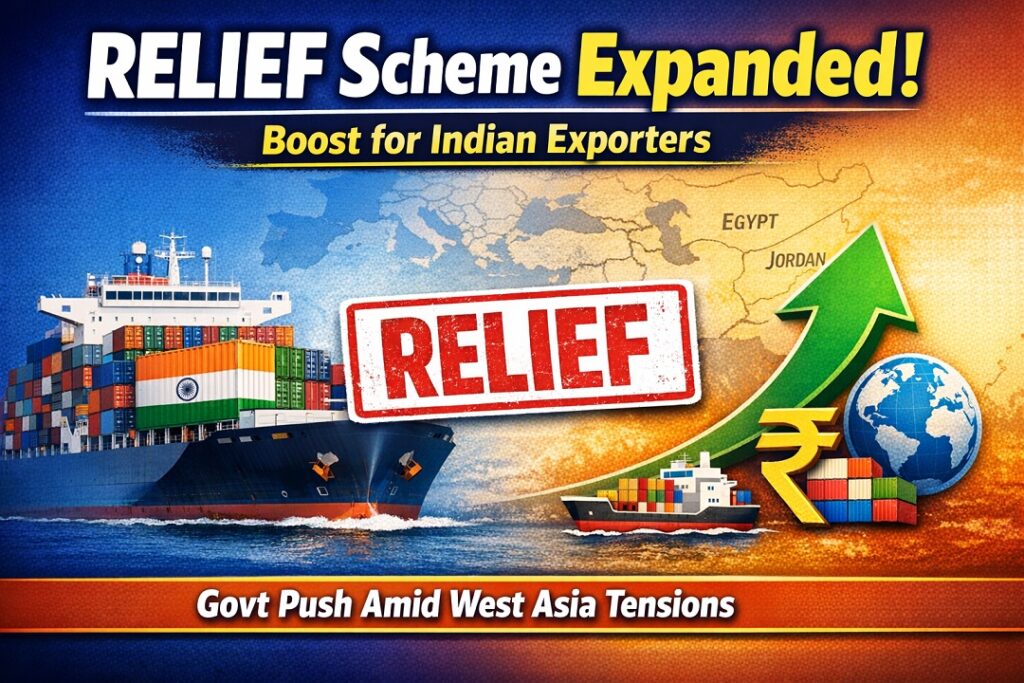
India has widened the geographic scope of the RELIEF (Resilience & Logistics Intervention for Export Facilitation) programme to now include Egypt and Jordan amid continuing instability in West Asia.
About the RELIEF Programme
Nature of Intervention:
RELIEF is a short-duration, crisis-oriented mechanism designed to cushion Indian exporters against disruptions caused by geopolitical tensions in West Asia. It offsets abnormal increases in freight, insurance premiums, and war-related charges, thereby preserving export competitiveness.
Launch Timeline:
Introduced on March 19, 2026, under the broader Export Promotion Mission (EPM).
Implementing Body:
Administered by ECGC Limited, the country’s export credit risk insurer.
Objectives
Continuity of Trade:
Ensures uninterrupted export flows by reducing the likelihood of order withdrawals during conflict situations.
Support to MSMEs:
Builds confidence among small exporters by minimizing financial exposure in high-risk markets.
Cost Stabilisation:
Bridges the gap between normal logistics costs and elevated conflict-induced expenses.
Core Components
Component A (Augmented Protection for Existing Policyholders):
Offers up to full (100%) coverage for political and war-related risks to exporters already insured under ECGC. Premium rates remain fixed at pre-crisis levels, with excess risk borne by the government.
Component B (Onboarding New Exporters):
Provides 95% risk coverage for new entrants securing ECGC policies, including those opting for the Whole Turnover Policy after mid-March 2026.
Component C (Relief for Uninsured MSMEs):
Allows reimbursement of 50% of exceptional freight and insurance surcharges, subject to a ceiling of ₹50 lakh per exporter.
Coverage Expansion
Geographical Reach:
The scheme now spans key West Asian and nearby markets including UAE, Saudi Arabia, Qatar, Oman, Bahrain, Iraq, Iran, Israel, Yemen—along with newly added Egypt and Jordan.
Importance
Trade Resilience:
Prevents disruption of India’s export supply chains during regional conflicts and maritime bottlenecks.
Protection of Margins:
Shields exporters—particularly MSMEs—from volatile shipping and insurance costs.
Strategic Safeguard:
Helps maintain export momentum despite uncertainties around critical routes such as the Strait of Hormuz.
Conclusion
The expansion of RELIEF reflects a proactive policy shift towards risk-mitigated trade facilitation. Sustained support, coupled with diversification of export destinations and logistics routes, will be essential to build long-term resilience against geopolitical shocks.
Source : PIB