
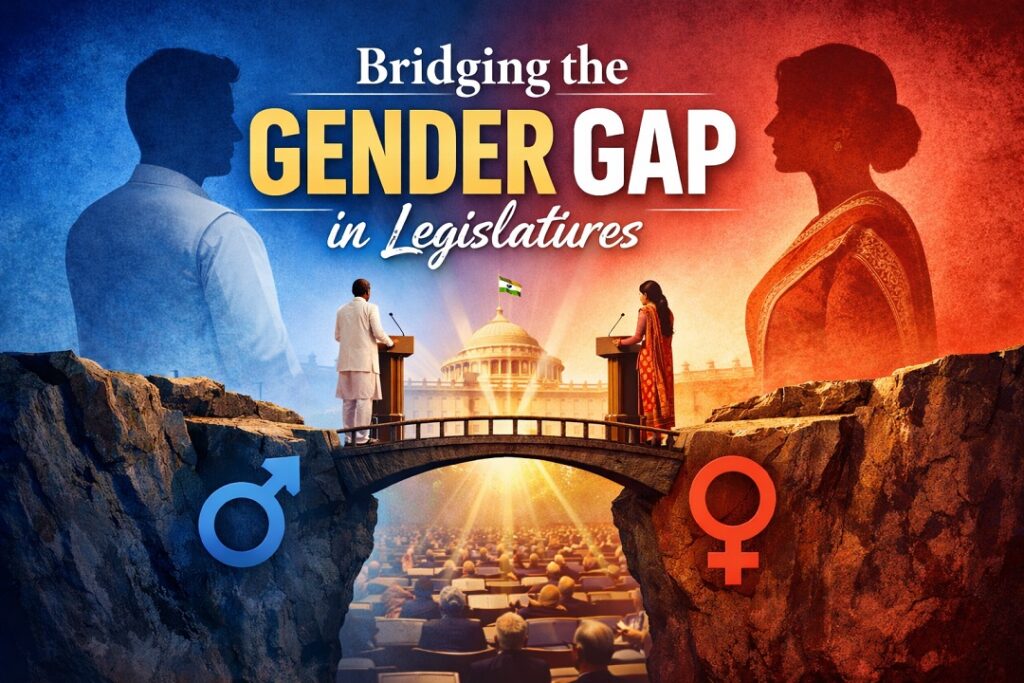
Bridging the Gender Gap in Legislatures: The Case for Immediate Reservation
Context
The rejection of the 131st Constitution Amendment Bill in April 2026 has revived the discourse on fast-tracking women’s reservation in legislatures.
Why Gender Quotas Need Urgent Action
Core Idea:
The demand for immediate reservation arises from the mismatch between women’s electoral participation and their minimal presence in decision-making bodies.
The political arena remains influenced by entrenched networks and access to resources, limiting fair entry for women and necessitating statutory intervention.
Status of Women’s Political Representation
Parliamentary vs. State Scenario:
Women account for nearly 14–15% in Parliament and around 9% in State Assemblies, despite forming almost half the population.
Electoral Participation:
Female voter turnout has reached parity or exceeded male turnout in many states, reflecting strong political engagement.
Grassroots Governance Impact:
Reservation in Panchayati Raj Institutions (33%–50%) has improved focus on welfare sectors like health, sanitation, and drinking water.
International Comparison:
India lags behind global standards of gender-balanced representation in legislatures.
Rationale for Immediate Implementation
Addressing Institutional Barriers:
Party-level commitments have proven inadequate; legal quotas are essential to overcome systemic exclusion.
Policy Reorientation:
Women leaders tend to prioritize human development sectors such as education, nutrition, and healthcare.
Norm Transformation:
Increased visibility of women in power positions helps dismantle patriarchal norms and inspires future leadership.
Democratic Credibility:
Inclusive representation strengthens the legitimacy and responsiveness of democratic institutions.
Aspirational Pressures:
Rising female participation in education and employment demands proportional political inclusion.
Key Features of the 106th Constitutional Amendment (2023)
Reservation Provision:
Provides 33% reservation for women in the Lok Sabha, State Assemblies, and the Delhi Assembly.
Time Frame:
Applicable for 15 years, subject to extension by Parliament.
Sub-Quota Clause:
Ensures representation for SC/ST women within the reserved seats.
Implementation Condition:
Linked to delimitation following the first Census conducted after enactment, delaying operationalization.
Rotation Mechanism:
Reserved constituencies will rotate after each delimitation exercise.
Implications of Postponement
Persistent Representation Gap:
Delays may exclude women from the 2029 General Elections, prolonging inequity.
Continuation of Political Gatekeeping:
Candidate selection processes remain biased without mandated quotas.
Limited Policy Inclusivity:
Absence of adequate female representation results in gaps in policymaking priorities.
Democratic Deficit:
Participation without representation weakens the depth of democratic functioning.
Suboptimal Growth Outcomes:
Gender-balanced governance is linked with improved developmental indicators, which remain underutilized.
Strategic Way Forward
Decoupling from Delimitation:
Explore legal mechanisms to implement reservation without waiting for Census-based delimitation.
Capacity Building:
Strengthen grassroots women leaders through SHGs and livelihood missions to create a leadership pipeline.
Internal Party Reforms:
Encourage political parties to adopt voluntary quotas in ticket allocation.
Support Ecosystem:
Provide financial, institutional, and mentorship support to women candidates.
Consensus Building:
Promote wider societal and political agreement to depoliticize the issue.
Conclusion
India’s democracy cannot be considered fully representative while women remain underrepresented in legislative institutions. Immediate implementation of women’s reservation is essential not only for equity but also for enhancing governance quality and ensuring inclusive national development.
Source : The Hindu