
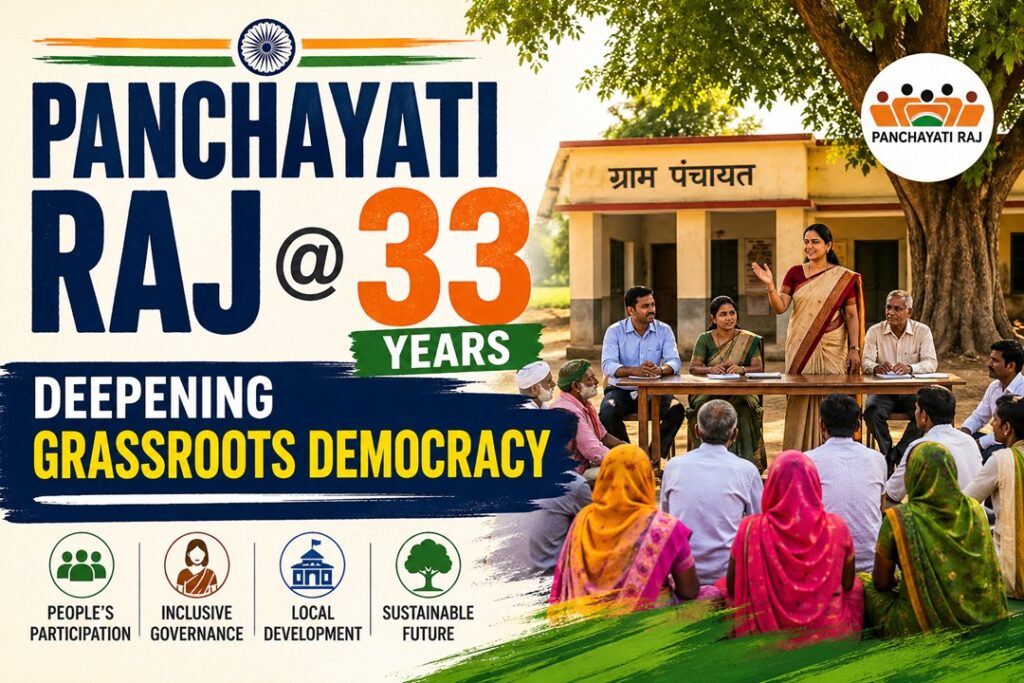
PANCHAYATI RAJ @ 33 YEARS: DEEPENING GRASSROOTS DEMOCRACY
Context
The Ministry of Panchayati Raj commemorated National Panchayati Raj Day, highlighting 33 years of the 73rd Constitutional Amendment Act which institutionalized rural local governance.
Panchayati Raj System in India
Overview:
Panchayati Raj Institutions (PRIs) form the backbone of decentralized governance in rural India, enabling people’s participation through elected bodies at the village, block, and district levels.
Core Features of PRIs
Legal Foundation:
The 73rd Amendment (1992) granted constitutional status, inserting Part IX and mandating regular elections, reservations, and State Finance Commissions.
Decentralized Structure:
A three-tier system—Gram Panchayat (village), Panchayat Samiti (intermediate), and Zila Parishad (district)—ensures governance at multiple levels.
Assessment Tool:
The Panchayat Advancement Index (PAI) is used to track performance and outcomes of local bodies.
Evolution of Panchayati Raj
Traditional Roots:
Village assemblies historically acted as self-governing units managing disputes and resources.
Committee Recommendations:
- Balwant Rai Mehta Committee: Advocated democratic decentralization via a three-tier model.
- L.M. Singhvi Committee: Recommended constitutional backing for PRIs.
Operational Launch:
First implemented in Rajasthan (1959), inaugurated by Jawaharlal Nehru.
Key Achievements
Democratic Deepening:
Shifted governance from top-down to participatory, involving millions in decision-making.
Women’s Leadership:
Reservation policies enabled large-scale political participation of women at the grassroots.
Social Inclusion:
Reserved seats for SCs/STs ensured representation of marginalized communities.
Last-mile Delivery:
PRIs play a critical role in implementing welfare schemes and improving service delivery in rural areas.
Persistent Challenges
Devolution Deficit (3Fs):
Inadequate transfer of Funds, Functions, and Functionaries continues to limit effectiveness.
Infrastructure Constraints:
Many Panchayats lack digital infrastructure, offices, and connectivity.
Proxy Representation:
Instances of informal control (e.g., family members of elected women representatives) dilute true empowerment.
State Control Issues:
Delayed elections and bureaucratic dominance hinder autonomy.
Transparency Gaps:
Weak financial management and irregular social audits affect accountability.
Reform Imperatives
Fiscal Empowerment:
Implement State Finance Commission recommendations for predictable fund flow.
Digital Enablement:
Expand broadband access to strengthen e-governance and transparency.
Capacity Enhancement:
Train elected representatives in governance, budgeting, and sustainable development.
Revitalizing Gram Sabhas:
Ensure active citizen participation in planning and monitoring.
Performance Incentives:
Use tools like PAI to reward efficient Panchayats and encourage competition.
Conclusion
Panchayati Raj Institutions embody the spirit of grassroots democracy and local self-rule in India. Strengthening their autonomy, capacity, and accountability is essential to realizing inclusive rural development and advancing the vision of Gram Swaraj in contemporary governance.
Source : PIB