
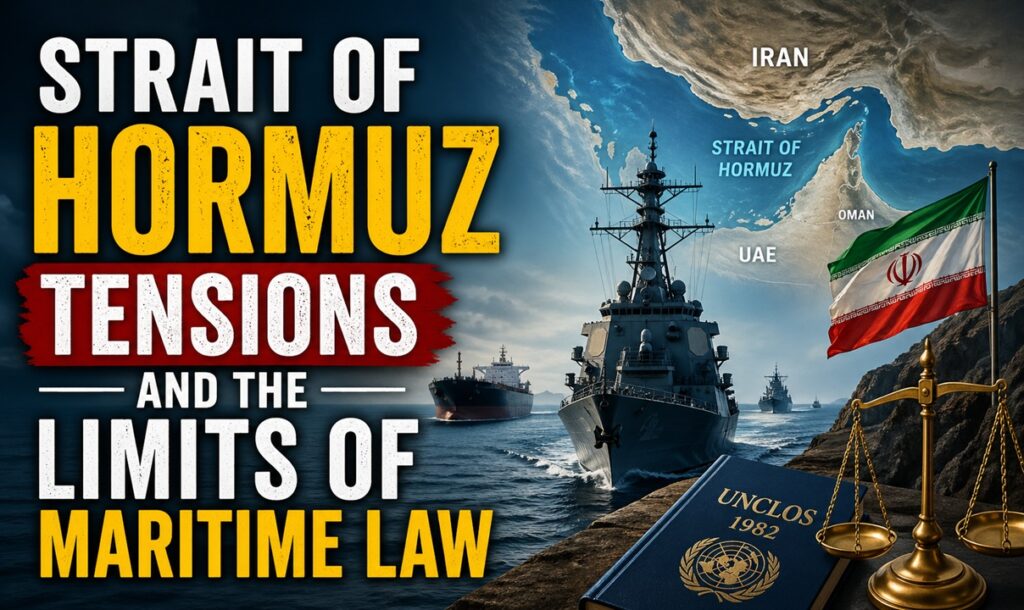
Strait of Hormuz Tensions and the Limits of Maritime Law
Context
The Strait of Hormuz has re-emerged as a geopolitical flashpoint, raising concerns over global energy flows and the enforcement of international maritime norms.
Global Maritime Legal Order (UNCLOS Framework)
Legal Basis: The United Nations Convention on the Law of the Sea (1994) forms the backbone of ocean governance, regulating navigation, resource utilisation, and dispute settlement.
Core Doctrine: Oceans beyond national jurisdiction are treated as global commons, ensuring freedom of navigation, especially on the high seas.
Navigation Rights: Commercial vessels enjoy largely unrestricted movement, subject to limited exceptions like:
- Law enforcement under “hot pursuit”
- United Nations Security Council-mandated actions
- Stateless vessels or flag-state consent-based interventions
Territorial Waters Norms: Within 12 nautical miles, ships retain innocent passage rights, provided they do not threaten coastal security.
Distinct Legal Regime of the Strait
Geographical Constraint: Overlapping territorial waters of Iran and Oman eliminate any high seas corridor.
Transit Passage Principle: UNCLOS introduces transit passage, allowing uninterrupted movement of ships and aircraft through international straits.
Key Conditions:
- Continuous and expeditious transit
- Compliance with designated sea lanes
- No unrelated commercial or military activity
- No threat to coastal states
Non-Suspendable Right: Unlike innocent passage, transit passage cannot be halted by coastal nations.
Recent Flashpoints and Legal Concerns
Iran’s Measures: Actions such as restricting passage, imposing heavy tolls, and detaining vessels challenge established norms.
Legal Issues:
- Charging transit fees violates UNCLOS provisions
- Use of force and selective access raises proportionality concerns
Justifications Offered: Iran cites security violations and navigation irregularities, though such claims require strict legal validation.
U.S. Response and Legal Ambiguity
Policy Actions: The United States has attempted interdictions and quasi-blockade measures targeting Iranian-linked shipping.
Legal Complexity:
- High seas enjoy immunity from unilateral interference
- U.S. sanctions lack universal legitimacy without UNSC backing
- Traditional naval blockade rules (notification, neutrality, effectiveness) remain only partially met
Implication: The legality of U.S. actions remains contested under international law.
Cycle of Escalation
Tit-for-Tat Dynamics: Reciprocal actions—detentions, warnings, and targeting of vessels—have intensified tensions.
Strategic Risk: Global trade routes, including energy supplies, face disruption risks.
India’s Position: India has asserted its right to free navigation and denied compliance with unlawful toll demands.
Role of Global Maritime Institutions
Key Body: The International Maritime Organization oversees safety and regulatory coordination in shipping.
Interventions:
- Condemnation of attacks on commercial vessels
- Opposition to toll-based transit restrictions
- Advocacy for safe passage mechanisms
Structural Limitation: Absence of enforcement authority; reliance on state cooperation limits effectiveness.
Policy Options and Strategic Choices
Diplomatic Engagement: Negotiations could stabilise transit and reduce tensions.
Multilateral Mediation: Greater involvement of UN institutions may help craft interim solutions.
Security Build-up: Increased naval deployment could deter escalation but also elevate confrontation risks.
Escalation Scenario: Continued retaliatory actions may disrupt global supply chains and energy security.
Conclusion
The Strait of Hormuz crisis underscores the friction between rule-based maritime order and power-driven geopolitics. While UNCLOS offers a robust legal framework, its success depends on compliance and restraint by states. Sustained diplomacy, respect for navigation freedoms, and cooperative security mechanisms are essential to prevent further escalation and safeguard global maritime stability.
Source : The Hindu